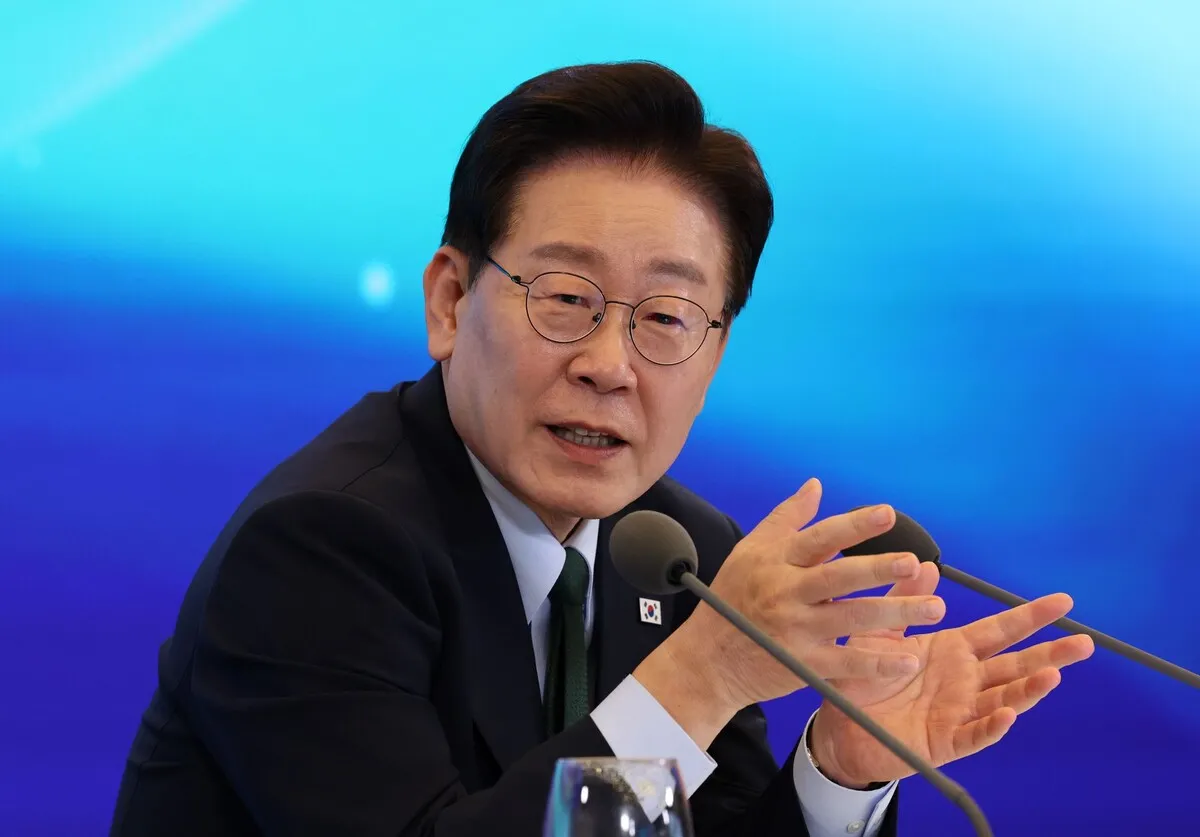
President Lee Jae-myung said on Monday that South Korea must recover wartime operational control from the United States at an early date and that his government is capable of handling the responsibility, according to 한겨레. Speaking at an unscheduled press meeting at the presidential office, Lee said negotiations with Washington are broadly proceeding in the direction of Seoul taking the authority back.
He described military command as one of the central elements of national sovereignty, arguing that South Korea needs to secure the authority swiftly to meet the minimum requirements of statehood. Lee added that the process would not be simple, but said that leaving wartime command in another country's hands and relying on it is not a situation that can be left unaddressed given South Korea's international standing.
Why it matters
Wartime operational control has been one of the most sensitive issues in the South Korea–US alliance for years. Seoul already holds peacetime command of its forces, but in the event of war the US-led Combined Forces Command would take charge. The timing and conditions of any transfer have repeatedly been contested, and Lee's remarks signal that his government intends to push the issue rather than let it drift.
The president's comments also come against the backdrop of a public dispute over the standards for any handover. General Xavier Brunson, commander of US Forces Korea, drew attention last week when he suggested at a Washington event hosted by the Gold Institute for International Strategy that the conditions for a transfer had clearly changed, pointing to a North Korean missile launch that week, according to 한겨레. Lee's government has since conveyed its concerns about Brunson's remarks, and 한겨레 reported that the US side expressed understanding of Seoul's position.
Intelligence differences and domestic priorities
At the same press meeting, Lee addressed reported differences between South Korean and American intelligence agencies. He said the two services are not in a state of perfect harmony, comparing them to a family or a couple, and acknowledged that disagreements exist. He attributed those gaps not to anyone's failure but to the ordinary process of each side protecting its own national interests, and said they are manageable.
The president also set out his thinking on expanding his party's appeal ahead of future elections. He said the democratic reform camp is a minority in terms of raw political power, and that regrouping only its own supporters would not be enough to win back the presidency if the centrist and reasonable conservative blocs lined up on the other side. His view, he said, is that the camp must build a platform that centrists and reasonable conservatives can accept, describing that as a structural majority.
On personnel, Lee indicated that a new police commissioner would be named soon. The post has been vacant since the December 2024 martial law episode, which he said had consumed resources that were not easy to replace. He also said appointments for the National Tax Service chief, left open after his chief of staff Lim Kwang-hyun was tapped for the role, and the justice minister are running late, but that his office is working to find the right candidates.
Economy, markets and a nod to social media
Lee touched on property and equity markets. He argued that the tax system currently allows property investors to pay almost nothing, which he said is undesirable from the standpoint of tax fairness and should be corrected. On the stock market, he said he had been worried about the pace of the recent rally, and that he would receive a comprehensive briefing soon and take whatever measures are needed. He added that remaining tasks, including building a culture of respect for shareholders and curbing abuse of controlling management rights, must keep being addressed.
The president also spoke about the role of social media in his political career, describing it as a lifeline. He said he might not have become president without it and that it helped him withstand hostile attacks, and he recommended that other politicians make greater use of the platforms as a channel to the public.
The presidential office said the meeting had originally been planned as a closed session and was opened to reporters to reflect Lee's wish to communicate candidly with the public, according to 한겨레.
What to watch next is whether Washington and Seoul put a concrete timeline or conditions on any transfer, and how the Brunson dispute is resolved, since the commander's remarks suggest the US military may be setting a higher bar for the handover than Seoul expects.