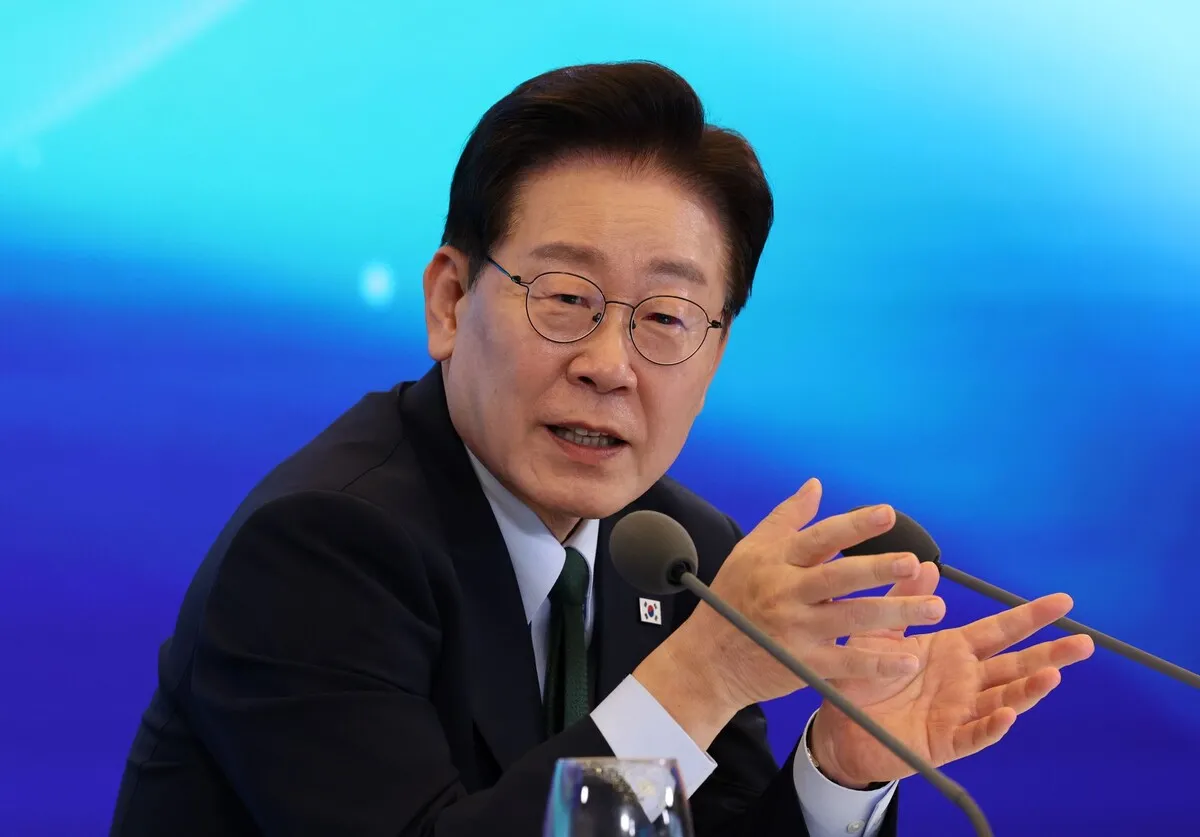
South Korean President Lee Jae-myung said on Friday that the bigger problem inside the democratic and progressive camp is not pure radicalism itself, but people who lack the ability to do a job while demanding high positions, trying to run personnel decisions and state policy their own way, and then attacking from within under the banner of radical reform when they do not get what they want. The remarks, made in a post on X, were read by Korean media as aimed at hardline prosecutors-reform figures in his own camp, including Gyeonggi Province Governor Choo Mi-ae, who has opposed the appointment of Kim Ji-yong as head of the Major Crimes Investigation Agency.
Lee shared a newspaper column by former Seoul education superintendent Cho Hee-yeon that analyzed the fracturing of the democratic and progressive camp, and quoted several passages directly. One passage asked what turns comrades into enemies, saying the starting point was a pure desire for a better world, and that eventually things are turned upside down — comrades are struck not for the sake of revolution, but striking comrades itself becomes the revolution. Another passage said that when a revolutionary, self-sacrificing movement becomes an established system of power, the outlook of interest flows in and the dynamics of personal politics and group politics take over.
Why it matters
The president's intervention puts him directly into a fight inside his own political camp rather than against the opposition. The dispute centers on who leads the body meant to take over investigative powers long held by prosecutors, a core piece of the administration's reform agenda. By framing the criticism as an internal attack dressed up as reform, Lee is signaling that he sees the challenge as a discipline problem within the camp, not a legitimate policy disagreement.
The timing also matters. The comments came as the ruling Democratic Party's leadership has been trying to contain the dispute, and as the president's own choice for the new agency has come under sustained public attack from within the party's own ranks.
The dispute over Kim Ji-yong
Governor Choo wrote on Facebook the previous night that Kim, as a candidate, had blocked an investigation related to the so-called Channel A case. According to her account, Kim did not approve the allocation of forensic costs for the mobile phone of lawmaker Han Dong-hoon, which she said obstructed the probe. She wrote that then-prosecutor-general Kim Oh-soo and Kim Ji-yong, as head of the Supreme Prosecutors' Office criminal division, should have approved 400 million won in forensic costs as investigation support expenses but did not.
Choo has kept up her offensive against the nominee despite repeated warnings from Democratic Party leader Kim Min-seok that the party would keep the matter under control internally. In a Facebook post on October 7, she described the nominee as a prosecutorial loyalist who, while serving as the Supreme Prosecutors' Office criminal division chief, held a press conference publicly opposing prosecutorial reform, and said he has since changed his position to say he sympathizes with reform in order to advance his career.
The pressure has not come only from Choo. Lee Seong-yoon, a member of the Democratic Party's Supreme Council, said during the National Assembly Legislation and Judiciary Committee's audit of the Ministry of Justice the previous night that Kim had been the criminal division head at the Supreme Prosecutors' Office at the time of the Channel A case. He called the nominee a prosecutorial loyalist and said people should not be fooled.
A president quoting a warning about movements that turn on themselves
Lee did not name Choo or any other figure in his post. Instead, he let the column carry the argument. The passages he chose describe a pattern in which a movement born from idealism hardens into a system of power, and the energy that once went into building something better gets redirected into fighting the people closest to it.
That framing is notable because it treats the internal criticism as a symptom of a broader drift rather than as a simple personnel quarrel. The president's wording — that the more serious problem is attacking from inside while claiming a noble cause — draws a line between holding a policy position and going after allies.
The column's author, Cho Hee-yeon, is a former Seoul education superintendent, and Lee shared the piece with his own comment attached, a format he has used before to weigh in on public debates.
What to watch
The immediate question is whether the ruling party's leadership can quiet the dispute over Kim Ji-yong's nomination, or whether the president's public criticism of hardliners in his own camp hardens the split further. Watch whether Choo Mi-ae and other critics respond directly to Lee's remarks, and whether the nomination proceeds to confirmation as scheduled.