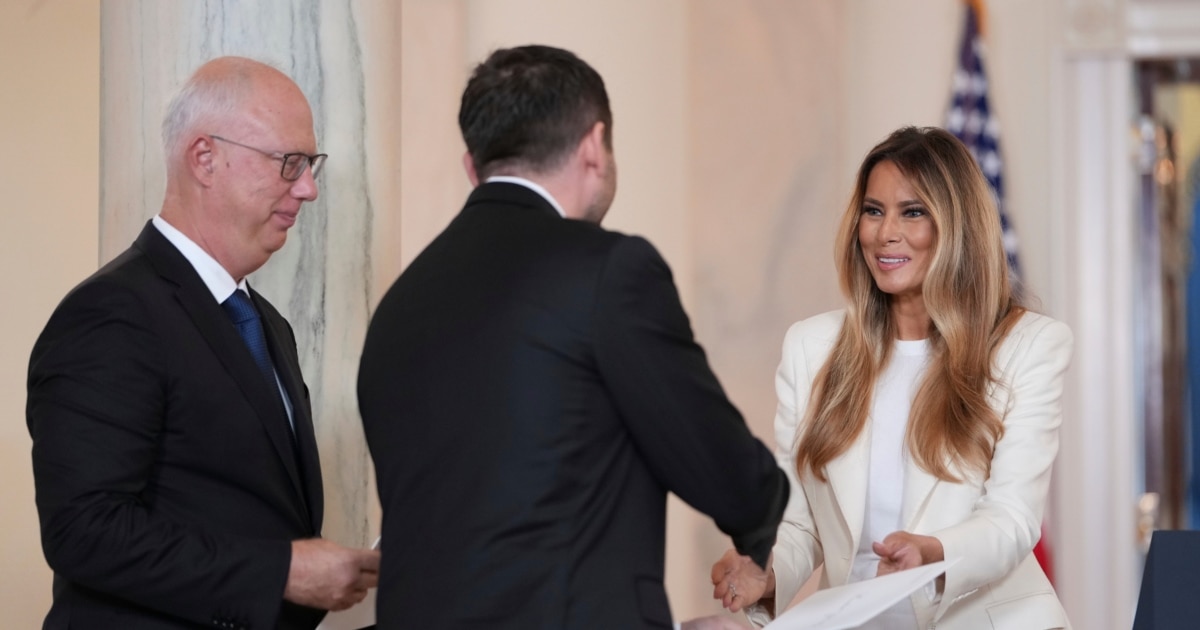
First lady Melania Trump brought Russian and Ukrainian officials together at the White House on Thursday, November 5, and urged both sides to build on a brief, localized ceasefire in the Russian-occupied city of Oleshky and turn it into a wider peace, according to 美国之音.
She said the two countries should draw on the same resolve that produced the Oleshky arrangement and seek common ground rooted in shared concern for civilians caught in the fighting. Working together, she added, they could achieve something more durable than a temporary halt in hostilities.
Why it matters
The meeting places the first lady at the center of a diplomatic track that has so far produced only a narrow, time-limited pause in one city. According to 美国之音, the Oleshky truce was signed on October 23 and fighting stopped between October 27 and November 1, allowing nearly 800 people to be evacuated. The first lady said she wants that local opening to serve as a model for broader talks.
Her involvement also gives Washington a channel to Moscow that operates outside the formal negotiating teams. President Donald Trump did not attend the event, 美国之音 reports.
A hands-on role in the Oleshky operation
The first lady said she learned of the humanitarian crisis in Oleshky in September and asked her representative, Mark Beckman, to contact both governments. She described herself as involved in every stage of the planning, saying she reviewed demining plans and aerial imagery, assessed road conditions, and discussed evacuation routes, hospital access, vehicle logistics and medical supplies.
Kirill Dmitriev, special envoy to Russian President Vladimir Putin, was invited to speak and praised what he called her exceptional humanitarian role. According to 美国之音, Dmitriev said Putin personally issued instructions for the operation and asked him to convey the Russian president's thanks to the first lady. Dmitriev also said Putin appreciates President Trump's efforts toward peace.
Ukraine's delegation presented the first lady with the Order of Princess Olga, first class, an award from Ukrainian President Volodymyr Zelenskyy. Dmytro Lubinets, Ukraine's parliamentary human rights commissioner, said the honor recognized her leadership, her courage and her work in saving Ukrainian lives and helping Ukrainian children return home. He relayed a request from Zelenskyy that she continue her efforts and keep supporting the Ukrainian people.
Davyd Arakhamiia, who leads Zelenskyy's Servant of the People faction in parliament, also asked her to keep pressing to ease tensions and end the war, 美国之音 reports.
The first lady closed with an appeal for the Oleshky effort to spread: she said she hoped that small spark would grow into a flame lighting the way to lasting peace.
Fighting resumes as talks take shape
The calm in Oleshky did not hold. Tetiana Hasanenko, who heads the town's Ukrainian military-civil administration, told Ukraine's national news agency Ukrinform that a former school principal, Kostiantyn Melnyk, was killed in a drone strike after the ceasefire ended.
Violence continues elsewhere in Ukraine. On Monday, Russian guided bombs struck the village of Komyshuvakha in Zaporizhzhia region. Zelenskyy said on Telegram on Thursday that 43 deaths had been confirmed, that one person previously listed as missing had been found alive, and that local police believe as many as 33 people may still be trapped under the rubble.
On the diplomatic side, U.S. special envoy Steve Witkoff said Monday that delegations from the United States, Ukraine and Russia would meet in Abu Dhabi on November 10 and 11. According to 美国之音, the agenda covers ending the war, postwar security arrangements and de-escalation.
Zelenskyy said he spoke by phone for 90 minutes on Wednesday evening with Witkoff and Jared Kushner. Writing on X, he said negotiations must move at full speed to end the war as soon as possible, and on Telegram he said Ukraine needs Patriot interceptor missiles to shield civilians from Russian attacks.
Rustem Umerov, Ukraine's chief negotiator, said officials from Ukraine, the United States, European governments and NATO met in Brussels on Wednesday and Thursday. Their discussions covered reconstruction, funding arrangements for 2027 and security guarantees, 美国之音 reports.
What to watch: whether the Abu Dhabi meetings on November 10 and 11 produce any commitment to widen the kind of local pause the first lady is championing, and whether Washington's humanitarian channel to Moscow carries into those talks.




