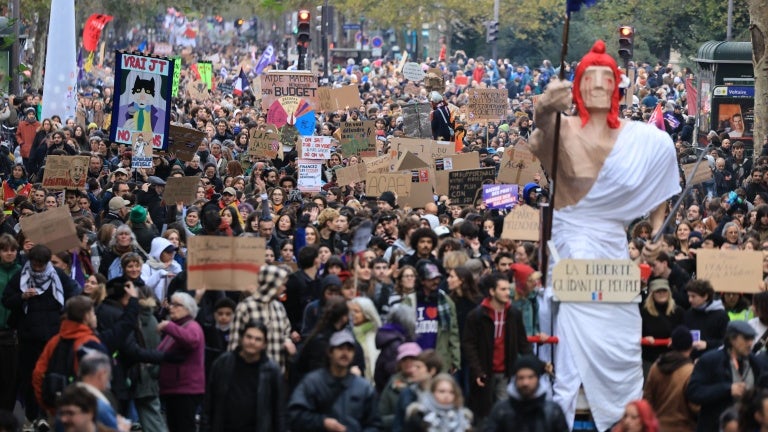
France's unions returned to the streets in force on Thursday, November 5, with the CGT claiming 1.6 million participants nationwide, including 350,000 in Paris, according to figures the union released at 5:45 pm. The Interior Ministry's own count, published at 8 pm, put the national total at 575,000, with 65,000 in the capital. BFM reported both sets of figures, noting that either way the day marked the largest single-day mobilization in France this autumn.
Why it matters
The November 5 action was the first interprofessional day led jointly by the CGT and CFDT in some time, and it placed a rise in the minimum wage at the center of its demands. The gap between the union and ministry counts is a familiar feature of French protest days, but the political weight of the turnout is not in dispute: Prime Minister Sébastien Lecornu announced the same day that a "social conference" bringing together unions and employers would be held at Matignon on Monday, November 9.
A day of strikes and marches
The mobilization extended beyond the marches themselves. The Education Ministry said close to 16 percent of teachers were on strike on Thursday. Transport Minister Philippe Tabarot said in a social media post that service was broadly maintained at a high level, with nine out of ten high-speed TGV trains running and two out of three regional trains operating, though he acknowledged variation between regions. Air traffic stayed close to normal at Paris-Charles-de-Gaulle and Paris-Orly, with disruptions reported in Réunion and Strasbourg. In the Île-de-France region, BFM reported no disruption to metro, bus or tram services.
In Paris, the head of the procession reached the Place de la Nation about three hours after the march began, while demonstrators were still gathered at the Place de la République. Manon Aubry, a La France Insoumise member of the European Parliament who joined the Paris cortege, told BFM she was struck by the size of the crowd. Speaking at around 5:30 pm as the last marchers left République, she said the route had been too short for the number of people, and that the procession had taken more than two and a half hours to pass. She argued that attempts to restrict the right to demonstrate had not dented people's resolve, and said the government must either concede to social demands or step aside.
CGT general secretary Sophie Binet told the Paris march that nothing would stop the movement against the government, calling for all salaries to rise and for the minimum wage to go up by 10 percent. She described the day as a success and the strike as highly effective, according to BFM.
Marine Tondelier, the presidential candidate for Les Écologistes, described the Paris demonstration on BFMTV as a joyful occasion. She said the whole left had been present at République, that it had moved her, and that she wanted a political outcome from the mobilization.
Teachers in the Paris cortege gave BFM their reasons for attending. François, a primary school teacher marching alongside colleagues Fabienne and Sylvain, said they had come to see that everything went smoothly and that the large crowd was well behaved. He cited the cost of living and said they were there to support school and university students whose demands, he said, teachers had carried for years.
Tensions and official reaction
Not every part of the day passed peacefully. The Haute-Garonne prefecture said in a statement that a demonstrator in Toulouse was injured in the jaw by a projectile that has not been identified. The Interior Ministry reported that 448 people had been arrested across the country as of 8 pm, a figure it described as preliminary, and that 53 members of the security forces had been hurt.
In Strasbourg, a dummy made up to look like a riot police officer was set on fire during the march. Interior Minister Laurent Nuñez condemned the incident and asked the Bas-Rhin prefect to refer the matter to prosecutors under article 40 of the criminal procedure code, which requires officials to report offences to the courts. His office told BFM that the minister was outraged by the burning and acted as soon as he saw video of it, while stressing that security forces had once again allowed the processions to go ahead.
Elsewhere in the country, turnout was strong. In Saint-Malo, close to 1,000 people demonstrated at the call of a local union alliance, with one participant describing a widespread sense of fed-upness, Ouest-France reported. In Lyon, workers told 20 Minutes they were giving up a day's pay to strike. Franceinfo reported full corteges from Douai to Limoges and in Paris, and spoke to participants who said they still believed change was possible while wondering what would come next.
The Interior Ministry's tally had stood at roughly 600,000 nationwide as of 5 pm before the final evening figure of 575,000 was issued. The CGT's count was released earlier, at 5:45 pm.
Attention now turns to Matignon, where Lecornu has called unions and employers to a social conference on Monday, November 9 — the first test of whether the pressure from the streets translates into negotiations over pay.




