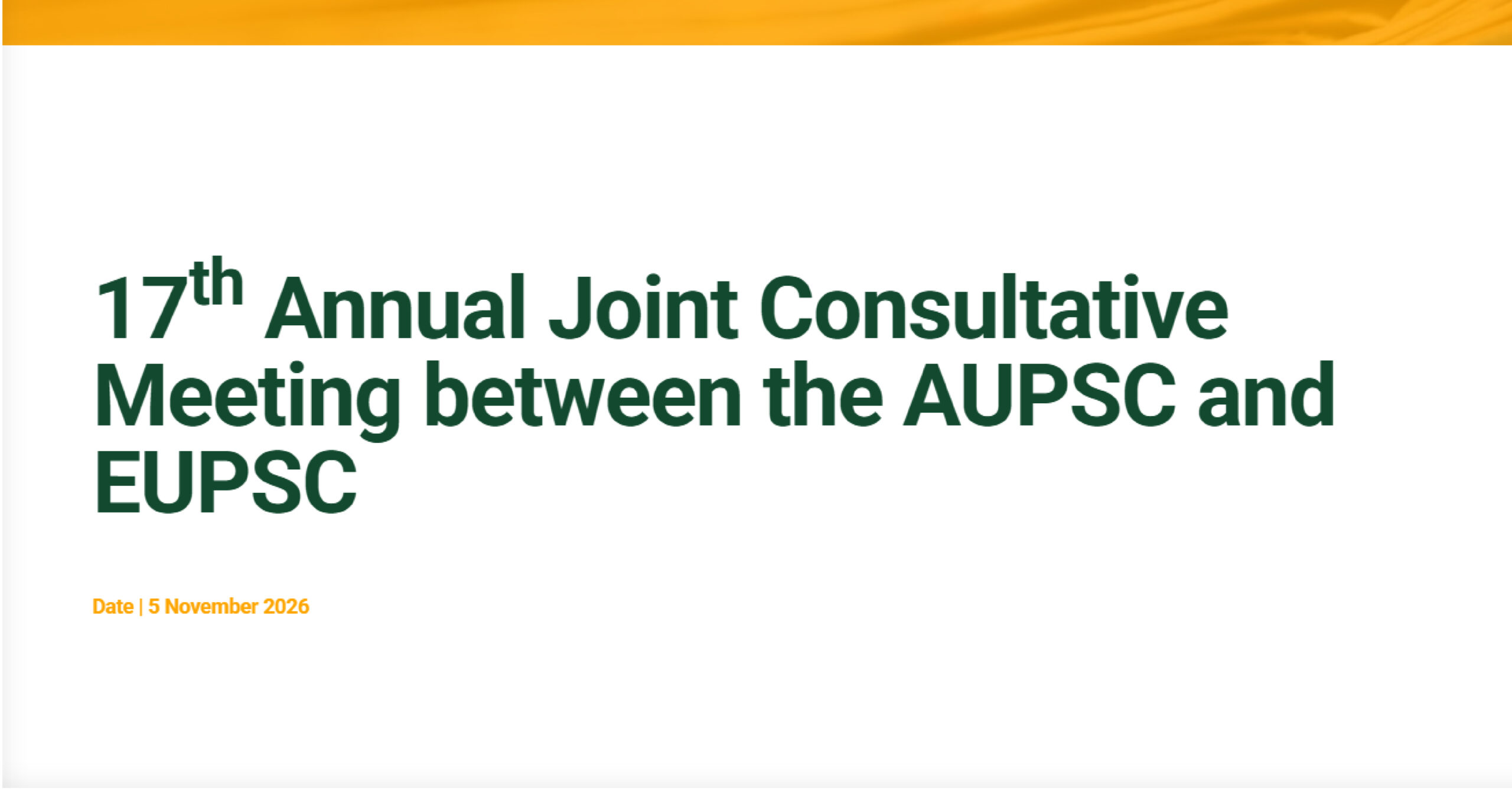
The African Union Peace and Security Council and the European Union Political and Security Committee hold their 17th annual joint consultative meeting on Friday, 6 November, in Addis Ababa, according to Amani Africa. The session follows a ninth informal joint retreat held a day earlier. Opening remarks are expected from Antonin Benjamin Biéké, Côte d'Ivoire's special envoy to the AU and the PSC's chairperson for November, and from Lene Vensild, permanent chair of the EUPSC.
Preparations were handled by the PSC Committee of Experts. Amani Africa reports that the committee met on 2 and 3 November to assign speaking roles and settle the draft joint communiqué, after earlier October contacts focused on the agendas for both the retreat and the annual meeting.
Why it matters
The talks come as the AU mission in Somalia, known as AUSSOM, is under strain on several fronts. Amani Africa reports that the mission has struggled with funding shortages since it was launched in January 2025, and that its immediate future is now uncertain. Because the EU has been the largest single financial backer of AU missions in Somalia, contributing close to €2.7 billion since 2007, the Brussels committee's posture carries real weight for the mission's survival.
The meeting also serves as a test of whether the two bodies can hold a common line on how AU-led peace operations are financed, a question that has gone unresolved in parallel talks with the UN Security Council.
An agenda trimmed by disagreement
The final agenda largely mirrors last year's, with one change: an item previously covering both Somalia and AUSSOM now deals with AUSSOM alone. Other items cover Sudan, eastern Democratic Republic of Congo, the Sahel and the Lake Chad Basin.
Several proposed items did not survive negotiations, Amani Africa reports, because the two sides could not agree on including them. These were peace support operations and UN Security Council Resolution 2719, the role of natural resource exploitation in conflicts, Somalia, the situation in the Horn of Africa, and Ukraine as a standalone item.
South Sudan is again absent from the agenda, despite what Amani Africa describes as a marked deterioration in its political and security situation since March. The country is due to hold its first elections since independence in 2011 on 22 December 2026.
As last year, the EU side is expected to raise wider global geopolitical developments under "Any Other Business."
Ethiopia, Uganda and Côte d'Ivoire are expected to lead interventions for the AU PSC, while Finland, Cyprus, Slovakia and Denmark are set to take the lead for the EU. Amani Africa adds that the DRC, Ethiopia, Algeria and Somalia are envisaged to make statements for the AU side, with Slovenia, Poland, the Netherlands, France and Germany delivering lead remarks for the EU.
Uganda's withdrawal adds to the pressure
Days before the meeting, Uganda's acting military spokesperson announced that the Uganda People's Defence Forces had begun pulling out troops deployed in Somalia under bilateral arrangements with the federal government, effective immediately. Amani Africa reports that roughly 2,000 personnel under those arrangements are expected to leave within days, while Ugandan troops serving under AUSSOM will be drawn down gradually by the end of 2027. The announcement came after two decades of Ugandan deployment.
The funding picture is equally unsettled. In July 2026, the United States said it would not back the continuation of the UN Support Office in Somalia, or UNSOS, beyond AUSSOM's current authorisation, which runs out at the end of this year. Washington later indicated it would allow a one-year window for UNSOS to wind down by the end of 2027, but without committing the office to keep providing logistical support to AUSSOM. Amani Africa reports that no plan yet exists to fill the gap once that support ends.
Troop-contributing countries met in Kampala on 31 July for their second extraordinary summit. They called for a unified mission support capability mandated by the UN Security Council to guarantee uninterrupted support for 18 to 24 months, which they argued would help meet agreed milestones, strengthen Somali security institutions and allow security responsibilities to be handed over in an orderly way. The summit also tasked the contributors' foreign ministers, working with the AU and Somalia, to set up a joint task force to drum up diplomatic and financial backing, including through a donors' and partners' conference.
Resolution 2719 back in the frame
Friday's consultations are expected to focus on how to manage the financial and logistical uncertainty facing AUSSOM when its current mandate lapses at the end of December 2026, and on the security vacuum a messy exit could open.
Resolution 2719, which sets out a framework for financing AU-led peace support operations through UN assessed contributions, is likely to stay central. Successive consultations between the AU PSC and the UN Security Council have failed to agree on applying it to AUSSOM because of US opposition, according to Amani Africa.
Whether the two bodies restate their shared view of the framework as a workable financing route is an open question. At their last consultative meeting, they used their joint communiqué to stress that Resolution 2719 should be fully and effectively implemented so that AU-led operations, AUSSOM included, get predictable, sustainable and adequate funding, describing it as the only viable way to protect gains already made. Given the EU's financial record on Somalia, the two sides may also press other international partners to step up support for AUSSOM.
Amani Africa identifies the most consequential item for Friday as work on a realistic transition plan for winding AUSSOM down in a managed way, together with steps to limit the security risks of a rushed or unplanned withdrawal.
Watch for the joint communiqué: whether it repeats last year's language on Resolution 2719, and whether it sets out any concrete timetable for a transition plan, will show how far the two sides are prepared to go beyond statements of principle.