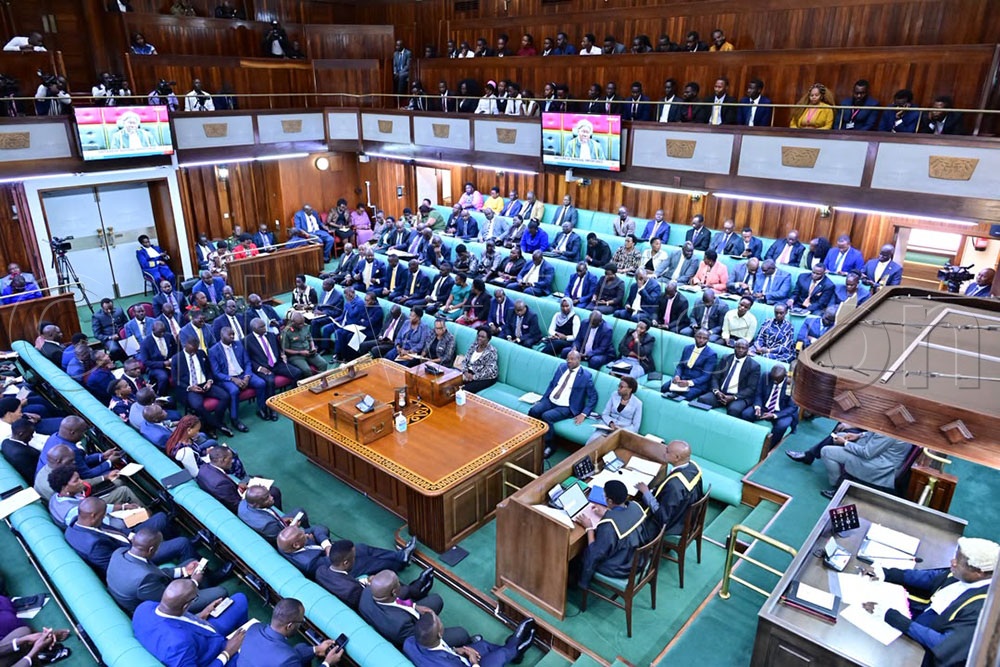
Uganda's Parliament has asked the Attorney General to rule on whether the Uganda Revenue Authority (URA) may lawfully demand revised excise duty from businesses for a period before the amended legislation took effect, according to NewVision.co.ug. The matter reached the House on Tuesday, November 3, after Karim Masaba, the Industrial Division Mbale City MP, said URA had issued demand notices and bank agency notices to oil marketing companies and sugar traders, with some bank accounts reportedly frozen.
Masaba told Parliament that the disputed taxes cover transactions made between July 1 and August 28, 2026 — a window during which the Excise Duty (Amendment) Act, 2026 had not yet been signed or gazetted. President Yoweri Museveni assented to the Act on August 20 and it was published in the Uganda Gazette on August 28, but its commencement clause sets the effective date at July 1, 2026. NewVision.co.ug reports that URA issued a public notice on September 23 telling taxpayers the amended provisions applied from July 1 and asking them to review their July and August returns and declarations accordingly.
Why it matters
The dispute turns on a collision between two ideas: a commencement clause that reaches backward in time, and the long-standing principle that tax laws should not apply retrospectively. Businesses caught in the middle say they are being asked to pay at rates that were not law when the transactions occurred. Some have reportedly had accounts frozen while the authority pursues the additional revenue. How the Attorney General resolves the question will determine whether those demands stand, and it will set a marker for how Uganda handles similar commencement clauses in future tax legislation.
Minister acknowledges the facts but defends URA's mandate
Henry Musasizi, the Minister of Finance, Planning and Economic Development, told the House that Masaba had described the circumstances accurately. He said URA was administering the law as Parliament had enacted it, and that the authority was acting within its mandate to collect taxes under legislation passed by the House.
At the same time, the minister voiced his own doubts about the retrospective element, pointing to a tension between the Act's commencement date and the principle against retroactive taxation. According to NewVision.co.ug, Musasizi told Parliament he did not believe it was correct for tax laws to apply retrospectively. He said his ministry had already written to the Attorney General for a legal interpretation and had a meeting with him scheduled for Thursday, November 5.
Musasizi asked the Speaker to give the ministry a week to examine the matter and report back to Parliament on Tuesday, November 10, after those consultations.
A 2010 case anchors the argument
Masaba asked the Attorney General to advise Parliament on when tax laws actually begin to operate, citing the 2010 Rock Petroleum versus URA case, which dealt with the legality of retrospective excise duty collection. He also called on the Ministry of Finance to step in and direct URA to suspend enforcement until the legal position is clear, arguing that businesses should not have to pay taxes for a stretch when the revised rates had not yet become law.
The MP's account of the demands was direct: URA, he said, is seeking taxes that were meant to have been collected between July 1 and August 28.
A separate complaint over dollar-denominated taxes
The session also surfaced an unrelated grievance. Joseph Ssewungu, the Kalungu County West MP, said traders were being required to pay taxes in US dollars on imported goods, even though Parliament had rejected dollar-denominated taxation. He warned that exchange-rate movements could inflate the tax burden on traders who buy goods abroad and bring them into Uganda.
Musasizi responded that this was a new issue that needed its own consideration rather than being folded into the clarification of the excise duty question.
Parliament expects to hear the Finance Ministry's position on the excise duty dispute next Tuesday, once the ministry has met the Attorney General.