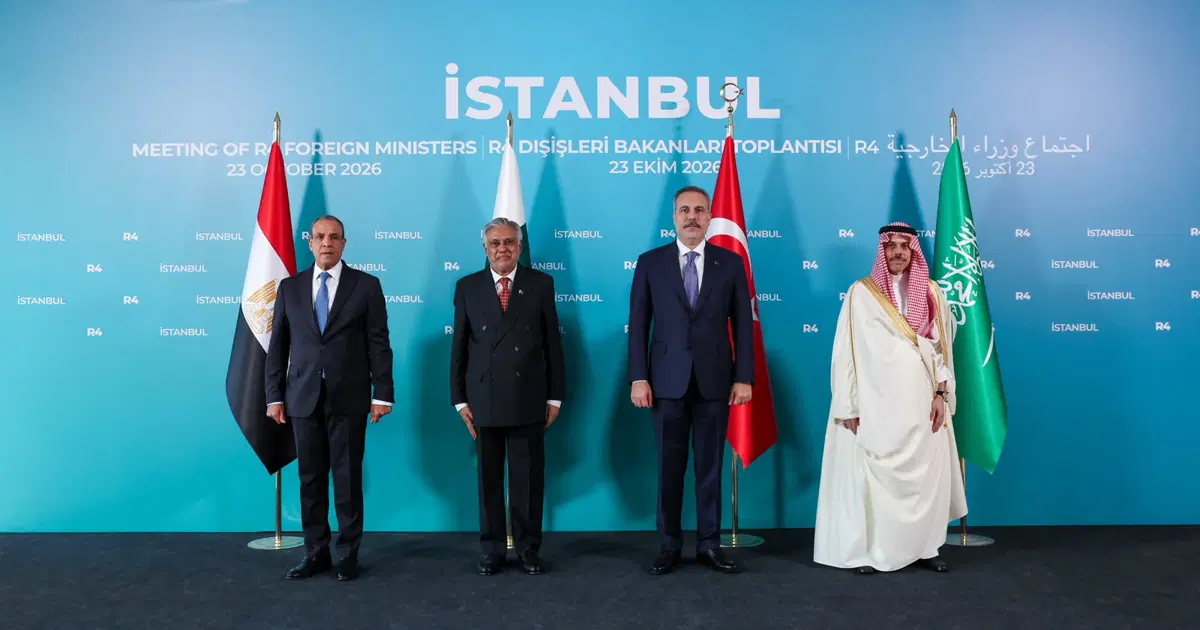
Turkish Foreign Minister Hakan Fidan hosted a meeting of foreign ministers from seven countries in Istanbul on Friday, convened at Turkey's initiative to seek common ground on a set of overlapping regional and global crises, NTV Haber reported.
The gathering brought together the R4 format — Turkey, Egypt, Pakistan and Saudi Arabia — with the E3 group of the United Kingdom, Germany and France at the same table.
According to NTV Haber, the ministers discussed the Palestinian question, developments around the Strait of Hormuz, tensions between the United States and Iran, Israeli attacks, the situation in Yemen and the Russia-Ukraine war. They also examined possibilities for new cooperation and coordination between their countries.
Why it matters
The meeting places two groupings with different origins and memberships in a single diplomatic setting. The R4 mechanism was established by Turkey, Egypt, Pakistan and Saudi Arabia to support lasting stability on the basis of regional ownership and to strengthen dialogue. Its foreign ministers have met six times, beginning with a first gathering in Riyadh on March 18 this year and most recently on the sidelines of the UN General Assembly in New York on September 21.
The E3 has operated since 2003 as a trilateral diplomatic framework among Germany, the UK and France focused on Iran's nuclear programme, and has over time taken on joint initiatives in other regional and international files, according to NTV Haber.
Fidan warns conflicts are feeding one another
Citing Foreign Ministry sources, NTV Haber reported that Fidan told the meeting that ongoing disputes must be prevented from reinforcing each other and pushing conflicts into new areas. He said Turkey gives priority to cooperation mechanisms built on regional ownership in order to stop regional tensions from turning into wider instability.
Fidan identified Israel's occupation of Palestine, what he described as its uncompromising stance that obstructs peace efforts, and its aggression spreading across the region as the main cause of tensions in the Middle East. He stressed that all states should avoid steps that would damage Jerusalem's historical and legal status or undermine the two-state solution.
The talks also included calls for the international community to take a firm stand against Israel's expansion of illegal settlements and its encouragement of illegal settler terrorism, with participants recording that pressure on Israel should be increased, NTV Haber reported.
On the US-Iran standoff, Fidan indicated that the tension can only be overcome through diplomacy and dialogue, saying military methods do not produce lasting results and instead increase vulnerabilities in the region. He said permanently guaranteeing freedom of navigation in the Strait of Hormuz and the Bab al-Mandab Strait is vital for both regional and global stability.
Addressing Houthi attacks targeting civilians and civilian infrastructure in Saudi Arabia, Fidan restated Turkey's support for Saudi security and pointed to the shared security and solidarity approach represented by the Mecca Defence Alliance.
Fidan said the R4 and E3 countries are contributing to strengthening stability and prosperity in Syria, while noting that Israel continues actions aimed at destabilising the country. He also raised the security risks created by the Russia-Ukraine conflict, adding that Turkey, as a Black Sea littoral state, continues to convey proposals to the parties aimed at preventing the war from spreading to that sea.
Who attended, and Italy's late addition
German Foreign Minister Johann David Wadephul, UK Foreign Secretary Ed Miliband, French Foreign Minister Jean-Noël Barrot, Egyptian Foreign Minister Badr Abdelatty, Pakistani Foreign Minister Muhammad Ishaq Dar and Saudi Foreign Minister Faisal bin Farhan Al Saud took part in the Istanbul summit, according to NTV Haber.
Italy's Foreign Ministry announced that Deputy Prime Minister and Foreign Minister Antonio Tajani would attend the meeting organised at Turkey's initiative. In a statement, the ministry said Tajani would be in Istanbul on Saturday for the ministerial gathering focused on major international crises. With Italy's participation, the talks are expected to assess challenges to international peace and security, particularly the Middle East, Palestine, Yemen and the safety of maritime transport in the Strait of Hormuz.
In his opening remarks, Fidan said Istanbul has long carried its identity as a centre of dialogue and diplomacy, describing the city as having fulfilled its duty of serving as a bridge between divisions. He said daily Israeli violations of the ceasefire erode confidence in the international system and create distrust on the matter.
Fidan cited Turkey's efforts in Libya as a concrete example of how the principles of consent, mutual trust and inclusiveness can lay a foundation, saying Ankara continues its dialogue with both east and west as well as with international partners in order to achieve results-oriented dialogue there.
He also referred to the Mecca Agreement, saying the Mecca Defence Alliance and the Balkan Peace Platform show how that principle can work in practice. The Mecca alliance, he said, was founded to protect regional security, peace and prosperity, and its establishment came about through a sense of regional ownership.
NTV Haber reported that President Recep Tayyip Erdoğan sent a video message to conference participants, telling them that parties should not leave the negotiating table even at moments when communication breaks down in international crises.
Watch for whether Italy's arrival on Saturday broadens the agenda beyond the crisis list discussed on Friday, and whether the R4 and E3 formats announce any joint follow-up mechanism.