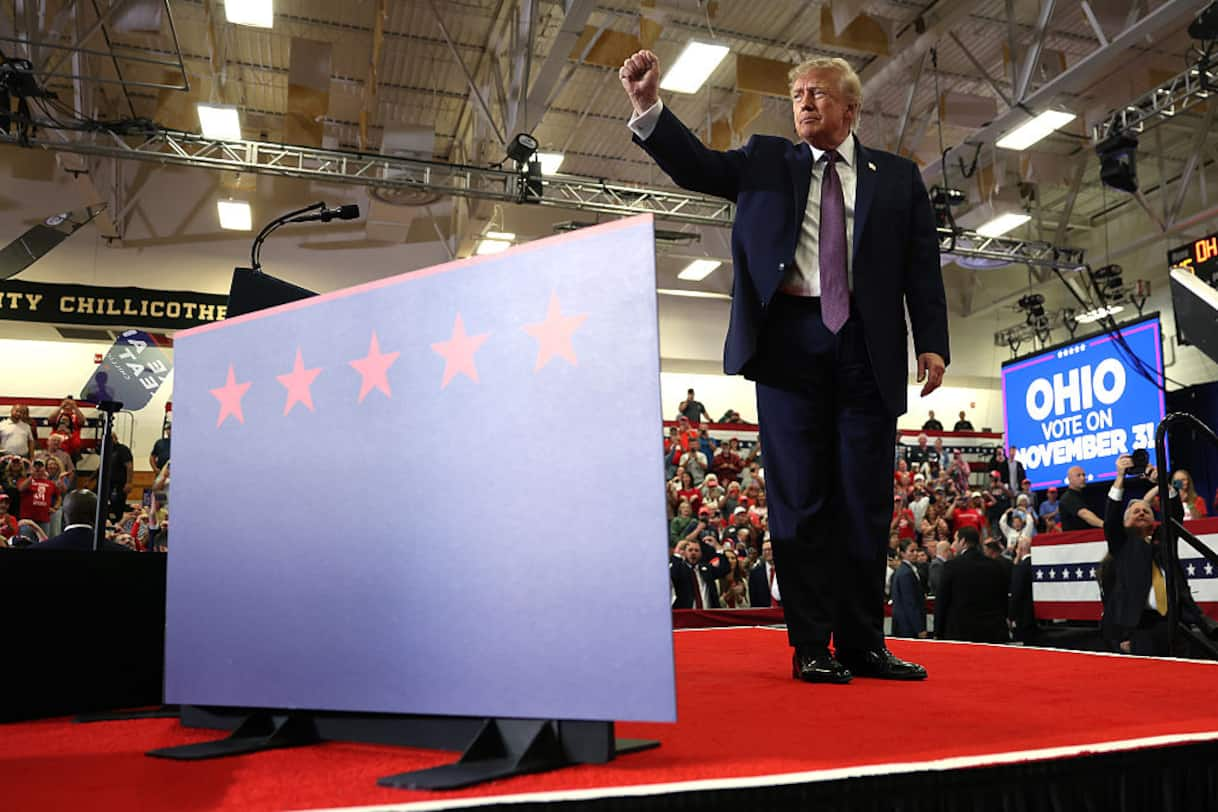
US President Donald Trump said on Thursday that he intends to bring the war with Iran to a close soon, telling an audience in Ohio that the only task left is to finish the conflict, which he said he would do "very quickly." According to Sky TG24, Trump also claimed that Iran had been "heavily defeated." The remarks came as Italian outlets reported parallel developments: confidential US-Iran talks in Abu Dhabi and a reported American military buildup in the region.
Why it matters
The statements pull in two directions at once. On one side, the US president is publicly promising a rapid conclusion to a war that, by the Washington Post's account, has already run eight months and cost more than $47 billion. On the other, reporting attributed to the Wall Street Journal describes the US military moving air-defense assets and repositioning troops — steps that suggest preparations for further exposure rather than wind-down. How those threads reconcile will shape both the pace of the conflict and the political fight over its funding in Washington.
Talks in Abu Dhabi and a letter to Tehran
According to Corriere della Sera, secret negotiations between the United States and Iran are under way in Abu Dhabi, with the nuclear program and sanctions back on the agenda. The outlet's reporting places both issues at the center of the discussions, reviving a diplomatic track that has repeatedly stalled.
A separate channel appears to have opened through JD Vance, who, per Sky TG24's account, wrote to Mohsen Rezaei, secretary of Iran's Supreme National Security Council, in an effort to restart negotiations.
On the military side, the Wall Street Journal reported that the US Army is shifting a Patriot missile battery from Texas to strengthen air defenses and is moving troops away from bases that could be vulnerable to Iranian fire. The White House declined to discuss what it called sensitive military plans whose existence it said still needed verification, while stressing that Trump keeps every option available to ensure Iran can never obtain a nuclear weapon, Sky TG24 reported.
Israel's coalition arithmetic shifts
In Israel, the political ground is moving as vote counting continues. With 97.3% of ballots counted, Likud has gained a seat at the expense of the ultra-Orthodox Shas party and now holds 27 seats, according to the tally cited in the reporting. Yashar, led by Gadi Eisenkot, stands at 21 seats, while the Bennett-Lapid list has 12.
Channel 12, as cited by the Times of Israel, reported that figures inside the United Torah Judaism party — one of the groupings in Benjamin Netanyahu's supporting bloc, currently holding seven seats — are floating external support for a government led by Eisenkot, who heads Yashar. Under that scenario, UTJ would back an Eisenkot-led executive from outside the coalition rather than join it, in exchange for compromises on military service exemptions. Eisenkot could additionally count on the seven seats of the Islamist Ra'am party, the report said.
"From Netanyahu we will get nothing," a UTJ source told Channel 12, according to the Times of Israel, describing the party's alliance with him as exhausted, particularly with him short of 61 seats. The source said the goal is to return to being a decisive factor in the Knesset and acknowledged the party could end up in opposition if a national unity government forms.
Eisenkot has set conditions for a coalition under his leadership, including a commitment to a Zionist government that backs universal military service — which UTJ opposes — and that pursues the dismantling of Hamas, the Times of Israel reported.
Turkey rejects election interference claims
Ankara has pushed back on allegations in some media that Turkey, together with Qatar, influenced Israel's elections through a campaign aimed at boosting support for Arab parties in Israel. In a statement from the Turkish presidency's disinformation committee, the government said the claims are entirely without foundation and form part of a deliberate disinformation effort to manipulate public opinion, urging the public to disregard what it called false reports designed to mislead.
Defense budget stalls as war costs climb
Trump's $1.5 trillion defense plan is at risk of stalling in Congress, where Republican-Democrat divisions — sharpened by the Iran war and difficult relations with Secretary of War Pete Hegseth — are holding up Pentagon funding, the Washington Post reported after interviewing 30 officials and experts involved in national security matters, including 20 lawmakers from relevant committees. With just over 20 legislative days left before the year ends, the impasse threatens to hamper the rearmament of US forces after eight months of war and to slow the administration's military programs.
The White House plan envisions a 40% increase in military spending, directed in part toward drones, precision missiles and funding for the Golden Dome missile shield. Hegseth has requested an additional $67 billion to cover the costs of the Iran war and overseas operations, but nearly all Democratic senators have blocked the request. The administration has split the budget into two parts: $1.15 trillion that requires opposition support and $350 billion to pass with Republican votes alone. According to the Washington Post, the GOP has not yet agreed on how to proceed. Meanwhile, the Iran conflict's cost has passed $47 billion, forcing the Pentagon to postpone training and maintenance to cover expenses.
Cargo ship sinks in the Black Sea
A vessel chartered by Israeli company Zim Integrated Shipping Services sank overnight after being struck by three naval drones off Bulgaria's Black Sea coast. Zim said the crew of the container ship, which had departed Haifa and was bound for Constanza in Romania, was rescued and evacuated safely. All 18 crew members — 14 Filipinos and four Ukrainians — were pulled from the water by Bulgarian Navy and border police boats and taken to the port city of Varna for medical checks, the Times of Israel reported. Images circulating on social media appeared to show one of the suicide drones skimming across the water before turning toward the ship.
What to watch
The next signals will come from Abu Dhabi, where the reported talks could either produce a framework or collapse, and from Congress, where the defense budget calendar is running short.