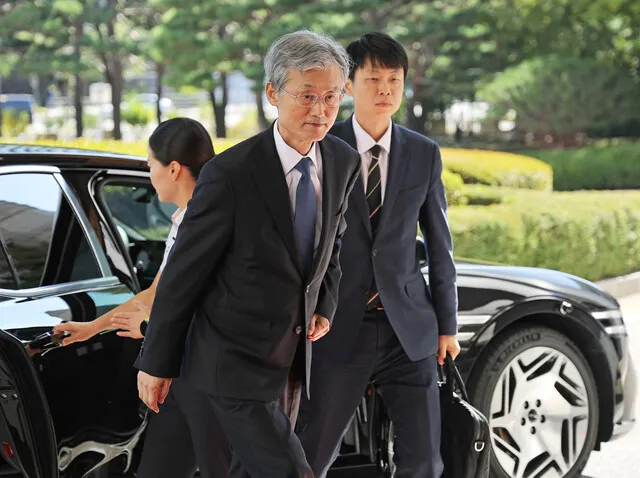
Supreme Court Chief Justice Cho Hee-dae has refused the Blue House's request to resubmit a nominee for an empty Supreme Court justice seat, according to 한겨레, pushing a standoff between the two offices into its eighth week and leaving the vacancy unfilled for a record 219 days.
Speaking at a National Assembly Legislation and Judiciary Committee audit on October 6, Cho produced a prepared document and stated that neither the National Assembly nor the president may take part in the chief justice's nomination, and that his constitutional authority and duty ended with the original submission, 한겨레 reported. The Blue House responded by repeating its existing position that it hopes the chief justice will proceed with the re-nomination process as quickly as possible.
The seat has been empty since former Justice Noh Tae-ak retired in March, making this the longest such gap in the court's history. The impasse began on August 18, when Cho submitted Son Bong-ki, a senior judge at the Daegu District Court, to President Lee Jae-myung in writing as Noh's successor. Since then, according to 한겨레, the sequence has repeated for roughly 50 days: the Blue House asks for a new nomination, Cho declines, and ruling-party figures call for him to step down.
Why it matters
A vacant Supreme Court seat is not simply a matter of one fewer judge on the bench. The court handles the final review and ruling on cases, so a prolonged absence affects how cases move through the system and, by extension, the public's right to have their cases heard.
The court can still hold hearings and issue rulings in its panels and the full bench with one seat empty. But with 11 justices other than the court administration chief covering the workload meant for 12, the physical burden is substantial, 한겨레 reported. One judge with Supreme Court experience told the paper that a single fixed vacancy becomes a problem when justices must also be away for one or two weeks at a time on overseas schedules, and that a long gap does more damage to final appeals than people expect.
A former senior judge told 한겨레 that the only apparent path forward is for Cho to reconstitute the Supreme Court Justice Candidate Recommendation Committee and run the recommendation process again, and warned that if Cho refuses to do so, the situation could persist until his term ends next June. The same former judge said he is worried because the court has never seen a vacancy last this long.
Pressure from the ruling party, and its limits
Democratic Party leader Kim Min-seok, speaking at a Supreme Council meeting, urged Cho to resign voluntarily, arguing that stepping down would be the honorable final duty of a chief justice rather than defending a position he described as unconstitutional while infringing on the public's constitutional right to a trial. Supreme Council member Lee Seong-yoon said Cho's only remaining options are resignation or impeachment, and party lawmaker Park Kyun-taek said impeachment should be considered. Prime Minister Han Seong-sook, speaking with reporters in Sejong, also criticized Cho, asking whether the president's appointment authority still exists if a nominee is appointed as submitted.
According to 한겨레, both the impeachment route and a constitutional jurisdiction dispute carry serious risks. Finding a clear legal violation by Cho would be difficult, and the outcome of a jurisdiction dispute is hard to predict. Either path would also require enduring considerable negative public opinion. A Democratic Party leadership official told 한겨레 that there is public unease about impeaching the head of the judiciary, and that even if impeachment succeeded and Cho's duties were suspended, it is unclear whether an acting chief justice could resolve the re-nomination question. The official said a different way out of the standoff needs to be found. Another ruling-camp official said the process is stuck at the first step because Cho is openly refusing to resubmit.
Not all voices in the ruling camp favor escalation. Daegu Mayor Hong Joon-pyo said the world is going astray and called for Cho to be respected rather than pressured, according to Daum.
A second vacancy looms
If the Blue House and the Supreme Court cannot resolve their disagreement, the outlook for filling another seat is also uncertain. Justice Chun Dae-yup retires next May, and 한겨레 reported that selecting his successor is not expected to be easy under current conditions.
Cho said during the audit that he would work to ensure the Supreme Court can be fully constituted, in closing remarks carried by KBS News. Analysts cited by 한겨레 said the two offices need to negotiate. Yoon Tae-gon, head of the political analysis office at The Moa, said that the harder Cho is pressed, the more the burden falls on the Blue House and the ruling party, and that the Blue House will ultimately have to find a way to break the deadlock.
What happens next depends on whether the Blue House and the Supreme Court open direct talks or whether the ruling party moves ahead with impeachment or a jurisdiction dispute — steps that 한겨레 reports carry heavy political costs and uncertain results.



