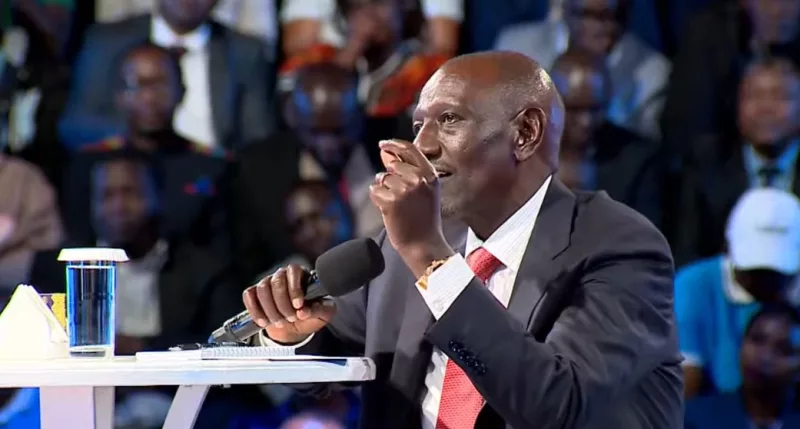
President William Ruto has warned that he will act against people he blames for blocking the work of the Kenya Sugar Board, saying the standoff has left roughly Sh4 billion in sugar levy collections unspent. He spoke on Thursday at the Agriculture and Food Security Presidential Town Hall held at Jamhuri Park in Nairobi, according to The Star, Kenya.
Ruto said the money was raised to pay for road improvements, to develop and distribute seed cane to growers, and to fund research into improved sugarcane varieties. None of it has been put to use, he said, because of a court dispute over the board.
Why it matters
The levy is a dedicated pool of money drawn from the sugar sector and intended to flow back into it. If the funds stay locked up, the farmers and millers the levy was designed to support do not receive the roads, planting material and research the president described. The impasse also raises questions about who controls the Kenya Sugar Board and, by extension, how the levy is spent.
Ruto framed the delay as the work of a small group rather than a systemic problem. According to The Star, Kenya, he said the individuals he had previously pushed out of the sugar sector had regrouped and were now holding the industry back.
Ruto points to court action and past rivals
The president said the people he had removed from the sector had taken their fight over the Kenya Sugar Board to court, which he said is why the levy funds remain untouched. He did not name them.
"We have collected about Sh4 billion from the sugar levy to ensure we have passable roads, develop seed cane and supply seed cane to farmers and ensure there is research on better varieties of cane for development," he said, as reported by The Star, Kenya.
He went on to say the money could not be used because those he had chased away had come together again. He accused the unnamed group of holding the sugar industry hostage for selfish reasons.
Ruto also argued that farmers should be allowed to choose their own representatives on the Kenya Sugar Board, and that the board should then determine how the levy is allocated. That position places him on the side of grower representation in a dispute that has centred on the board's composition and operations.
The president directed pointed remarks at those pursuing the case in court, warning them against using litigation to stall an entire industry. He said farmers have a right to elect board members.
He then issued a warning in a mix of English and Kiswahili, saying he would find a hammer to deal with people he said do not respond to any other approach, and that once that was done there would be a board in place. He added that those concerned know who they are, and that he knows them too.
The remarks came during a broader presidential event on agriculture and food security, which put the sugar dispute alongside wider questions about how Kenya feeds itself and supports its farming base.
A sector caught between growers and the courts
Sugar is a politically sensitive crop in Kenya, and the Kenya Sugar Board sits at the centre of how the industry is regulated and financed. The board's constitution and operations have been the subject of ongoing disputes, and the president's comments on Thursday suggest the disagreement has now become a direct obstacle to spending levy revenue.
The Sh4 billion figure is significant for a sector where growers have long complained about delayed payments and the cost of inputs. Seed cane supply and research into better varieties are the kind of long-term investments that determine yields years down the line, which means a delay of this kind has consequences beyond the current season.
Ruto's language was notably personal. He referred to the people involved as characters he had already removed once, and said he recognised them and believed they were listening to him. That framing turns the dispute from a technical question about board appointments into a contest over who has the standing to shape the industry.
It also puts the courts in the middle of a political fight. The president did not describe the legal arguments being made, only the effect he says they are having: money collected for farmers sitting idle while the case proceeds.
For growers, the practical question is unchanged. The levy was collected with the promise of better roads to move cane, enough seed to plant, and research that raises productivity. Until the board question is settled, none of that reaches the field.
What happens next depends on two tracks moving at once: the court case over the Kenya Sugar Board, and whatever action Ruto follows through on after Thursday's warning. Watch whether the levy funds are released, and whether farmers get the board elections the president says they are entitled to.