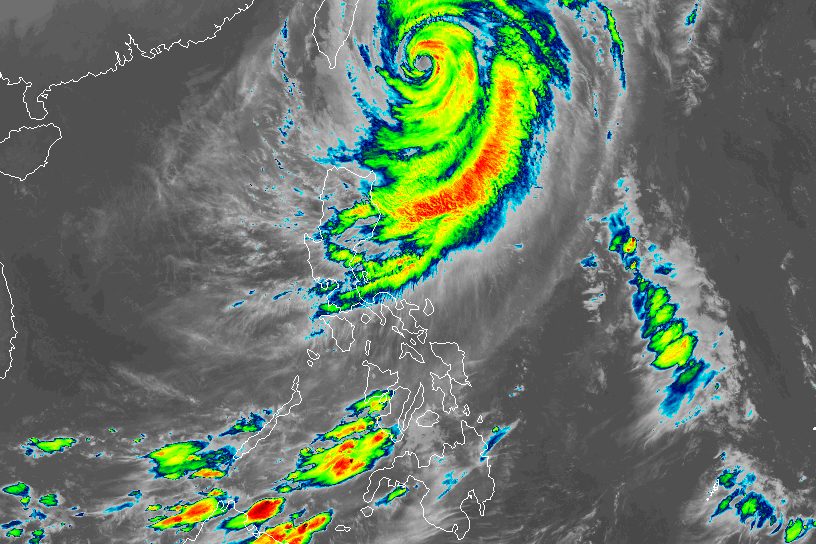
Typhoon Rosal, known internationally as Champi, kept dumping moderate to heavy rain on Batanes on Friday, October 23, even as the storm stayed clear of the Philippine coastline, according to Rappler. The typhoon was expected to leave the Philippine Area of Responsibility (PAR) by early Saturday, October 24, after entering it on Tuesday, October 20.
At 4 am on Friday, the storm was located about 275 kilometers east northeast of Itbayat, Batanes, moving northwest at a slow 15 kilometers per hour, Rappler reported. Its peak strength had already eased: maximum sustained winds dropped to 155 km/h by Thursday evening, October 22, with gusts down to 190 km/h. At its strongest, Rosal was a super typhoon carrying winds of 215 km/h.
In a 5 am bulletin on Friday, the Philippine Atmospheric, Geophysical, and Astronomical Services Administration (PAGASA) said Batanes would continue to get moderate to heavy rain, in the range of 50 to 100 millimeters, over the following hours, according to Rappler.
Why it matters
Rosal never made landfall in the Philippines, but its slow drift near the country's northern edge was enough to keep forecasters and local officials on alert for most of the week. The storm's outer bands and the northeasterly windflow combined to threaten strong to gale-force gusts across exposed areas, while rough seas kept small vessels at risk on affected coasts.
The typhoon was the country's 18th tropical cyclone of 2026 and the first of October, Rappler reported. PAGASA had earlier projected that one or two cyclones could form or pass through Philippine waters during the month, so Rosal's arrival fell within expectations.
Rain and wind spread across Northern Luzon
Beyond Batanes, PAGASA said Ilocos Norte, Apayao, Cagayan, and Isabela could see continued rain and gusty winds on Friday, Rappler reported. The rest of the Cordillera Administrative Region, the remainder of Cagayan Valley, Ilocos Sur, La Union, and Aurora were likely to get scattered rain and thunderstorms driven by the typhoon.
The storm's trough, or extension, was also affecting Masbate, Palawan, the Visayas, the Zamboanga Peninsula, Lanao del Norte, Misamis Occidental, Basilan, and Tawi-Tawi, where scattered rain and thunderstorms were possible, according to the same report. Tropical cyclone wind signals remained in place in several areas as of 5 am Friday, and warnings for seaboards touched by the storm had not been lifted. Coastal waters in some areas were described as moderate to rough, with small vessels advised to take precautions or stay in port where possible.
Rosal's passage also disrupted air travel. The Civil Aviation Authority of the Philippines temporarily closed Basco Airport in Batanes because of the typhoon, the Daily Tribune reported. BusinessWorld, meanwhile, reported that Signal No. 2 was raised over Batanes and parts of the Babuyan Islands at the height of the threat.
A storm that weakened on its way out
Rosal's decline was steady rather than sudden. After reaching super typhoon status with 215 km/h winds, the cyclone lost strength through Thursday evening and was forecast to keep weakening after leaving PAR. PAGASA expected it to be downgraded to a severe tropical storm by Saturday morning and further to a tropical storm by Saturday evening, Rappler reported.
The storm's exit comes as the Philippines shifts between monsoon seasons. The southwest monsoon, or habagat, ended on October 5, and the country is now moving into the northeast monsoon, or amihan. PAGASA has said the coming amihan period could be warmer than usual because a strong El Niño in the tropical Pacific is predicted to become very strong in the last quarter of 2026, according to Rappler.
Forecasters will be watching whether Rosal's departure brings a full clearing of wind signals across the north, with ABS-CBN reporting that all signals had been lifted once the typhoon left PAR.



