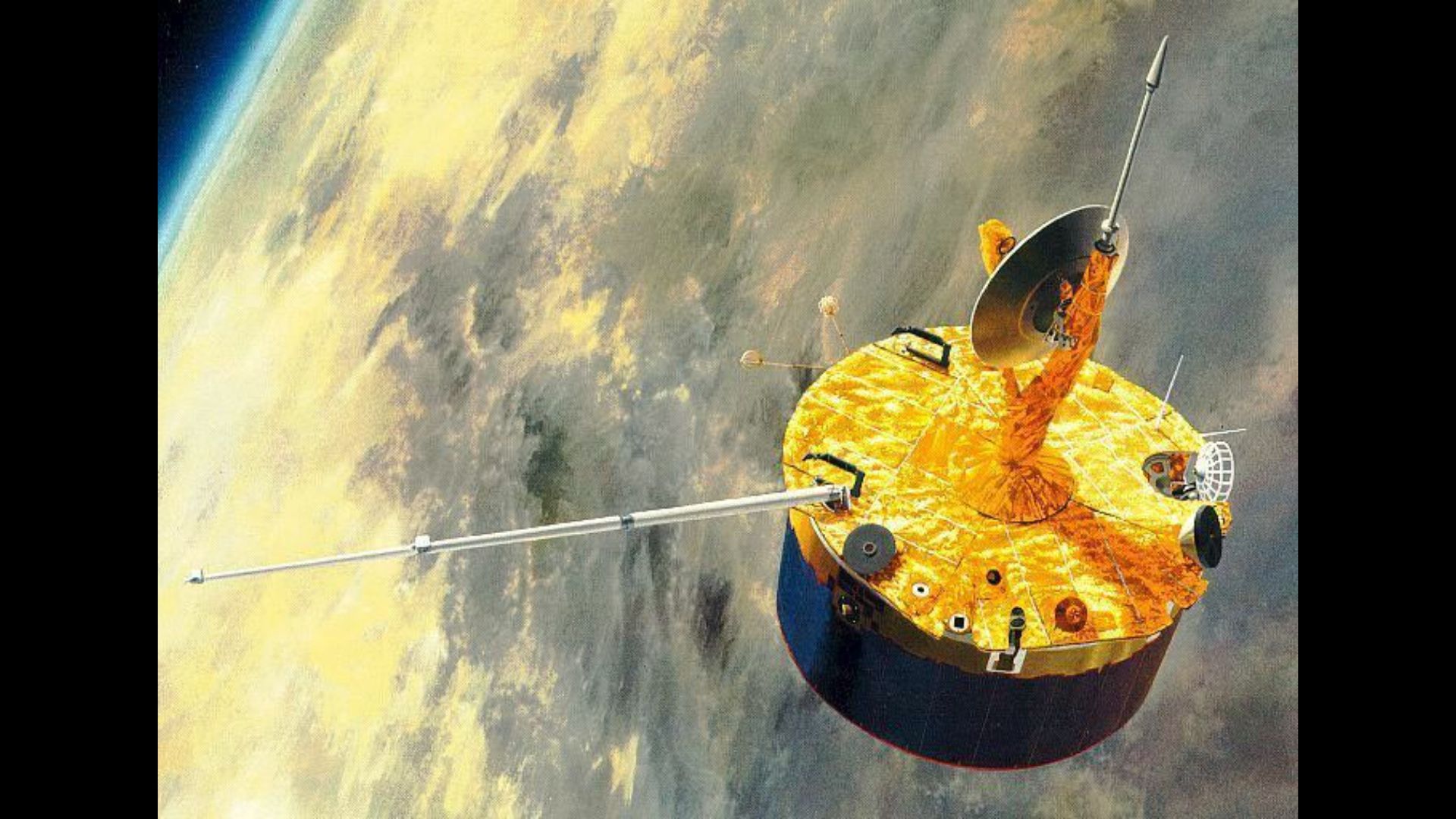
NASA's Pioneer 12 spacecraft met its end in the skies of Venus on Oct. 8, 1992, burning up in the planet's atmosphere after circling it for 14 years, according to Space. The probe, also called the Pioneer Venus Orbiter, had run out of propellant, and its orbit decayed until the craft broke apart in the Venusian air.
The spacecraft holds a notable place in exploration history: it was the first American probe ever to enter orbit around Venus.
Why it matters
Pioneer 12 gave scientists their longest sustained look at Venus from orbit up to that point, and its instruments kept returning data long after the mission's original goals were met. Space reports that the probe studied the planet's atmosphere and examined how its ionosphere and magnetic field interact with the solar wind, the stream of charged particles flowing outward from the sun.
Its radar also peeled back the planet's thick cloud cover, producing a picture of Venus that differed sharply from Earth. According to Space, the data showed a world that is rounder and smoother than our own, with its tallest feature, Maxwell Montes, standing 6.5 miles (10.8 kilometers) above the surface. NASA noted that the planet has a peak taller than Mount Everest and a canyon deeper than the Grand Canyon, Space reports.
A tag-team mission to Venus
Pioneer 12 was part of a two-spacecraft effort. It lifted off on May 20, 1978, aboard an Atlas Centaur rocket from Launch Complex 36A at Cape Canaveral in Florida, and reached orbit around Venus on Dec. 4 of that year. A companion probe, Pioneer Venus 2, followed in August 1978, but the orbiter launched first.
The spacecraft carried 16 instruments and operated from an orbit roughly 99 miles (160 kilometers) above Venus, completing one lap of the planet in a little more than 23 hours, according to a NASA overview cited by Space. Its instruments mapped most of the surface between 73 degrees north latitude and 63 degrees south latitude, at a resolution of 47 miles (75 kilometers). Space reports that cameras also picked up nearly continuous lightning in the atmosphere, and that the mission confirmed Venus has little or no magnetic field.
Mapping work reached a milestone on March 19, 1981, when the probe had covered 93 percent of the area its instruments could see, prompting NASA to shut down its mapping radar. A decade later, in 1991, the spacecraft's position allowed it to view new parts of southern Venus, and the agency switched the radar back on 13 years after launch to collect fresh data.
A comet-watching bonus
Pioneer 12's itinerary was not limited to Venus. While in orbit, it also observed Halley's Comet, and Space reports that it went on to study comet Encke in 1984, Giacobini-Zinner in 1985, comet Wilson in 1987, and comets NTT and McNaught, both in 1987.
The mission finally ended when the probe exhausted its propellant. With no fuel to maintain its orbit, Pioneer 12 drifted lower over time and disintegrated in Venus's atmosphere on Oct. 8, 1992.
For readers tracking space anniversaries, Space maintains an archive of its "On This Day In Space" stories and videos.



