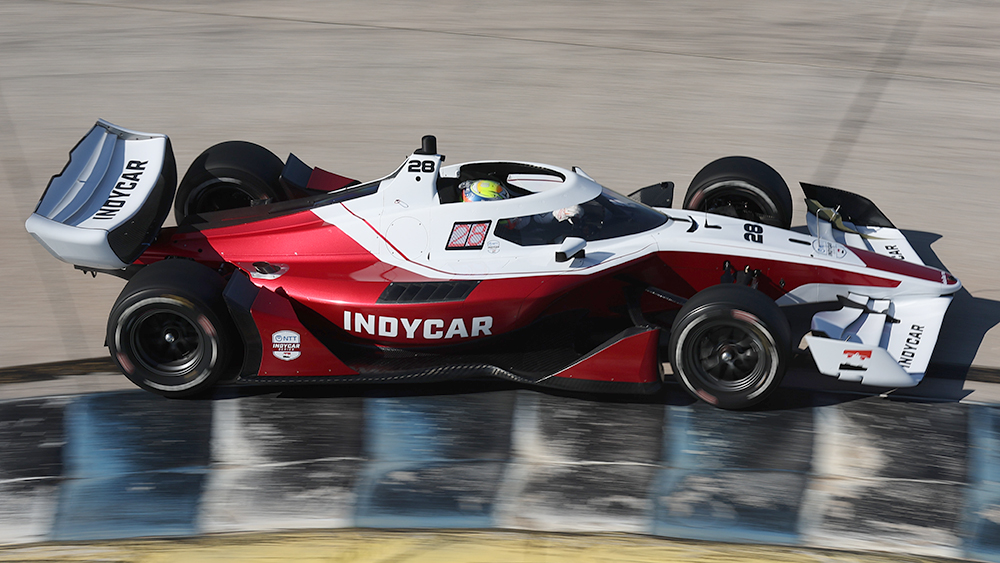
Alex Palou turned 43 laps in the IR-28 on Monday at Sebring International Raceway in Sebring, Florida, marking the first time IndyCar's next-generation chassis has tested anywhere other than Indianapolis Motor Speedway, according to INDYCAR.com.
The five-time and reigning NTT INDYCAR SERIES champion, driving for the Honda-powered Chip Ganassi Racing team, ran the Florida circuit's outer loop. Alexander Rossi, the 2016 Indianapolis 500 winner who drives for the Chevrolet-powered ECR team, is scheduled to take over testing duties there on Tuesday, INDYCAR.com reported.
The Sebring session follows the car's first on-track running in August and September at IMS, where the IR-28 was put through its paces on both the road course and the oval. Those two circuits share a notable trait: asphalt smooth enough that INDYCAR.com compared it to a billiard table.
Why it matters
Sebring is a different kind of examination altogether. The track's rough surface and its blend of asphalt and concrete make it a favored proving ground for IndyCar teams, because those conditions come closer to the temporary street circuits that accounted for roughly a third of the series schedule in 2026.
INDYCAR.com described Sebring as a punishing, unforgiving venue that tests the durability and strength of a car's components perhaps more thoroughly than any other site the series uses. That is precisely why the IR-28 was sent there.
"We're trying to test it as tough as we can," Palou said, according to INDYCAR.com. "It's a bumpy course. Before we produce all the new cars, we want to make sure it passes this stress test and that it's good to go for racing."
He added that the goal is to accumulate mileage and identify failures while there is still time to correct them: "We're trying to get miles and miles, see what breaks so we can fix it."
The IR-28 is set to be introduced at the start of the 2028 season. Palou and Rossi remain the only series drivers who have tested it.
Cooling changes draw praise from Palou
The Sebring running also gave Palou a chance to see whether feedback he provided at Indianapolis had been acted on. He said it had, particularly on driver cooling and braking.
"Yeah, it's been so much better, the cooling, since we started a couple months ago," Palou said, per INDYCAR.com. "Huge step, and that's something we've been asking for a long time on our current car."
The current car received the aeroscreen in 2020, with cooling ducts fitted into its existing carbon fiber body as an addition. The IR-28 instead has a greater number of ducts placed more deliberately from the outset of its design, according to INDYCAR.com.
Palou pointed to one duct in particular, positioned directly in front of the driver, which he said redirects air upward and improves flow through the cockpit. "We have a very big one right in front of us that makes the air go from down to up and makes the airflow so much better," he said. "It's been huge."
First pass of a current car
Monday's session produced a milestone for the program. Palou overtook a current-spec car driven by Kyle Kirkwood of Andretti Global, who was at Sebring conducting Firestone Firehawk tire testing alongside Scott McLaughlin of Team Penske. According to INDYCAR.com, it was the first time the IR-28 has passed another car on track.
"It wasn't planned," Palou said. "We went out, and I saw Kirkwood was doing the tire test. We spoke during lunch that at some point this afternoon we would go together. We wanted to see how this car does in traffic. It was cool. We were playing a little bit."
The encounter had practical value beyond the novelty. Evaluating how a new car behaves in another car's wake is a standard part of development, and Sebring offered a convenient opportunity to gather that information while a current car was running on the same day.
Sebring's familiarity to IndyCar teams adds another benefit to holding the test there: the series has accumulated substantial data on the current car at the circuit, which can be measured against what the IR-28 produces. INDYCAR.com reported that all systems on the new car remain in working order.
What Palou expects from the car
Palou's early impression of the IR-28 extends beyond its mechanical behavior. He said he likes its appearance and believes it will improve the quality of racing, citing the prospect of cars following one another more closely on road courses, street circuits and ovals.
"I'm very excited," he said. "I like the looks of it. It seems safer. It looks like it's going to be much better racing because we're going to be able to follow much closer on road, street and ovals."
He also said he would prefer to be racing it sooner rather than later, while acknowledging the value of the remaining development window. "I'm just excited to go racing. I wish it was already '27," Palou said. "Having said that, it gives us so much time to work on the car, to make sure it's good. If there's something that doesn't really work on ovals or whatever, we can go test it before we actually race it."
That window is the point of the exercise. With the IR-28 not due to compete until 2028, Dallara and INDYCAR officials are working through a lengthy checklist of basic system and performance evaluations alongside the drivers, a process that began at Indianapolis and now continues in Florida. The Sebring test is the first opportunity to run the car on a surface that behaves like the street courses it will eventually face.
Rossi's turn in the car on Tuesday will give the program a second driver's perspective at the same track, on the same surface, under the same conditions — a comparison that was not available during the IMS tests, where the two drivers ran on smooth asphalt.
For now, the program remains in its data-gathering phase, with durability the immediate question and driver comfort an area where Palou has already seen movement. The next scheduled step is Rossi's session Tuesday at Sebring.


