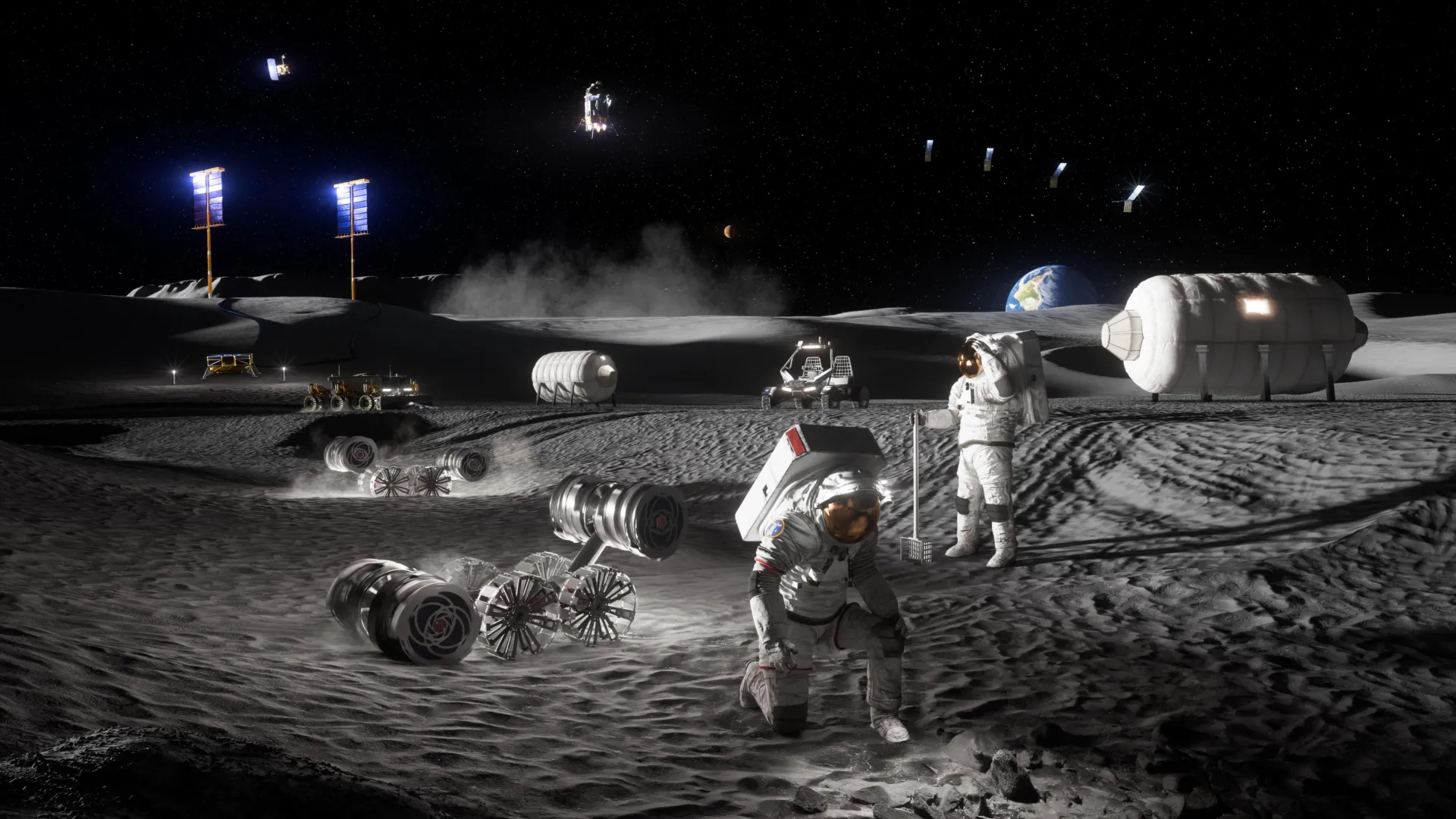
NASA has chosen three scientific investigations that will examine whether underground caves, buried water ice and environmental hazards could support a permanent human presence on the Moon. The payloads were picked through the agency's Payloads and Research Investigations on the Surface of the Moon (PRISM) program and will reach the lunar surface via NASA's Commercial Lunar Payload Services (CLPS) initiative, according to ScienceDaily. The selections form part of the agency's broader Moon Base Program.
Each investigation targets a separate obstacle to living on the Moon. One will study natural shelters, another will hunt for usable resources, and a third will track conditions that future habitats and equipment must survive. NASA says the combined results will feed into its Artemis and Moon Base efforts.
"NASA Science is building the ultimate interplanetary survival guide to ensure that science goes first to the lunar surface to provide our future astronaut crews with the vital information, resources, and safety precautions needed ahead of time to survive the night on the Moon," said Nicky Fox, associate administrator of NASA's Science Mission Directorate at the agency's Washington headquarters. She added that the PRISM selections would help the agency reduce risks to astronauts while advancing its goal of setting up humanity's first lunar outpost as preparation for sending astronauts to Mars.
Why it matters
The Moon offers no atmosphere to speak of and no protection from the hazards that constantly strike its surface. Any long-term base will have to contend with temperature swings, radiation and a steady rain of small debris. ScienceDaily reports that the three investigations are intended to answer open questions about shelter, resources and danger before crews arrive.
The findings could shape where NASA places habitats and how those habitats are built. They could also determine whether astronauts can rely on materials already present on the Moon rather than hauling everything from Earth.
A monitoring station at the south pole
The first investigation, the Lunar Environment Monitoring Station -- South Pole (LEMS-SP), will set up an autonomous station to observe environmental conditions and possible threats over a long period.
Part of its job is spotting micrometeoroids, the tiny fragments of space debris that hit the lunar surface. Earth's atmosphere destroys most incoming objects before they land, but the Moon has no comparable shield, which makes these strikes a worry for equipment and structures. The station will also gauge how abundant volatiles are in the Moon's thin outer layer of gases. Volatiles are substances that turn into gas easily, and following them could help researchers understand how the lunar environment shifts over time.
LEMS-SP will carry a short-period seismometer as well. The instrument is built to pick up vibrations and seismic activity, including moonquakes. Such readings could expose hazards that NASA needs to account for when designing buildings and placing delicate instruments on the surface.
By gathering data on impacts, seismic events and surrounding conditions, the station could give engineers what they need to build safer, sturdier infrastructure for a permanent base. Dr. Mehdi Benna of the University of Maryland, Baltimore County will lead the investigation.
Probing a pit that may open into a lava tube
The second investigation, Geophysical Instruments for Marius Lunar pit Investigation (GIMLI), will look at the Marius Hills Pit, a hole in the lunar surface that may lead into a large underground lava tube.
Lava tubes take shape when the surface of flowing lava cools and hardens while molten rock keeps moving underneath. After the lava drains out, a hollow tunnel can remain. Scientists suspect that formations of this kind lie beneath parts of the Moon's volcanic terrain.
GIMLI will use geophysical measurements to probe what sits below the pit and to establish whether it links to a wider passage. The work should also shed light on the volcanic activity that carved the lunar landscape.
If large underground spaces are confirmed, they could give future explorers a significant edge. The lunar surface faces severe temperature shifts, ionizing radiation and a constant stream of small impacts. Lava tubes could offer steadier temperatures and act as natural shielding against those threats. Rather than depending entirely on protective structures erected on the surface, astronauts might be able to use existing geological formations as shelter. Confirming whether such spaces exist, and how big they are, could therefore influence where NASA sites future habitats and how it designs them. Dr. Nathaniel Putzig of the Planetary Science Institute will serve as principal investigator for GIMLI.
Measuring ice in the Moon's coldest pockets
The third investigation, the Depth Imager with Spectral and Color Optics (DISCO), will target water ice, a resource that could prove central to sustaining people on the Moon.
DISCO is designed to make the first direct measurements taken from the lunar surface of ice held inside small, extremely cold areas called micro-cold traps. These spots stay cold enough for ice to survive because they get little or no direct sunlight. Pinpointing where the ice is, how much of it there is and how it is spread out could tell scientists whether it can be put to practical use on future missions.
Shipping water from Earth into space is costly. If ice can be reached on the Moon, astronauts might eventually source water locally and possibly convert it into oxygen and hydrogen for other purposes.
Landing itself presents a complication. Rocket exhaust can throw dust and loose material away from the ground, which may put nearby equipment and structures at risk. Researchers will also assess how stable the terrain is, to better judge how safely astronauts, robotic vehicles and other gear can travel across it.
What to watch
The three investigations now move forward under the PRISM program, with delivery to the lunar surface planned through CLPS as NASA continues work on its Moon Base and Artemis objectives.



