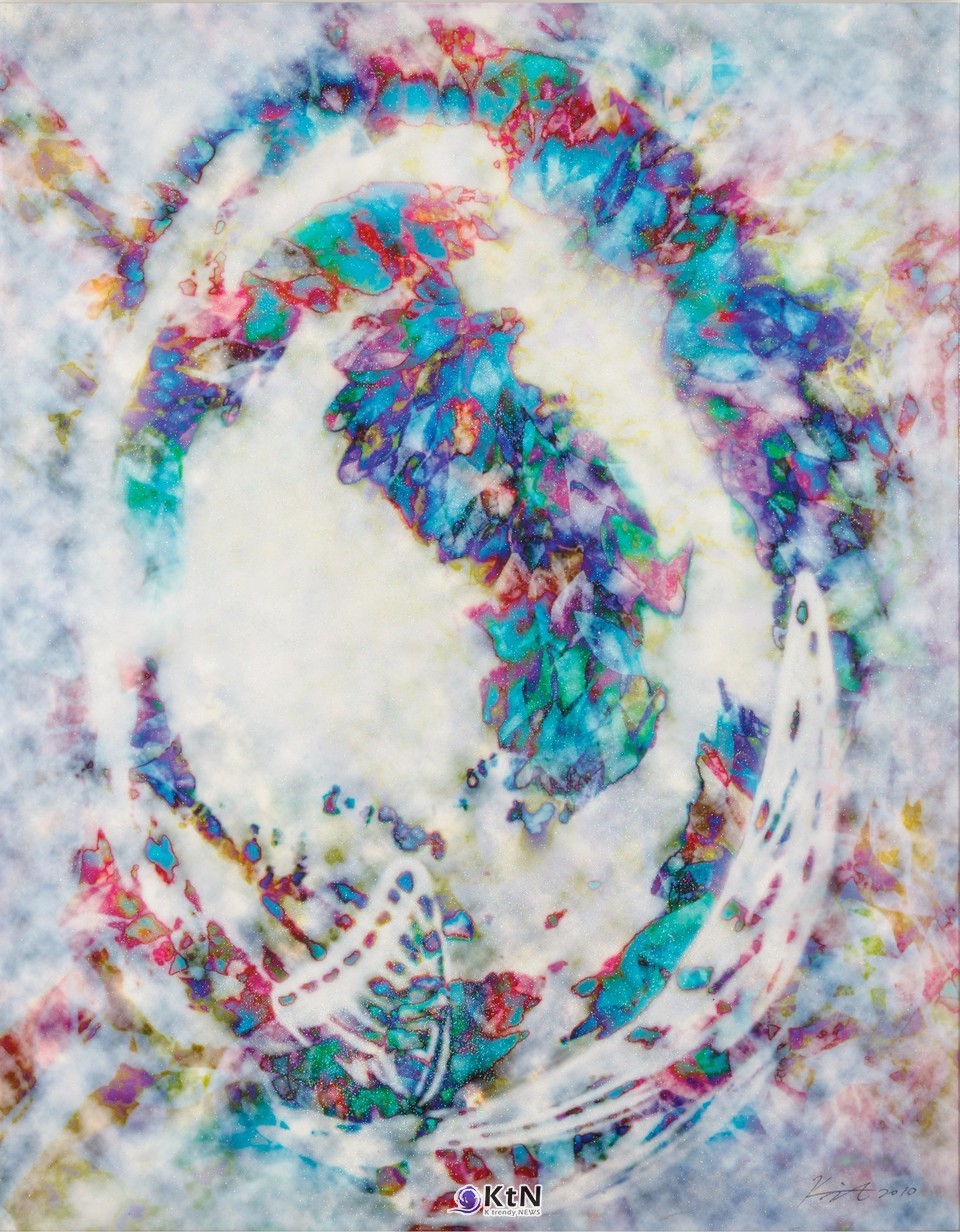
Artist Kim Hyun-jung, who works under the name Navikim, made "Infinity 1" in 2012, and the painting is built around a single large vertical oval. According to 케이트렌디뉴스, the inside of that oval opens into a broad, near-white field, while color and butterfly forms pull back toward the edges instead of filling the middle.
The shift is the point. In earlier work by the artist, color layered and crowded together. In "Infinity 1," that color steps aside, and emptiness itself occupies the center of the composition, 케이트렌디뉴스 reports.
Why it matters
The change marks a turn in how the artist thought about light, and it points toward work she would develop for more than a decade afterward.
케이트렌디뉴스 describes the white area in "Infinity 1" as closer to a concentration of light than to a plain background color. In earlier pieces, brightness emerged where many colors overlapped. Here, a wide white field holds the center on its own, and because the density of color drops, the presence of light grows.
That is a different idea of what light is. It moves from physical brightness toward an inner state, according to the outlet's reading of the work. Even without an actual light source, the emptied center of the oval stays the brightest part of the painting.
The outlet also links the piece to the artist's later "Vital Claritas" series. In her early work, the central question was how clearly and transparently light could be rendered. In "Infinity 1," brightness no longer comes only from the intensity of color. The space she took away, and the white left behind, do part of that work.
A quieter oval than the one before it
Set "Infinity 1" beside "Zero 2" from 2010, and the distance between them is easy to see, 케이트렌디뉴스 reports.
Inside the vertical oval of "Zero 2," purple, teal, white and pink mixed in a swirl, with butterfly and nature forms moving densely within. That oval read as an egg holding life, a world where many beings churned together, and thin light spread outward from it in all directions.
In "Infinity 1," the same family of vertical oval becomes much lighter. The color and forms that once filled the interior move to the perimeter, leaving a bright gap in the middle. If the "Zero" oval was an egg carrying countless possibilities before birth, the "Infinity 1" oval reads as a form that has cleared its space so those possibilities can move into a new state, according to the outlet.
The meaning of the egg changes along with it. An egg is not only a sealed mass packed full of something. It can also be a space where life stirs before it has taken shape. The empty oval in "Infinity 1" sits closer to the moment just before a beginning than to a place where something has ended, 케이트렌디뉴스 writes. Where specific forms have thinned out, the possibility of a next form that has not yet been made comes in.
The artist brought a related idea into her studio practice around this time: that emptying is the premise of re-creation. The vertical oval in "Infinity 1" is the most direct shape she gave that thinking, per the outlet. The wide, cleared interior carries the notion that a new world can begin once an old order is set down. The outlet also notes the influence of the Zhuangzi concept of xu, or emptiness, and the possibility of the blank space.
Where the butterflies went
The butterflies left at the edges of the work follow the same movement, according to 케이트렌디뉴스.
In the artist's early paintings, butterflies appeared as concrete living things, resting on flowers or spreading their wings wide. In "Flying Light," they blended into light and transparent layers of color. In "Zero," they became one of several beings composing the world inside the oval. By "Infinity 1," they no longer claim the center. They sit at the edge of the cleared space and suggest a new movement to come.
The outlet stresses that the butterfly's meaning has not disappeared; its position has changed. Earlier, the butterfly's form carried the story of light. Here, the place the butterfly has stepped away from becomes part of the work's meaning too. The idea that what is needed for something to take flight is not more color and form but room to move connects to the empty space inside the oval.
Compare "Infinity 1" with "Infinity 7," made the same year, and the title itself splits in two directions, 케이트렌디뉴스 reports. In "Infinity 7," five butterflies fly toward distant mountains, and LEDs installed inside the work blink, creating time and motion. Speed, direction and an actual changing light source drive that piece.
"Infinity 1" moves far more quietly. No real light blinks, and no butterfly travels quickly in one direction. Instead, the bright interior of the oval opens wide, making a space where the eye can rest or drift out. Within the same "Infinity" series, one work works through infinity as the motion of a real light source, and the other through the potential of empty space, according to the outlet.
Infinity here is not a state of endlessly adding. It opens rather through subtraction. The part where color has gone is not a lack but a place for the next change to enter, and the empty oval holds the tension of something about to be generated rather than a static blank, 케이트렌디뉴스 writes.
The outlet also points to how the piece led into the artist's "Propose" series. The relationship between emptying and re-creation that begins in "Infinity 1" took concrete form more than a decade later in work about relations between beings, about recovery and love. If the cleared space was first a place to receive a new form, later an open space begins to hold a relationship in which beings turn toward one another.
That makes "Infinity 1" one of the quietest works Kim made in 2012 and one of the longest-running, per 케이트렌디뉴스. No strong LED and no fast flight stands in front of the viewer. Instead, the artist clears the middle, pushes color and butterflies to the edges, and changes the breathing of the whole painting.
In "Zero," the oval was an egg holding life. In "Infinity 1," the inside of that egg opens brightly. Moving from a filled world to an emptied one, the oval shifts from a protective shell into a space preparing for a new start, according to the outlet.
Emptiness in "Infinity 1" is not the leftover gap after something ends. White light enters where color and form have stepped back, and a next world not yet made stays there. For Kim, 케이트렌디뉴스 concludes, infinity comes closer to the possibility of starting again from a cleared place than to a state of endless filling.
Watch for how the outlet's ongoing series on Kim's light works traces the line from these 2012 paintings to the "Propose" series and the "Vital Claritas" idea that followed.


