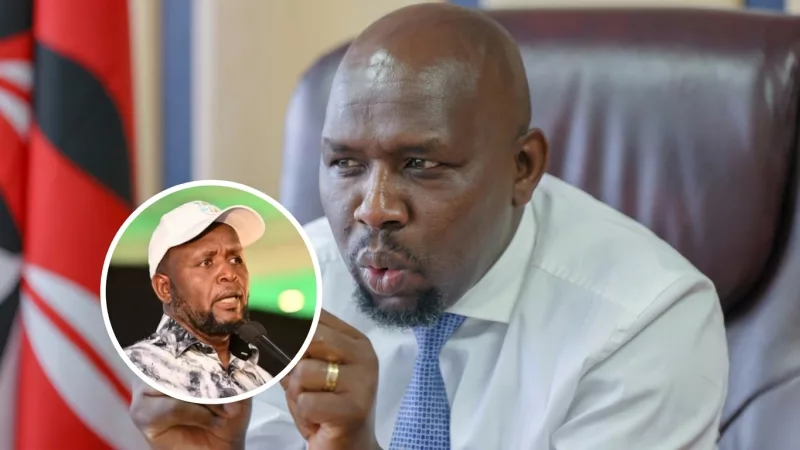
Kenya's Interior Cabinet Secretary Kipchumba Murkomen has publicly defended the removal of security officers assigned to Trans Nzoia Governor George Natembeya, accusing the county chief of keeping company with people he called goons and of plotting unrest. Murkomen made the remarks on 15 October 2026 in Elgeyo-Marakwet County, during a tour of the region by President William Ruto, according to The Star, Kenya.
The statement came after Natembeya protested the withdrawal of his security detail, which he said had happened for a second time, and asked Inspector-General of the National Police Service Douglas Kanja for a formal explanation.
Why it matters
The dispute places a sitting governor and the national government on opposite sides of a question that touches both politics and constitutional law: how, and on what grounds, the state may reduce protection for an elected official.
Natembeya has framed the matter as a test of whether administrative decisions affecting his personal safety followed the law. He pointed to Article 47 of the Constitution, which guarantees lawful, reasonable and procedurally fair administrative action and requires written reasons when such action harms a right or fundamental freedom, The Star, Kenya reports.
He also cited Article 238, which states that national security must be pursued in accordance with the law and with respect for the rule of law, democracy, human rights and fundamental freedoms, and Article 244, which requires the National Police Service to uphold professionalism and discipline while respecting human rights and human dignity.
Murkomen's response shifts the argument from procedure to conduct. He told the gathering in Elgeyo-Marakwet that his ministry would not permit politicians to turn government-provided security into a tool for organising violence, and he said those running the security sector would not be swayed by pressure.
The exchange is unfolding against a backdrop of heightened political activity in the Rift Valley, where President Ruto has been holding a series of public rallies. Coverage of the withdrawal by Kenyan outlets, including Kenyans.co.ke and Tuko News, has linked the timing to a recent public clash between Natembeya and the President, though Murkomen's stated justification rests on the governor's alleged associations rather than on that confrontation.
What Murkomen said
Speaking during the presidential tour, Murkomen said the era of what he termed political goonism must come to an end. He argued that some politicians benefit from state protection while simultaneously making plans for disorder.
He singled out the governor of neighbouring Trans Nzoia, saying Natembeya spends time with goons and prepares chaos, and that it was unacceptable for him to hold police officers while also planning violence. The Cabinet Secretary said no politician would be allowed to use government offices and government security for such purposes.
Murkomen added that officials responsible for national security would remain resolute in confronting political violence and would not be intimidated in carrying out that role.
What Natembeya is asking for
The governor has not framed his complaint around the accusations. His statement focuses on process. He said the removal of his guards was the second such occurrence and questioned whether the authorities had observed the constitutional and legal steps that govern changes to the security arrangements of public officials.
Natembeya argued that any decision affecting his personal security must comply with the Constitution and the rule of law, and he invoked the right to fair administrative action, including the requirement that reasons be given in writing when a decision adversely affects a right or fundamental freedom.
He directed his demand to the Inspector-General, seeking an explanation from police leadership and asking whether due process had been followed. The Star, Kenya reported that the governor raised concerns over the withdrawal and called for a formal account of the decision.
A pattern of friction
This is not the first time the governor's protection has been pulled. Natembeya said the current episode repeats an earlier withdrawal, which is central to his argument that the move may be punitive rather than administrative.
The political context adds weight to that reading. The withdrawal followed a public disagreement between Natembeya and President Ruto, an encounter that Kenyan media outlets highlighted when reporting the story. Murkomen's defence, delivered on the sidelines of the President's regional tour, keeps the matter inside a national political frame rather than treating it as a routine police staffing decision.
For the national government, the case raises the question of how it distinguishes between an official's entitlement to protection and an official's alleged conduct. For the governor, it raises the question of whether the state must document its reasons when it decides an elected leader no longer needs guards.
Both questions now sit with the police leadership, which has yet to respond publicly to Natembeya's request. The Inspector-General's office has not issued the written explanation the governor is seeking, and Murkomen has given no indication that the decision will be reversed.
What to watch: whether Inspector-General Kanja provides the written justification Natembeya has demanded, and whether the governor escalates the matter to court on the strength of the constitutional provisions he has cited.