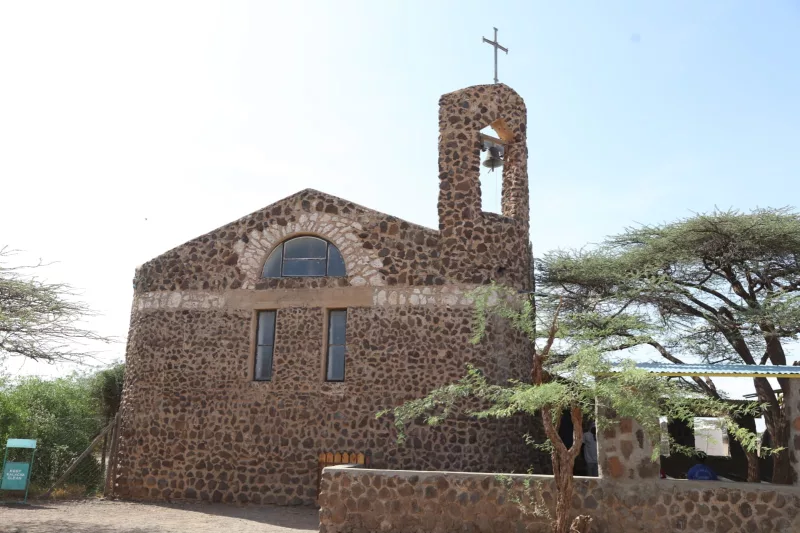
A Catholic church on the edge of the Chalbi Desert in Marsabit County has become both a place of worship and a cultural attraction, drawing local and foreign visitors to see its biblical murals and unusual design, The Star, Kenya reports.
The Kalacha Catholic Church sits between Maikona and North Horr, in a landscape of dry plains and volcanic formations. Parts of the building are set into the ground around volcanic rock, and its interior, roughly pentagonal in shape, is arranged around the altar and pulpit.
According to catechist Martin Molu, the site's history begins in 1972, when Catholic missionaries set up their first station in Kalacha. The Star, Kenya reports that the initial structure was a simple iron-sheet building erected by an Italian missionary known locally as Father James, serving a community of about ten believers at the time.
Why it matters
The church offers a different view of a region whose tourism is usually associated with dramatic scenery and indigenous cultures. Its story shows how Christianity took root in a remote part of northern Kenya and how a single building can serve religious, cultural and historical purposes at once.
For travellers on the northern tourism circuit, which takes in the desert, Lake Turkana and local communities, the church is a potential stop that adds religious art and architecture to the itinerary.
From iron sheets to rock and murals
As the congregation expanded, the original building proved too small. A more permanent church was constructed and opened in 1982, according to The Star, Kenya.
The earlier iron-sheet structure did not fall idle. It was later turned into a dispensary and then used as a nursery school, an example of how buildings in remote settlements can be repurposed as community needs change.
What sets the present church apart is its interior artwork. Large sections of the walls carry paintings illustrating key moments in biblical history, with particular focus on the life and ministry of Jesus. The scenes include his baptism, his temptation, the calling of his first disciples and the Last Supper. Other paintings depict stories from the Old Testament.
Local accounts attribute the murals to an Ethiopian artist, The Star, Kenya reports. Beyond their artistic value, the paintings reflect how religious art helped convey Christian teachings in communities where images could make biblical stories easier to understand.
Molu told The Star, Kenya that the church serves worshippers and tourists alike. Visitors stop to pray, learn about the building's history or take photographs, he said.
Growth prompts a new building
The congregation has kept growing, and Molu says that has created a need for more space. Plans shared with The Star, Kenya indicated that a new church structure was expected to be commissioned in December.
For the local Catholic community, the expansion reflects the church's continuing role as a centre of worship and fellowship. For visitors, the older building and its murals remain a record of the community's religious past.
Preserving the paintings will be central to keeping that record intact. The Star, Kenya notes that the murals have remained a defining feature of the church for decades, and that their survival for future generations will depend on conservation efforts.
What to watch: whether the planned new church is commissioned as scheduled, and how the future of the original building and its artwork is handled as the congregation moves into larger premises.


