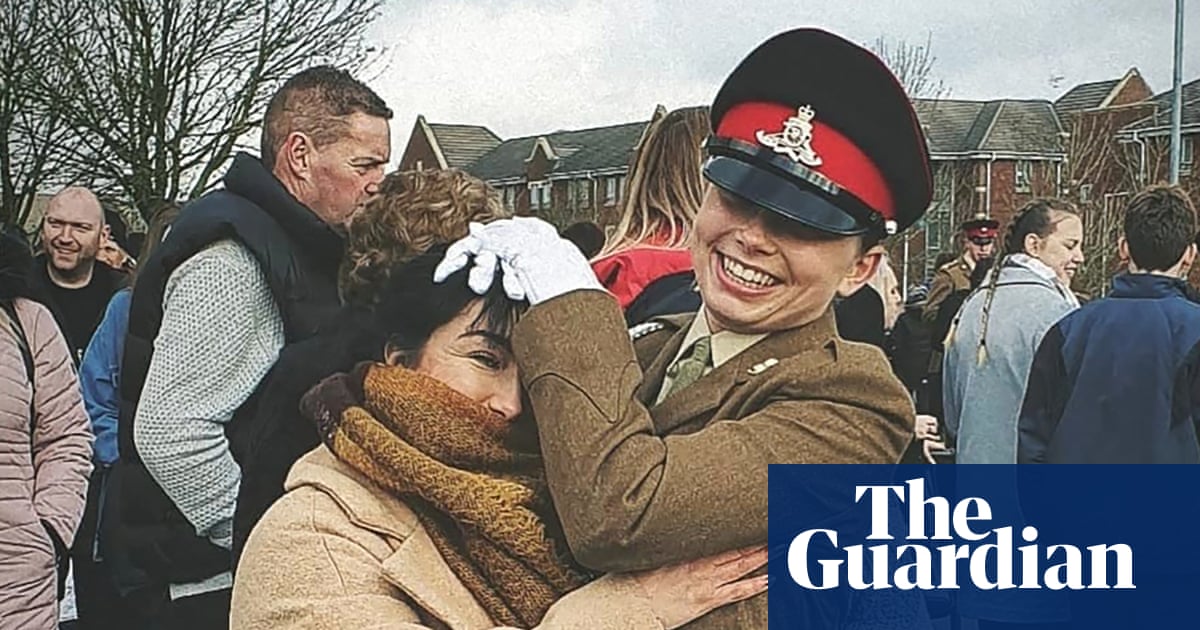
A new Stacey Dooley documentary examines the death of Gunner Jaysley Beck and the five-year campaign her mother has waged since to uncover what happened to her. The Guardian reports that Beck, 19, a Royal Artillery soldier, took her own life in her bedroom at her Wiltshire barracks on 15 December 2021, after being sexually assaulted by a sergeant major and then subjected to an intense campaign of messages from her line manager. The film, Death in the Barracks, follows her mother Leighann McCready's continued search for answers.
According to The Guardian, Beck had joined the army at 16. In July 2021, during a training exercise, she was sexually assaulted by Michael Webber, then 39, a married battery sergeant major. She got away and spent that night hiding in her car. When she reported the assault, the paper reports, senior officers warned her against being "a female troublemaker" and urged her to consider Webber's career and his family. After she reported it a second time, Webber was instructed to write her a letter of apology, and he was promoted soon afterwards.
Three months later, The Guardian reports, her line manager, bombardier Ryan Mason, then 32, began taking an obsessive interest in her. He sent her more than 4,600 messages over two months, which Beck shared with her family on a WhatsApp group. Because of how her earlier complaint had been handled, the paper says, she had no confidence in the complaints process and nowhere else to turn.
Why it matters
The case has drawn attention to how the British army treats, safeguards and protects young female recruits. The Guardian reports that Beck's death prompted scrutiny of the military's handling of sexual assault allegations and of the support available to personnel who report them. For McCready, the documentary is the latest stage in a public campaign that has already run through a service inquiry, an inquest and a subsequent police investigation, all of which she has followed while speaking to the press and advocating for her daughter.
The Guardian describes McCready as having worked for 30 years in the care sector, much of it as an end-of-life nurse. She told the paper that grief did not arrive the way it is portrayed on television. From the moment she learned of her daughter's death, she said, she felt as though she had put on a uniform — protecting and guiding her family. She calls it her "invisible uniform" and says she has never taken it off. However often she gives interviews or sees her daughter's photograph in the news, she said, it does not feel real.
A family's Christmas plans, and a mother's foreboding
The Guardian's account begins on the morning of 15 December 2021, when McCready called her daughter at about eight o'clock and got no answer. Beck nearly always picked up, the paper reports, but she had been at a party at the barracks the night before, so her mother assumed she was sleeping. The family, which owns a village pub in Cumbria, was preparing for Christmas. McCready had already bought matching pyjamas for Beck and her older sister Emilli.
Two days earlier, Beck had been Christmas shopping, calling her mother throughout the day while McCready transferred money to cover the purchases. She bought a Gucci bag, a belt and a purse for herself and her sister, and James Blunt concert tickets for herself and her father, Anthony Beck, to use the following February. At the end of the trip she messaged her mother to say how lucky the two of them were and that she loved her.
As the hours passed without word, The Guardian reports, McCready's unease grew, because she knew her daughter had been enduring weeks of escalating harassment from her line manager. Emilli called a friend at the barracks, who said Beck was probably asleep and offered to wake her. McCready kept ringing her daughter's phone until a different voice answered and asked who was speaking. She said she knew immediately, before anyone told her.
The paper also describes Beck's path into the army. As a child she was lively and fond of helping her father with DIY jobs, her mother said. At 15 she came home from a school careers day set on enlisting, a plan her mother first took for a phase. Beck trained by running around the village with backpacks loaded with bricks, and the family attended her passing-in parade at Army Foundation College Harrogate.
What the documentary adds
Death in the Barracks is presented by Stacey Dooley and was scheduled to air on BBC One Northern Ireland, with coverage of its broadcast details carried by the Salisbury Journal, TVGuide.co.uk and other outlets. The Guardian reports that the film follows the family's continuing search for justice and features McCready, who says she still finds it hard to accept that any of it is happening.
McCready told the paper that in the days after her daughter's death, as military personnel filled the family home, she resolved to make public everything she knew. She was determined, she said, that Beck would not become another statistic or another "sudden passing". The Guardian reports that she has found some answers over the past five years but believes much remains uncovered.
The paper also records how far the case sat outside the family's experience. McCready recalled that when her daughter described resisting Webber, she had addressed him as "sir", and that her mother's first reaction was to ask why she had done so. Some of what her daughter was navigating, she said, was beyond her.
For CYBEV readers, the documentary places a bereaved parent's account of institutional failure alongside the public record already built through the inquiry, the inquest and the police investigation. The Guardian's reporting makes clear that McCready's central question — whether the army could have protected her daughter — remains the one she is still pressing.
Watch for the documentary's broadcast and for any response it draws from the Ministry of Defence or from the army on the handling of Beck's complaints.