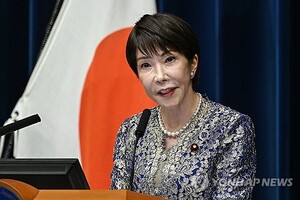
Japanese Prime Minister Sanae Takaichi declined a Chinese request to incorporate conciliatory language toward Beijing into her policy speech at an extraordinary Diet session, according to a report by Japan's Mainichi Shimbun cited by 천지일보. The rejection leaves the two countries' dispute over Taiwan unresolved and makes a near-term recovery in China-Japan relations unlikely, the report said.
According to 천지일보, Beijing conveyed its request to Tokyo before Takaichi delivered her policy address, asking that her China policy be returned to the approach taken by former Prime Minister Shinzo Abe.
Why it matters
The episode shows how little room either government currently has to step back from the standoff that began in November last year, when Takaichi suggested in the Diet that Japan could be drawn into a Taiwan contingency. Beijing reacted sharply and demanded she retract the remark; she has kept her position, and the impasse has now run for roughly a year.
The Mainichi report, as summarized by 천지일보, indicates that a possible opening existed and was closed. Japanese officials appear to have read the Chinese request as a signal of willingness to improve ties, but the prime minister chose not to act on it.
What Beijing asked for, and why Abe was the reference point
China's request pointed to a specific precedent. Abe's relations with Beijing deteriorated after Japan moved to nationalize the Senkaku Islands — known in China as the Diaoyu Islands — in 2012, and worsened further the following year when he visited Yasukuni Shrine.
In a September 2014 Diet speech, Abe did not raise the sensitive disputes between the two countries directly. Instead, according to 천지일보's account, he stressed building a stable and friendly relationship and proposed an early summit with Chinese President Xi Jinping. A China-Japan leaders' meeting followed that November in Beijing.
Beijing's request to Takaichi was read as an attempt to reproduce that sequence and ease a conflict that has now persisted for an extended period.
A speech drafted one way, delivered another
According to Mainichi, the Prime Minister's Office treated the Chinese proposal as a gesture worth answering. Officials considered including economic cooperation language in the speech that would signal continuity with Abe's policy line.
That drafting was reportedly revised after Takaichi declined to accept the request. In the end, 천지일보 reports, the speech stated only a general willingness to improve relations. It also raised China's export restrictions on critical minerals and human rights issues, and called on Beijing to act responsibly.
The gap between what Tokyo considered and what was delivered did not go unnoticed in Beijing. A Chinese government official later complained to a Japanese counterpart that Takaichi appeared to have no intention of improving relations with China, according to the report.
Where the relationship stands
Mainichi's analysis, as relayed by 천지일보, suggests China still has reasons to want better ties with Japan, including the economic cooperation it needs. But the report concludes that unless the Taiwan issue — which Beijing treats as a core interest — is addressed, the Chinese government is unlikely to take the first active step toward reconciliation.
For now, both sides appear to be holding their positions: Tokyo has not withdrawn the Taiwan remark, and Beijing has not dropped its demand that it be retracted.
What to watch is whether either government offers a face-saving formula on the Taiwan language, or whether the standoff simply becomes the accepted baseline for the relationship.