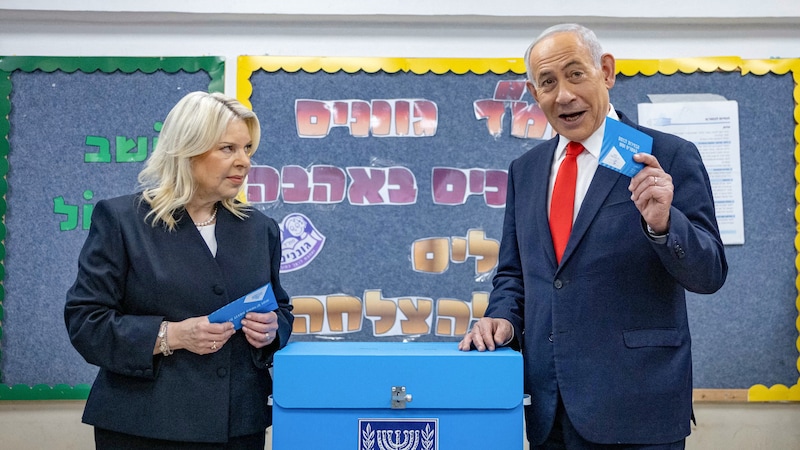
Israelis voted on Tuesday in an election that the first exit polls describe as extremely close, with Prime Minister Benjamin Netanyahu's Likud emerging as the largest single party but his opponents' bloc holding a narrow lead. The projections, broadcast by Israeli television channels as polling stations closed, were reported by VG.
According to the first figures from Channel 12, Likud wins 24 seats — down from 32 at the election four years ago. Even so, challenger Gadi Eisenkot's bloc is projected at 52 seats against 50 for Netanyahu's bloc, VG reports.
The remaining 18 seats belong to the Arab parties, which did not commit to either side before the vote. That leaves them potentially able to decide which bloc can assemble a majority in the 120-seat Knesset.
Why it matters
The outcome determines who can command a majority in the Knesset, and with the two blocs separated by a handful of seats, the uncommitted Arab parties and possibly the ultra-Orthodox parties hold the balance. VG notes that neither the prime minister's governing bloc nor the opposition was projected to reach a majority before election day, and the race had long been seen as very tight.
The result also carries personal stakes for Netanyahu. The 77-year-old has served a total of 19 years as prime minister and faces charges of corruption and abuse of power; he denies wrongdoing. As long as he remains prime minister, he does not have to appear in court in the corruption cases, according to VG. Historian and Middle East researcher Hilde Henriksen Waage told the outlet that the day he is no longer prime minister, he must return to the dock.
Different channels, slightly different numbers
The projections come from surveys conducted by Israeli news channels as voters left polling stations, which means the answers vary between broadcasters. Channels 11 and 13 reported that Eisenkot's bloc took one seat from the Arab parties, giving it 53, according to VG.
VG cautions that a definitive result is unlikely to be clear on Tuesday night, since the projections would have to prove exactly right for the election to be settled.
Turnout was unusually high. Shortly before the first projections, Channel 12 reported that 74.3 percent had voted by 19:00 Norwegian time — the highest participation since 1988, per VG. A total of 7.3 million Israelis are eligible to vote, nearly 800,000 of them living abroad, and many flew home to cast ballots.
A referendum on the prime minister
Waage described the vote to VG as a referendum for or against Netanyahu. Since the Hamas attack of 7 October 2023, the prime minister has faced heavy criticism, and for three years he refused to appoint an inquiry commission, the outlet reports.
According to Waage, many are asking how one of the world's most powerful militaries could fail to protect its own population and prevent the Hamas attack. She told VG that Netanyahu built his reputation on putting Israel first and on a willingness to use military force to crush Hamas and Hezbollah, but that this time he did not manage to protect his own people — something she says has haunted him for three years.
The challengers have rallied behind former defense chief Gadi Eisenkot (66), former prime minister Naftali Bennett (54), Yair Lapid (62) and Yair Golan (64). Waage told VG there is no real opposition, saying none of them wants peace with the Palestinians and none is open to a two-state solution.
Small margins, key players
The electoral threshold is 3.25 percent, so small shifts can move several seats between the blocs, VG reports. Beyond the Arab parties, the ultra-Orthodox parties could also play a key role: long close allies of Netanyahu, they have opened the door to other partners because of a dispute over military service.
Watch for the official vote count and the coalition talks that follow, as the uncommitted Arab parties decide which bloc they will back.