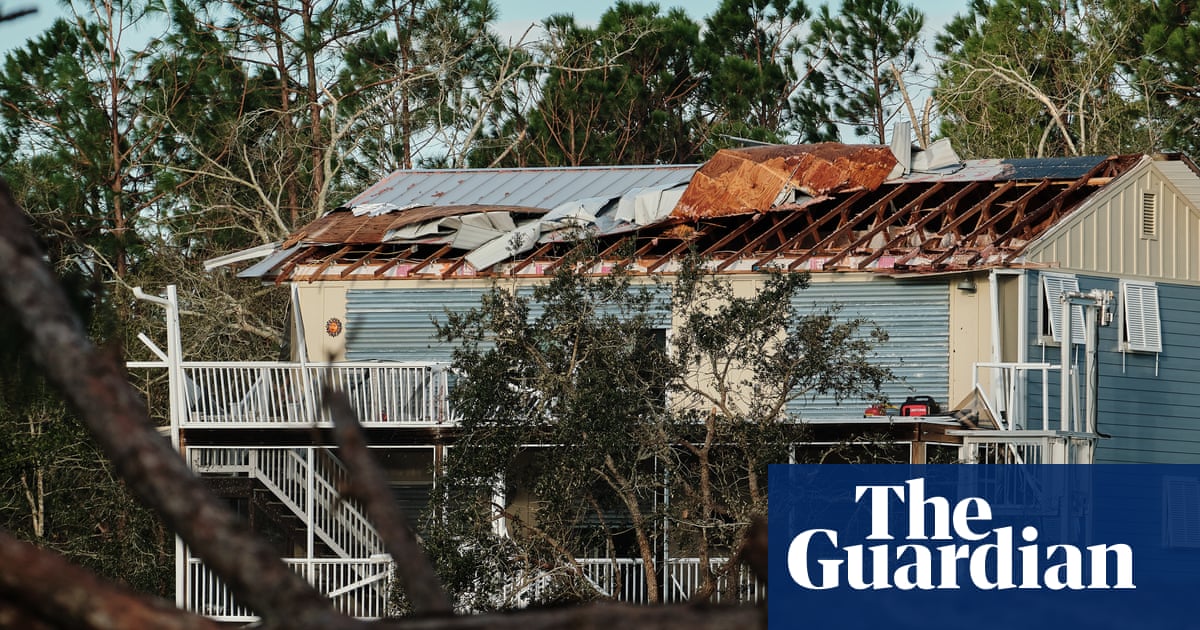
At least four people died after Hurricane Isaias came ashore on Florida's panhandle late Friday as a Category 2 storm, according to authorities cited by The Guardian. Two of the deaths were recorded in Escambia county, Florida, and two in Alabama as the system pushed inland, local officials said. By Saturday evening the storm had weakened to a post-tropical cyclone, but forecasters warned that flooding and tornado risks remained across a wide stretch of the Southeast.
The Guardian reports that falling trees caused one death in Escambia county and another in Birmingham, Alabama, in each case striking a home. A third person was found dead in a closed garage in Escambia county alongside a running generator, and four members of that person's family were taken to hospital with carbon monoxide poisoning, according to the Escambia sheriff's office.
Alabama governor Kay Ivey said the storm, which was forecast to dissipate on Sunday, "cannot clear fast enough."
Why it matters
Isaias was an unusually late arrival. It became the first Atlantic hurricane of the 2026 season only in October, and its 105mph (169km/h) maximum sustained winds stood in sharp contrast to forecasts that had pointed to a quiet year. The National Oceanic and Atmospheric Administration had projected between three and six hurricanes at the start of the season, which officially opens on 1 June, and an August update lowered that range to two to six. Before Isaias, none of the season's eight named storms had grown stronger than a tropical storm.
The storm's timing also places it in rare historical company. According to The Guardian, Isaias is one of the two latest-forming Atlantic hurricanes on record, matching a mark set on 8 October 1905. The next latest date for a season's first Atlantic hurricane was 11 September, reached in both 2002 and 2013.
The last hurricane to reach the US mainland before Isaias was Milton, which hit Florida in October 2024.
Outages, rescues and a region reopening
More than 679,000 customers across Florida, Alabama and Georgia were without electricity on Saturday afternoon, according to the tracking site PowerOutage.us, down from over 900,000 earlier in the day. The National Hurricane Center said storm surge and tropical storm warnings tied to Isaias had been discontinued, but cautioned that the system would still likely bring "considerable impacts" to much of southern Alabama, the Florida panhandle and south-western Georgia.
The center said flash, urban and river flooding was possible across the region, with a heightened chance of flash flooding and landslides in the southern Appalachians. It also warned that tornado risk would persist through Saturday afternoon in parts of the eastern Florida panhandle, Georgia and the Carolinas.
Rainfall forecasts through Sunday called for 4-8in across southern Alabama, the panhandle and Big Bend regions, and south-west Georgia, with isolated totals reaching 15in, particularly inside rain bands over the panhandle and Big Bend. Elsewhere in the South-east, 2-5in was expected, with localized amounts up to 10in possible, especially in the southern Appalachians and along the coastal Carolinas.
Jared W Perdue, secretary of Florida's state transportation department, urged residents at a news conference not to attempt to drive through water on roads. "It does not have to be that deep, and it can wash away your car, it can wash away a human, it can become very dangerous very quickly," he said.
Isaias made landfall near Destin, Florida, on Friday, battering the Gulf coast with heavy rain, strong winds and dangerous flooding. Tim Mowry, a Pensacola resident, told the Associated Press that the wind sounded like "a train whistle." He lost power on Friday afternoon but said he had a generator to fall back on, and he described his son turning back from a drive to his home about 15 minutes away because fallen trees and power lines blocked the route. Mowry said that considering everything, he was "really fortunate."
In Crestview, Florida, resident Ashley Weeks told the station WEAR that a tree from her backyard came down on her house, damaging the roof close to her daughter's bedroom and leaving the ceiling in piles of debris.
What to watch
Isaias is expected to dissipate on Sunday, but officials and forecasters say river flooding, landslides and isolated tornadoes could continue to affect the South-east until then.



