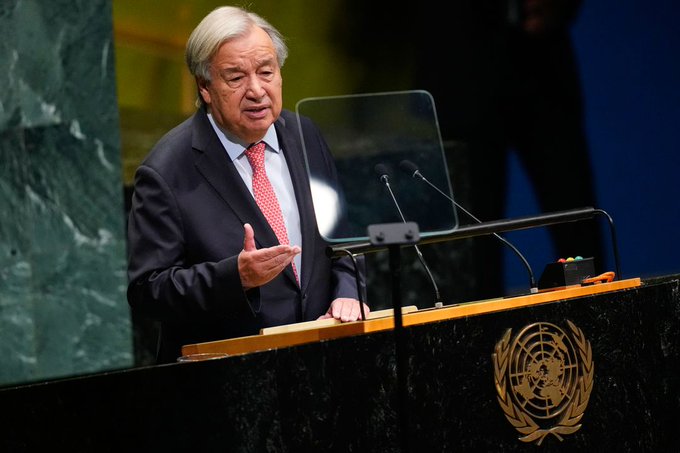
UN Secretary-General António Guterres has voiced concern over reports that Eritrean troops have crossed into Ethiopian territory, according to Ethiopia Observer. His statement followed a letter from Ethiopia to the UN Security Council accusing Eritrea of violating its territorial sovereignty.
In a letter dated Friday, Ethiopian Foreign Minister Gedion Timothewos said Eritrea had deployed infantry and mechanized units in recent weeks. He also accused Eritrea of backing insurgent groups by supplying them with support, financing, weapons and direction.
Guterres said the fighting in the Tigray, Afar and Amhara regions carries a risk of escalating in ways that would further destabilize the wider region. He reminded all states in the area of their obligation under the UN Charter to avoid threatening or using force against the territorial integrity or political independence of any state, and of the principle that states should not interfere in one another's internal affairs.
The UN chief also called on countries with influence over the parties to use that influence to encourage de-escalation, and to refrain from any action that could intensify the conflict.
Why it matters
The exchange marks a sharp deterioration in relations between Ethiopia and Eritrea, two neighbors whose recent history includes both a long border war and a period of cooperation. An accusation of this kind, made directly to the Security Council, raises the prospect of a wider confrontation in a part of the Horn of Africa that has already absorbed years of conflict.
The Tigray, Afar and Amhara regions named by Guterres were the main theaters of the war in northern Ethiopia that ended with a peace agreement in 2022. Any renewed fighting there would land on communities that have not fully recovered, and it would test the fragile arrangements that ended the previous round of hostilities.
Guterres's warning about regional destabilization reflects a broader worry: that a dispute between two states could draw in others, either through direct involvement or through the networks of armed groups that operate along the border. His appeal to outside powers to push for calm suggests the UN sees the situation as serious enough to warrant pressure from beyond the immediate neighborhood.
Ethiopia's letter to the Security Council
The Ethiopian government's case rests on the letter from Foreign Minister Gedion Timothewos, dated Friday. According to Ethiopia Observer, the letter states that Eritrea has moved infantry and mechanized units into Ethiopian territory over recent weeks. It further alleges that Eritrea has supported, financed, armed and directed insurgent groups.
Those are serious claims, and they carry legal weight. A formal complaint to the Security Council asks the international body to treat the matter as a threat to peace and security, which in turn opens the door to discussion among member states and possible action. Ethiopia has framed the issue as a violation of its sovereignty, a charge that, if accepted, would put Eritrea at odds with core principles of the UN Charter.
The reporting does not indicate how the Security Council has responded to the letter, or whether Eritrea has issued a reply. Those gaps matter, because the accuracy of the accusations and the willingness of either side to step back will shape what happens next.
A region already under strain
The areas Guterres singled out — Tigray, Afar and Amhara — have been at the center of Ethiopia's recent conflicts. The war that began in 2022 and ended with a peace deal left deep damage: displacement, loss of life and a humanitarian crisis that aid agencies have spent years trying to address.
Separately, The Reporter Ethiopia has reported that the UN warned of disruptions to aid deliveries in Tigray after humanitarian depots were looted. That development adds to the picture of a region where access to assistance is already precarious. If fighting spreads or if supply routes are cut, the consequences for civilians would compound quickly.
Guterres's reference to the Charter's ban on the threat or use of force is a reminder that the principles at stake are not abstract. They are the same principles that govern how states in the region are expected to treat one another, and they apply regardless of which government is making the complaint.
Pressure from multiple directions
The UN Secretary-General is not the only voice calling for restraint. Addis Standard reported that the UN chief and US lawmakers urged de-escalation after Ethiopia accused Eritrea of what it described as an "all-out invasion" and vowed to defend itself. The involvement of American legislators signals that the issue is drawing attention beyond the region, and that diplomatic channels are active on several fronts.
Guterres's specific appeal — that countries with leverage over the parties use it to calm the situation — is a recognition that the UN's own tools are limited. Mediation and public statements can set a tone, but the decisions that determine whether troops advance or withdraw are made by governments and commanders on the ground.
For now, the public record consists of Ethiopia's allegations, the UN chief's expressions of concern, and calls for restraint from multiple quarters. What is not yet clear is whether Eritrea has responded to the accusations, whether the reported troop movements have been independently verified, or whether either side has taken steps to reduce tensions.
What to watch
The next signals will come from the Security Council's handling of Ethiopia's letter and from whether the reported deployments lead to further fighting or to a pullback. Statements from Eritrea, and any independent confirmation of the claims, would clarify a situation that currently rests largely on one government's account.



