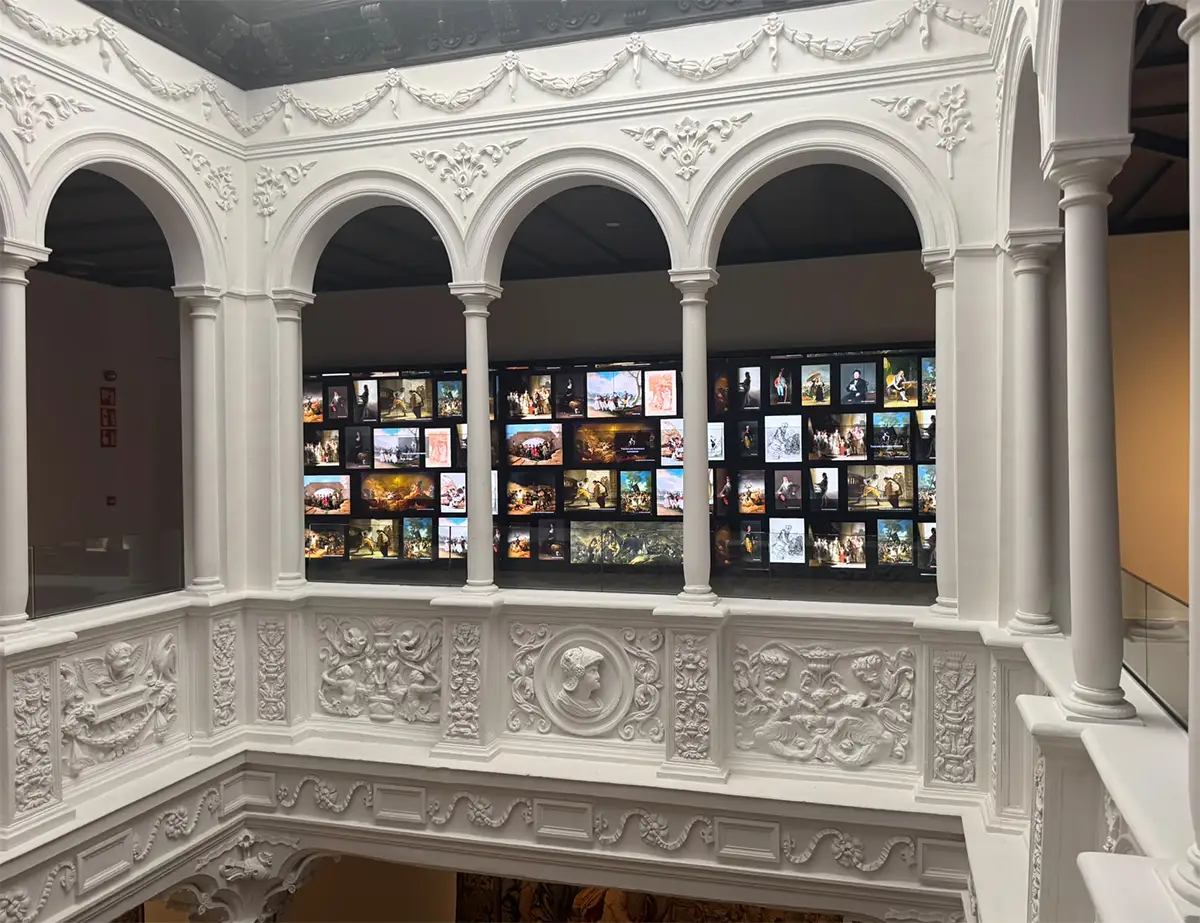
The Goya Museum in Zaragoza has reopened after a full expansion and renovation by Fundación Ibercaja, growing to 4,661 square meters and adding a new entrance on Calle Santiago near the Plaza del Pilar, according to Con peques en Zaragoza. The museum also gains a viewing terrace overlooking the Basílica del Pilar. The reopening coincides with Fundación Ibercaja's 150th anniversary and launches alongside a temporary exhibition, "Solo Goya. El arte de ver," which Con peques en Zaragoza reports will run from October 9, 2026, to January 10, 2027.
The renovation places immersive experiences, virtual reality and interactive tools along the visitor route. According to Con peques en Zaragoza, the technology is not meant to replace the original works but to serve them — revealing details invisible to the naked eye, showing how Goya worked and offering new angles on his vision.
Why it matters
The project reorganizes how one of Spain's key Goya collections is presented, pairing the artist's original prints and paintings with digital layers aimed at families, school groups and younger visitors. Con peques en Zaragoza notes that the museum now includes a dedicated space for educational activities aimed at school audiences, and that the interior levels are linked by new accessible routes with ramps — a change the outlet says will be welcomed by visitors with strollers.
The reopening also reshapes the museum's presence in the city. Its new stone facade, made of pieces three meters tall, uses selected fragments to evoke some of Goya's best-known prints, and a large screen on the side of the building will project images, content and activities, Con peques en Zaragoza reports. The outlet describes the facade itself as a good start to a visit, suggesting families pause to pick out figures, faces or scenes in the stone before going inside.
The architectural project is by Sebastián Arquitectos, while the museographic renovation and new digital content were developed with EMPTY, according to Con peques en Zaragoza.
Immersive rooms and a reorganized collection
The museum's immersive, interactive and audiovisual elements are spread throughout the route. Con peques en Zaragoza describes "Goya, el gran observador" as the emotional core of the proposal: a multi-screen immersive experience two stories tall, with enveloping projections, music, sound and visual effects that explore how the painter observed the major events of his time and captured his subjects' psychology.
Other installations include an interactive explanation of the calcographic and lithographic techniques Goya used for printmaking; high- and ultra-high-resolution digitized paintings and drawings that allow close inspection of details and changes the artist made while working; and a virtual reality piece, "Goya en las alturas," that lets visitors move through his large mural cycles, including the frescoes of the Basílica del Pilar, the Cartuja de Aula Dei and San Antonio de la Florida, from unusual viewpoints.
Con peques en Zaragoza also lists "Goya geolocalizado," an interactive display showing where the artist's work is held across museums, institutions and collections worldwide; "Guerra, desastre y ruina," which examines the Peninsular War and the Sieges of Zaragoza and connects the Disasters of War with other artistic and documentary depictions of the period; and "Como si hubiese pintado el futuro," an audiovisual piece inspired by the art critic John Berger's reflections on the enduring relevance of Goya's gaze.
The galleries have been rearranged to tell the story more clearly, per Con peques en Zaragoza. The visit opens with the artistic antecedents that preceded the Aragonese master, continues through rooms devoted to Francisco de Goya, then moves into the renovated print room, and closes with a space for 19th- and 20th-century painting and sculpture showing Goya's influence on later generations.
The print room notably expands the collection on display. It adds Goya's copies after Velázquez (1778–1785) and a series of prints that had never been shown, according to Con peques en Zaragoza. During the closure, the museum's entire collection was cleaned and restored, and the outlet reports it now appears with new luminosity.
Among the new arrivals are thirteen panels and a sketchbook by Joaquín Sorolla, and the contemporary work "El sueño de Goya" by the Cuban artist Roberto Fabelo. The celebrated models by Francisco Bayeu, previously presented in the Patio de la Infanta, have also come to the museum and occupy a room dedicated to the artist, Con peques en Zaragoza reports.
The temporary exhibition hall has grown to 315 square meters with a double-height configuration intended for large national and international projects. The gallery of arches on the upper level of the 16th-century house that holds the museum has also been recovered — one of the building's most distinctive features, according to the outlet.
The opening exhibition
The new stage begins with a major temporary show conceived as the conceptual axis of the renovated museum. Con peques en Zaragoza reports it is curated by Luis Fernández-Galiano, with advice from Víctor Nieto and José Ignacio Calvo.
The exhibition brings together close to fifty works from museums, institutions and collections of international standing, among them the Museo Nacional del Prado, the National Gallery, the Uffizi Galleries and the Hispanic Society, per Con peques en Zaragoza.
The terrace, meanwhile, offers a perspective on the Basílica del Pilar and the historic ensemble that Con peques en Zaragoza describes as practically unprecedented for the public — a different way of looking at the city that shaped the painter's life and work.
What to watch next: the "Solo Goya. El arte de ver" exhibition is scheduled to remain on view through January 10, 2027, giving the museum's reorganized permanent route and its new digital installations their first full season with the public.


