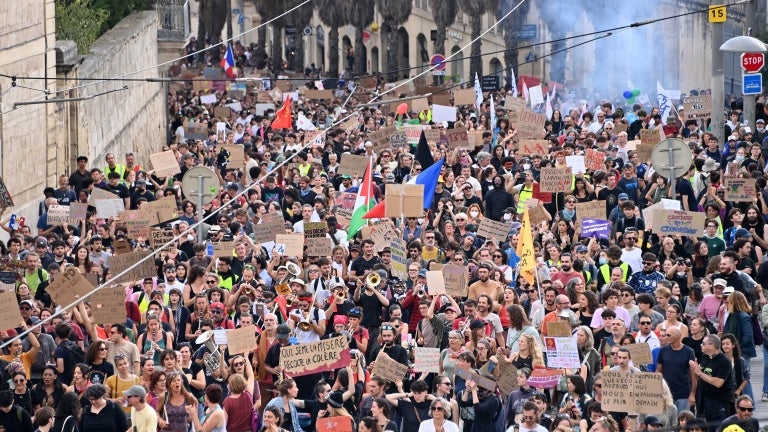
Around 70,000 police officers and gendarmes are being deployed across France on Saturday, October 24, for a fresh day of demonstrations, according to BFM. The mobilization follows violence on October 17 that authorities say they underestimated, and it unfolds alongside a Rassemblement National (RN) congress in Orléans that has drawn its own counter-mobilization.
Authorities have authorized marches in a limited set of cities, while bans apply in Marseille and Lyon. The list of permitted events remained subject to change through the day because of legal challenges still working their way through the courts, BFM reports.
Why it matters
The scale of the deployment signals how seriously the government is treating a second consecutive weekend of protest. After the October 17 disturbances, Paris police acknowledged that the size and intensity of that day's crowds had been misjudged. How forces handle Saturday will shape the political debate over policing tactics, protest rights and the government's handling of public order.
The day also tests the legal boundaries of protest bans. Several restrictions have been challenged in court, and the Conseil d'État has rejected appeals filed after comments by President Emmanuel Macron, according to Orange Actualités. The outcomes determine where people can legally gather and what penalties those who defy bans may face.
Where marches are allowed, and where they are not
Paris is among the cities with an authorized demonstration. The route was changed after lengthy debate: instead of the initially planned Bastille-to-Nation course, the procession will run from Porte de Vincennes to Porte d'Italie between 1 p.m. and 7 p.m., BFM reports.
Other major cities with authorized marches include Lille, Strasbourg, Mulhouse, Grenoble, Marseille, Toulouse and Amiens. In Marseille, where a demonstration was ultimately permitted, officers were already positioned on the Vieux-Port in the morning, according to BFMV journalists on the ground. That march is set to start at 2 p.m. and travel between Les Réformés and Porte d'Aix.
Bans remain in place in Marseille and Lyon, alongside other localized restrictions, BFM reports. With appeals pending, the picture could shift during the day.
Security concerns and the arsenal under scrutiny
Hélène Denéchère, spokesperson for the Paris police prefecture, told BFM that the threat of further disorder in the capital persists. She said the scale of last Saturday's mobilization had been poorly assessed and that it is now being estimated more accurately.
"La menace existe, elle est prise en considération," she said, describing the previous weekend's events as very serious and of a magnitude and violence that had been misjudged.
Speaking in Limoges on Friday, Interior Minister Sébastien Lecornu said the threat level remains high from the far left, according to Le Monde's account of his remarks. He also warned that ordinary crime exploits such unrest to sow confusion and steal, and said lessons from October 17 informed Saturday's policing plan.
The equipment used to police crowds is again part of the discussion. Defensive ball launchers, grenades and tear gas are presented by authorities as a graduated alternative to firearms, yet some of these items are legally classified as war materiel, and their use in recent years has caused serious injuries, mutilations and deaths, BFM reports. That record has revived questions about whether such weapons suit crowd-control missions.
On tear gas specifically, the chemical irritates the eyes, skin and throat temporarily. Some specialists worry about greater danger depending on exposure levels, while the national police say they have received no significant reports of long-term effects, according to BFM.
Several dozen police trainees volunteered with their leadership to take part in Saturday's arrangements. They will not be assigned to crowd control and will handle other duties, BFM reports. Deploying officers near the end of their training is not new; it happened during the Olympics and the Covid-19 pandemic.
Orléans: an RN congress and a counter-rally
In Orléans, the RN congress is expected to draw about 5,000 activists on Saturday and twice that number on Sunday, BFM reports. Around 50 organizations have called for a counter-mobilization, with police sources cited by BFM estimating 10,000 to 15,000 participants.
Loiret prefect Hugues Moutouh said Thursday that 20,000 to 30,000 people from across France were expected in the city. Mayor Serge Grouard announced an "exceptional" preventive plan, including major traffic restrictions and the closure of several public services. Trams will not run all day Saturday and self-service bikes will be removed from the entire city center. Shops may stay open provided that terraces in the center are folded away.
The counter-protest route, originally set to begin at the cathedral and pass through the heart of the center, was changed by the prefecture to start north of Orléans in the morning, BFM reports. Early on Saturday, several buses left Place de la République in Paris for Orléans carrying people preparing the counter-demonstration, according to BFMV journalists.
Transport, sport and shops
At the request of the Paris police prefecture and for security reasons, RATP says 24 metro stations will close from 9 a.m. in the capital. They are: Argentine, Assemblée Nationale, Bel Air, Champs-Élysées – Clemenceau, Charles de Gaulle – Étoile, Cluny - La Sorbonne, Concorde, Daumesnil, Dugommier, Franklin D. Roosevelt, George V, Mabillon, Maubert – Mutualité, Miromesnil, Odéon, Picpus, Rennes, Rue du Bac, Saint-Germain-des-Prés, Saint-Sulpice, Sèvres - Babylone, Solférino, Tuileries and Varenne.
Sport has been affected too. Several fixtures on the eighth matchday of Ligue 1 were postponed because of the expected mobilizations, and the PSG-Lyon match was moved to Monday, the day of the Ballon d'Or ceremony, BFM reports. The weekend's headline sporting event, the first NFL game of the American football season, is still scheduled for Sunday.
With school holidays under way, many shops have chosen to open on Saturday. "Ce sont de gros samedis. Fermer, c'est aussi baisser les bras," said Élodie Tonon, manager of a boutique in Toulouse, as other businesses boarded up, BFM reports.
What to watch
The legal challenges to protest bans are the key variable: court rulings during the day could add or remove authorized marches, and the deployment will be adjusted accordingly. Watch also how the Paris route and the Orléans counter-rally unfold, and whether the day passes without a repeat of the October 17 violence.



