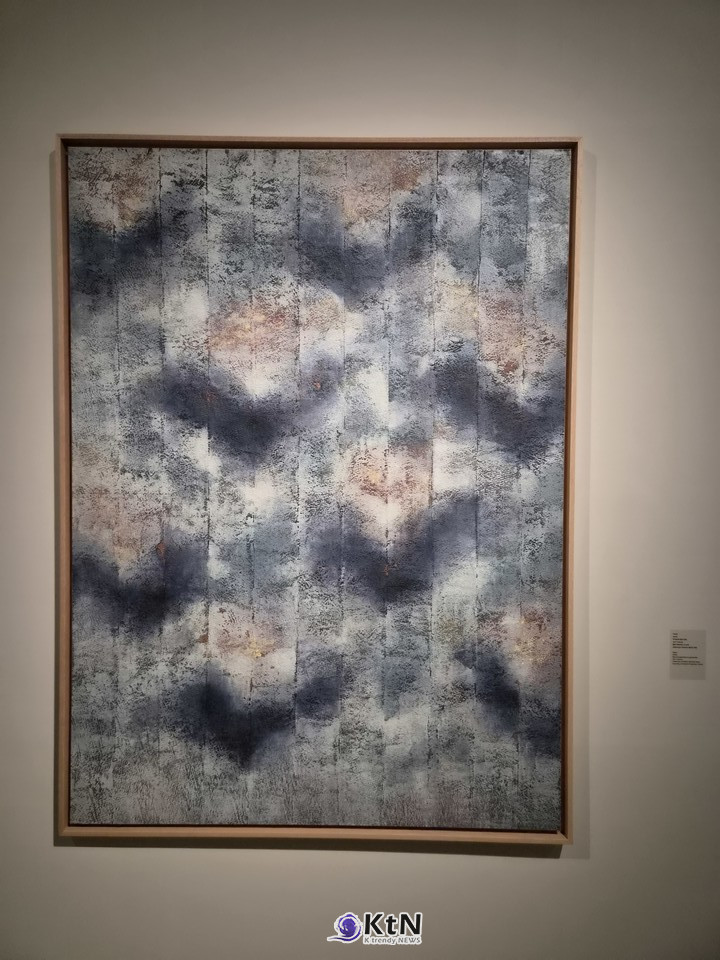
Bang Hye-ja's 2000 work "Bisang" places deep indigo and near-violet tones across a pale gray-white and cream ground, with the colors scattered in several directions at once, according to a report by 케이트렌디뉴스. Brown and orange hues push into the gaps between those darker passages and spread outward, while the light background keeps wide open areas between one cluster of color and the next. The piece is held up by the Korean outlet as an example of how pigment that bleeds, splits, and rejoins can suggest ascent and expansion without ever drawing a wing.
The work is not built around a recognizable silhouette. Instead, the movement of the paint itself carries the sense of rising and spreading that runs through the whole surface, 케이트렌디뉴스 reports.
Why it matters
"Bisang" is a useful case for anyone thinking about how abstraction communicates motion. The title points toward flight, but the canvas offers no bird, no body, no feather. What it offers is process: color that soaks into nonwoven fabric, separates, and reconnects.
That choice puts the emphasis on material behavior rather than illustration. 케이트렌디뉴스 describes the result as a work in which scattered color becomes wings — not because wings are painted, but because the way the pigment travels reads as lift.
For viewers accustomed to reading meaning off identifiable subjects, the piece asks for a different kind of attention. The eye follows density rather than outline.
Where the color sits, and where the air gets in
Across the front of the composition, masses of color rest at differing densities, according to the report. Dark indigo and violet move back and forth between the left side, the center, and the right, linking up in an irregular chain rather than a settled pattern. Around those darker forms, brown, ocher, and orange appear as short, thin traces that have seeped into the fabric.
The light areas left between the color masses do two jobs at once. They separate one cluster from another, and they open pathways the eye can travel along. 케이트렌디뉴스 frames this spacing as the source of the painting's breathing — the sense that the surface is not static but inhaling and exhaling.
Where dark pigment gathers, the work gains weight. Where the ground shows through over a wider area, air seems to enter. The viewer's gaze moves along the dark traces and then escapes back out into the lighter regions of fiber.
Rather than converging on a single focal point, color appears and disappears at multiple points and widens into a flow that runs across the entire piece, the outlet reports.
Reading motion without a subject
That structure is what gives "Bisang" its particular tension. A conventional image of flight would anchor the eye — a body at the center, wings on either side, a clear direction of travel. Here, direction is distributed. The dark passages do not point anywhere in particular; they accumulate, thin out, and resume elsewhere.
The nonwoven fabric matters to this effect. Pigment that spreads across such a surface does not sit on top of it the way it might on a sized canvas. It sinks and diffuses, producing edges that are soft rather than drawn. 케이트렌디뉴스 notes that the flow of pigment — spreading, cracking apart, and joining again — is what generates the impression of ascent across the whole work, rather than any specific wing shape.
The title "Bisang," which suggests taking flight or rising, thus operates as a frame rather than a description. The painting does not show the thing named. It reproduces the sensation.
What to watch
"Bisang" dates to 2000 and remains part of the conversation around Bang Hye-ja's use of nonwoven fabric as a painting surface. Readers interested in the work can look to 케이트렌디뉴스's original report for the full description of how the colors are arranged.


