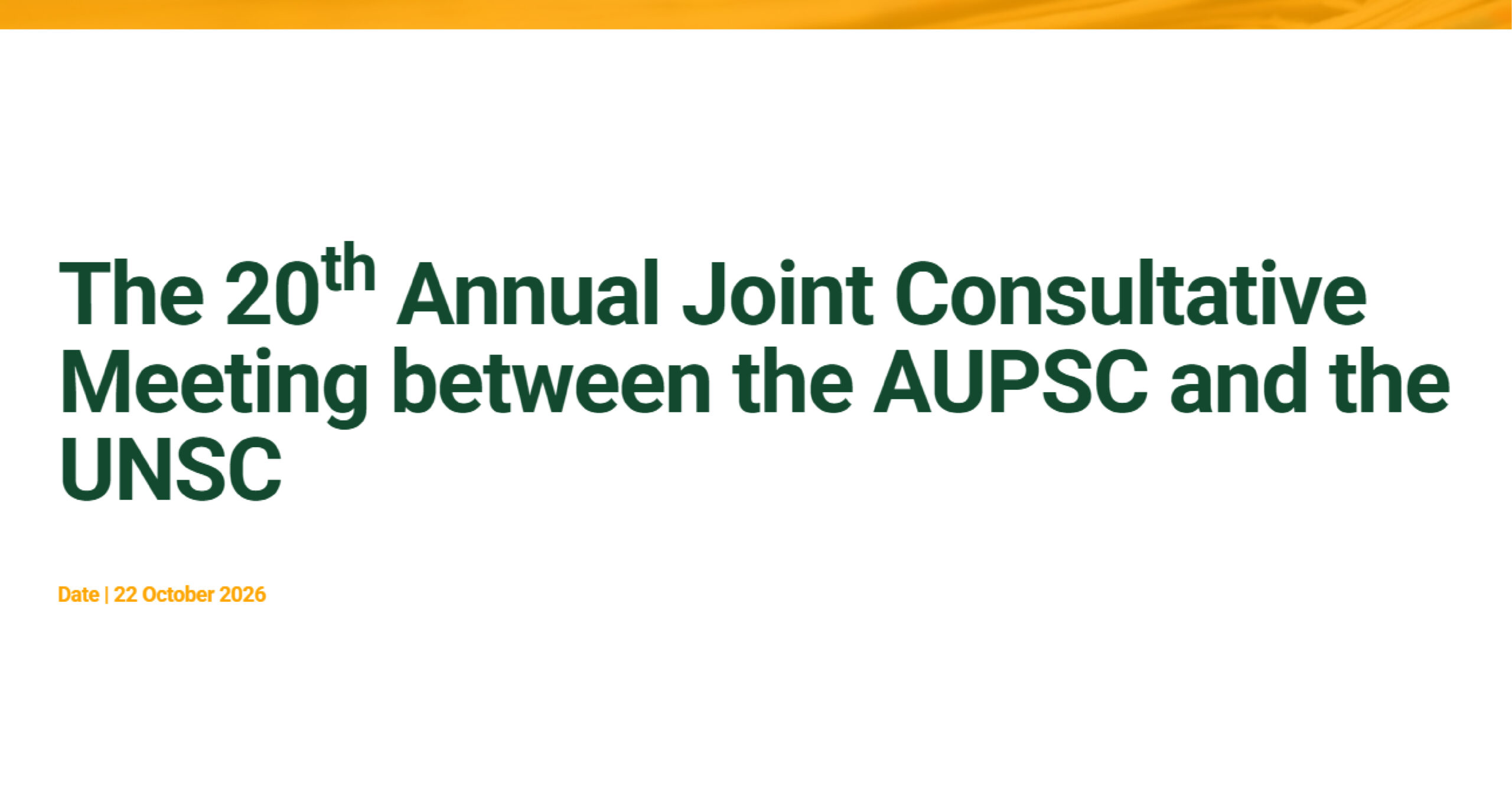
The African Union Peace and Security Council and the United Nations Security Council will hold their 20th annual joint consultative meeting in New York on 23 October, according to Amani Africa. The session carries four agenda items: how to identify and optimise future resources and support mechanisms for AUSSOM, and the situations in Sudan, South Sudan and eastern Democratic Republic of Congo.
Cameroon's permanent representative to the AU, Churchill Ewumbue-Monono, who chairs the PSC for October, will co-chair alongside Greece's permanent representative to the UN, Aghi Balta, who holds the UNSC presidency this month. Amani Africa reports that Rosemary DiCarlo, UN Under-Secretary-General for Political and Peacebuilding Affairs, and Bankole Adeoye, the AU Commissioner for Political Affairs, Peace and Security, are expected to address the meeting.
Why it matters
The annual gathering is one of the few formal settings where the two councils sit at the same table, and this year's agenda puts two of the continent's most intractable conflicts and its most underfunded peace operation in the same room. Decisions taken now on AUSSOM's financing will shape whether the mission can hold its planned course to 2029 or faces a disorderly exit. On Sudan, the meeting follows a series of mediation efforts whose progress the councils are expected to weigh.
Sudan: ceasefire diplomacy and outside interference
On Sudan, Algeria, Ethiopia, Nigeria and Somalia will co-lead for the PSC, while Liberia, Russia, Panama and Pakistan lead for the UNSC side, per Amani Africa.
The discussion is expected to draw on recent exchanges, including the Security Council's open briefing and closed consultations on 16 October and the PSC's August field mission to Khartoum. The PSC may present its observations on the scale of destruction and the humanitarian crisis, with talks likely to centre on diplomatic initiatives and how the various mediation tracks fit together. Amani Africa reports that the PSC may point to recent work by the Quintet — the AU, IGAD, the League of Arab States, the EU and the UN — including its September Good Offices Mission to Khartoum and October consultations with Sudanese civil society and political groups in Addis Ababa.
The councils may also welcome the first joint high-level meeting of the Quad and Quintet on 23 September. A follow-up meeting is scheduled for 20–21 October in Switzerland, aimed at coordinating ceasefire efforts and preparations for a political transition. The consultative meeting gives both bodies a chance to assess how far those efforts have moved toward a ceasefire and an inclusive process leading to civilian rule.
On the domestic political track, the SAF-backed Preparatory Committee for a Sudanese-led dialogue was set up in late August, a step the AU Commission Chairperson welcomed. Amani Africa notes, however, that the Sudanese authorities said the Rapid Support Forces would be left out. The Civil Democratic Alliance for Revolutionary Forces (Somoud) rejected the initiative and criticised the AU Commission's statement, cautioning that a political process run under military control without a ceasefire could cement Sudan's de facto division.
External involvement is also likely to feature. The September 2026 report of the UN Independent International Fact-Finding Mission for Sudan identified foreign recruitment and external support networks as factors driving the conflict. At its 1218th session in June 2024, the PSC tasked its Sub-Committee on Sanctions with identifying outside actors backing the warring parties and proposing ways to curb their involvement. According to Amani Africa, the two councils may therefore look at closer coordination between that sub-committee and the UNSC Sudan Sanctions Committee.
AUSSOM: a funding model still unresolved
On AUSSOM, Uganda and Nigeria will represent the PSC, with Somalia and the United Kingdom co-leading for the UNSC.
The talks come before the Security Council considers renewing the mission's mandate in December, giving both bodies an opening to exchange views on where the mission goes from here. Amani Africa reports that AUSSOM has operated under severe financial strain since it began work in January 2025, having deployed without predictable and sustainable funding. The AU has argued consistently that Resolution 2719 should be applied to AUSSOM as its first test case, describing it as the most workable route to adequate, predictable and sustainable financing. The United States has firmly opposed that approach. The question was among the most divisive at last year's consultative meeting.
The pressure has grown since the US announced in July 2026 that it would not back the continuation of the UN Support Office in Somalia beyond AUSSOM's current authorisation, which runs out on 31 December 2026. UNSOS supplies logistics that the mission depends on, including fuel, rations, medical and casualty evacuation, aviation, communications and reimbursement for contingent-owned equipment.
Against that backdrop, the second Extraordinary Summit of AUSSOM troop-contributing countries and Somalia, held in Kampala on 31 July, called for a unified, integrated mission support capability mandated by the Security Council to guarantee uninterrupted support for 18 to 24 months. The aim would be to meet agreed milestones, strengthen Somali security institutions and allow security responsibilities to be handed over in an orderly way. The summit also asked foreign ministers of troop-contributing countries, working with the AU and Somalia, to set up a Joint Task Force to mobilise diplomatic and financial backing, including through a donors' and partners' conference.
Amani Africa notes that keeping AUSSOM going until its envisaged exit in 2029 looks increasingly difficult, while a sudden withdrawal risks undoing security gains. With little sign of the US shifting on Resolution 2719, the discussion may move toward interim support arrangements and a coordinated, phased drawdown.
Eastern DRC
On eastern DRC, Gabon, Cameroon and Sierra Leone will represent the PSC, while the DRC, France and China co-lead for the UNSC. Amani Africa reports that the councils are expected to review developments there, though the published summary does not set out the detail of that discussion.
What to watch
Watch the December Security Council decision on AUSSOM's mandate and whether the two councils converge on interim financing arrangements, and whether the Switzerland follow-up on Sudan, set for 20–21 October, produces anything the councils can build on in New York.