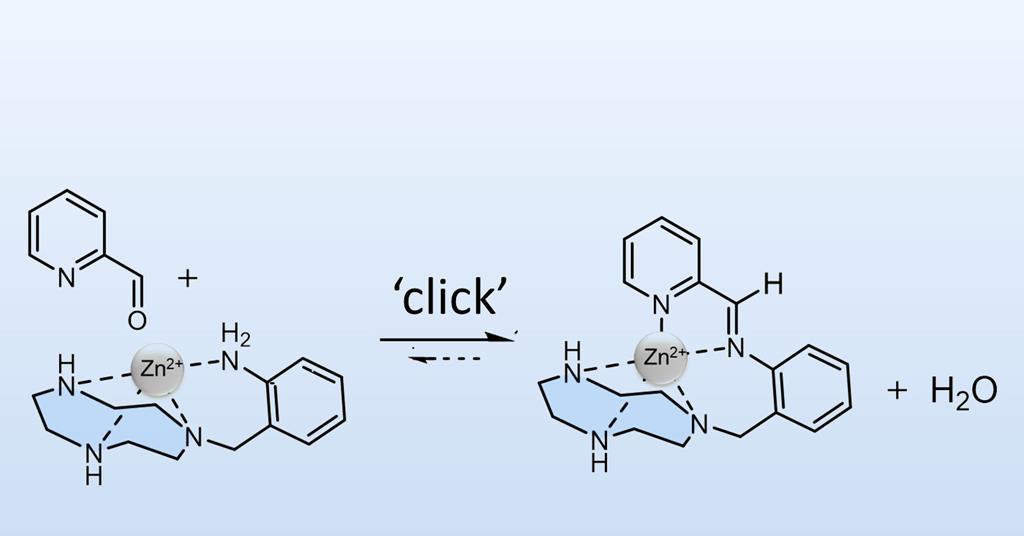
A team of chemists in Italy has found a way to make imine bonds in water quickly, cleanly and selectively — behaviour the field normally associates with click reactions. According to Chemistry World, the group led by Leonard Prins at the University of Padova, working with Deepak and colleagues, used a zinc complex to overcome the bond's well-known tendency to fall apart in aqueous conditions. The work was published in the Journal of the American Chemical Society.
Imines form easily when an amine meets an aldehyde under gentle conditions, and the starting materials are widely available, which is why the bond has become a workhorse of supramolecular chemistry. Prins describes it in the report as a dynamic covalent bond exploited across materials, supramolecular assemblies and sensors. The catch is durability: in water, the same bond tends to hydrolyse back into its components.
Why it matters
Kate Jolliffe, a supramolecular chemist at the University of Sydney who was not involved in the study, explained the underlying problem to Chemistry World. Water is released when an imine forms, so a water-rich environment pushes the equilibrium back toward hydrolysis under Le Chatelier's principle. Building a single imine in water is, in her words, fundamentally challenging.
That limitation has kept imine chemistry largely out of aqueous settings — including biological ones — where responsive molecular systems and bioconjugation would benefit from it. A method that forms the bond reliably in water widens the range of environments where chemists can use it.
How the zinc complex changes the balance
The Padova team's answer is to attach a 1,4,7-triazacyclononane (TACN)·Zn(II) unit to the amine precursor. The zinc complex latches onto the aldehyde and holds it in position, which makes the carbonyl more open to attack by the amine and, once the bond closes, keeps the resulting imine stabilised through coordination. Chemistry World reports that highly stable imines formed within two hours this way, with neutral pH and micromolar concentrations proving particularly favourable. The reaction ran fast, went to completion and picked out its targets when reactants were supplied in a stoichiometric ratio at sub-millimolar levels.
The new paper extends earlier work from the same group, which had shown near-quantitative imine formation in water by condensing salicylaldehyde derivatives with anilines carrying the TACN·Zn(II) group. The latest study broadens the chemistry in two directions: simple amines can now take part, not just the functionalised anilines, and additional aldehyde precursors have been brought in, including pyridine-based ones. Adding a pyridine unit makes the carbonyl more electrophilic, which shortens the reaction from days to hours and yields imines that are more thermodynamically stable.
The researchers also tested the system in a messy biological setting — Escherichia coli cell lysate — and showed the bonds still formed there.
What the result opens up
Deepak told Chemistry World that treating the imine bond as a click reaction in water makes it possible to build the kinds of systems the field has long discussed in a solvent that was previously seen as off-limits. Jolliffe said the clean formation of a single imine bond in cell lysate makes bioconjugation an obvious application. She also flagged the limits: widening the set of dynamic bond-forming reactions that tolerate water is a meaningful advance, but she noted that further work will be needed to add other functional groups before the chemistry can serve supramolecular and molecular-recognition applications more broadly.
Watch for follow-up studies that extend the approach to new functional groups and to more complex biological media.