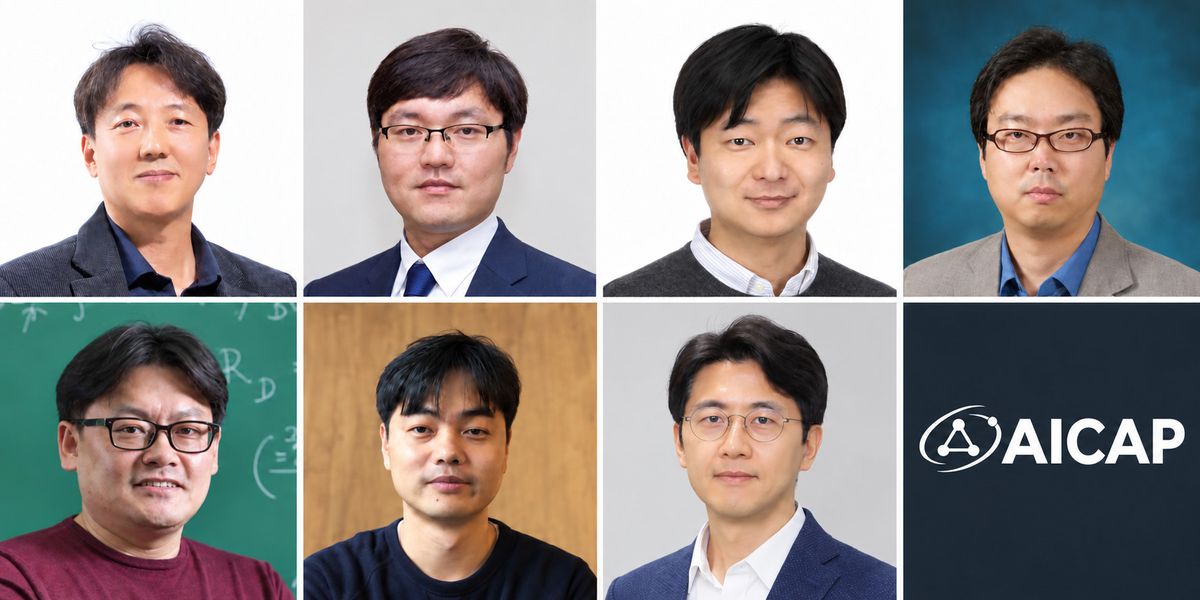
Yonsei University's Department of Astronomy has secured a major government research grant to pursue one of physics' longest-standing mysteries. According to 파이낸셜뉴스, a team led by Professor Ji Myeong-guk was selected on October 14 as a research center under the 2026 AI-Based University Science and Technology Innovation Program, run by the Ministry of Science and ICT and the National Research Foundation of Korea.
The selection brings the team 12 billion won over six years, through 2032, to apply artificial intelligence to the question of what dark matter actually is. Yonsei will lead the project, with Sejong University and Kyung Hee University participating as partners in what 파이낸셜뉴스 describes as a large interdisciplinary collaboration.
Dark matter is thought to make up roughly 85 percent of all matter in the universe. Its existence was first proposed in the 1930s, and nearly ninety years later its nature remains unidentified — the puzzle the new center is built around.
Why it matters
Decades of direct searches have come up empty. 파이낸셜뉴스 reports that research groups worldwide have pushed detector sensitivity up by more than a factor of ten billion in attempts to catch dark matter particles directly, without producing a confirmed result. That record of failure is precisely the argument for trying a different approach.
The Yonsei-led center proposes to stop treating the problem as two separate searches. Astrophysics, which studies dark matter's effects on the scale of entire galaxies, and particle physics, which looks for collision signals inside detectors, generate very different kinds of data. The team's plan is to combine both into a single AI inference system — effectively teaching one model to read two scientific languages at once.
The technical core is a method called simulation-based inference. Physical phenomena are reproduced in computer simulations, and those simulations are used to train neural networks, which then estimate properties that are difficult or impossible to observe directly. In this case, the networks would be trained to draw conclusions about dark matter from both galactic observations and detector data together.
If it works, the payoff extends beyond a single discovery. The AI methods developed along the way are the kind that can be transplanted to other fields that rely on simulation, according to the team.
Open data, summer schools, and a pipeline of researchers
Because the project is publicly funded, the center has attached a social-return and training plan to the science. 파이낸셜뉴스 reports that the large training datasets and AI models built during the research will be released fully as open source.
The center also plans an annual summer school for undergraduates, giving a total of 240 students hands-on experience with real data analysis over the six-year run. Alongside that, it aims to produce at least 15 doctoral graduates trained across all three areas — astrophysics, particle physics, and AI — rather than in a single discipline.
Professor Ji framed the project's value in terms that go past the dark matter question itself. He said the AI methodology being developed in the search could be applied directly to fields that use simulation, including new materials design, climate prediction, and medical image analysis. He added that the research leaves something behind even before an answer is found, according to 파이낸셜뉴스.
A crowded and contested field
The grant lands in a research area where conventional assumptions are under active pressure. 파이낸셜뉴스's coverage links to related reporting, including work described as shaking up established thinking on whether dark matter consists of particles or black holes — a reminder that the target itself is not settled.
That uncertainty cuts both ways for the Yonsei team. A method built to fuse galactic and particle-scale evidence could help discriminate between competing candidates, but it also means the simulations the AI learns from must encode assumptions that researchers are still arguing about. The project's open-source commitment will let outside groups test those assumptions against the released models and data.
The scale of the funding also signals a shift in how Korea's science ministry is directing money: not at a single experiment, but at AI as shared infrastructure for basic research. The 2026 program is explicitly built around AI-driven innovation at universities, and this center is one of its flagship selections.
For now, the work is at the starting line. The team has six years and 12 billion won to show whether machine learning can narrow a search that has resisted direct detection for nine decades. Watch for the first open-source data and model releases, and for whether the summer school pipeline produces the cross-trained researchers the project is counting on.





