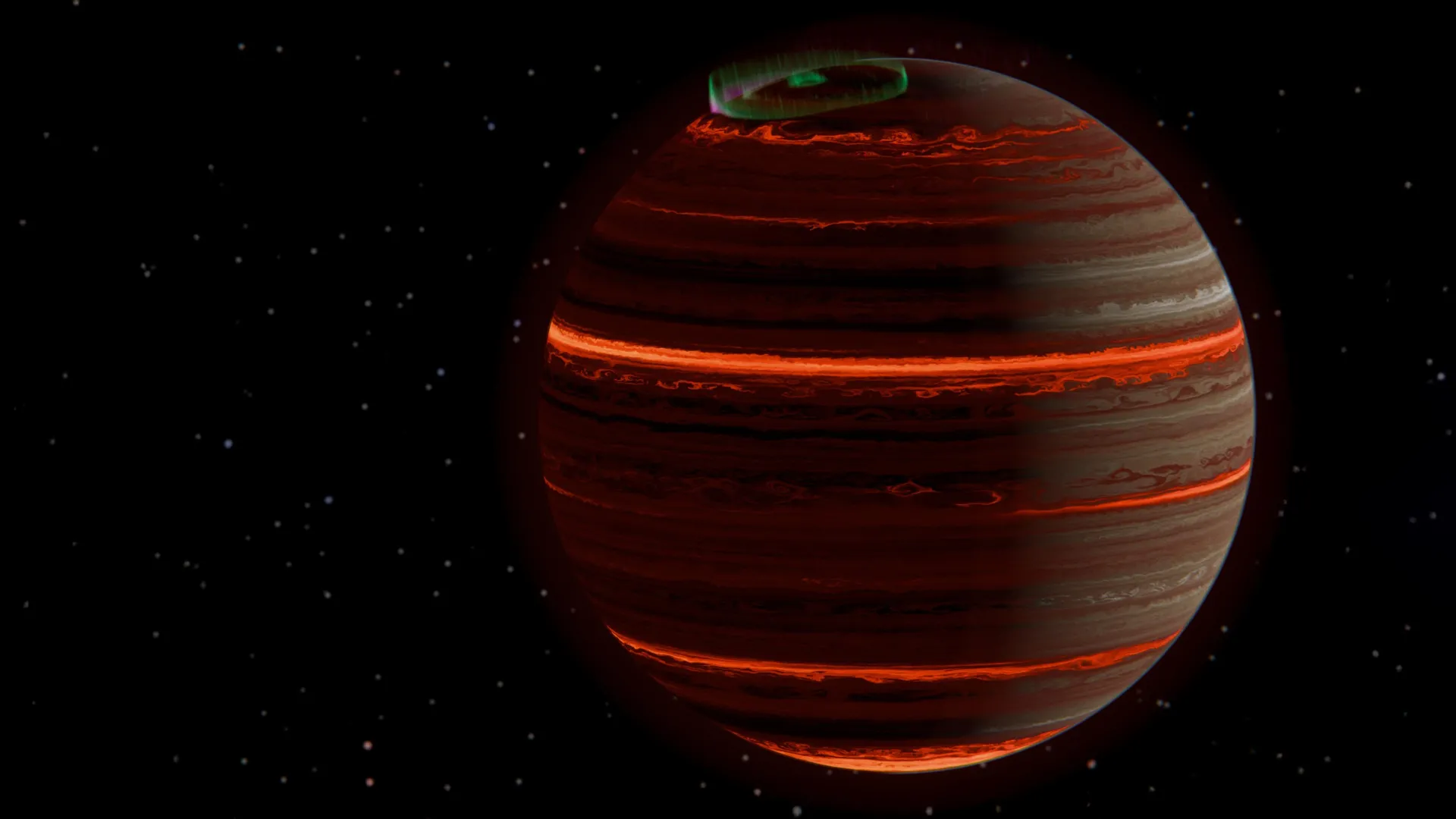
Astronomers at Trinity College Dublin have used observations from NASA's James Webb Space Telescope to work out what drives the weather on SIMP 0136, a brown dwarf about 20 light-years from Earth. According to Science Daily, the team found that nearly all of the object's atmospheric variability comes down to two factors: shifts in temperature and changes in how its clouds are stacked vertically. The findings were published in Astronomy & Astrophysics.
The work offers a template for reading the atmospheres of worlds far beyond the Solar System, where telescopes can capture only a single point of light.
Why it matters
Brown dwarfs sit in an awkward middle ground between planets and stars. SIMP 0136 is bigger and hotter than a typical gas giant, but it does not carry enough mass to burn like a star. Its atmosphere holds vast cloud systems that change quickly, producing weather that Science Daily describes as an extreme version of Jupiter's rather than anything seen on Earth.
That makes these objects useful stand-ins for giant exoplanets. Brown dwarfs can often be observed directly, giving researchers a way to watch cloud formation, heat transport and atmospheric circulation under conditions that are difficult or impossible to study on most planets orbiting other stars.
The Trinity method could make such studies faster. By quickly isolating the processes behind most of what a telescope sees, researchers may be able to apply the same approach to brown dwarfs that are fainter, more distant or less well documented.
Letting the data pick out the patterns
The team analyzed Webb observations of SIMP 0136 using a mathematical tool called Principal Component Analysis, which sifts large, complex datasets for their strongest underlying patterns. Rather than starting with assumptions about how the atmosphere ought to behave, the researchers tracked how the brown dwarf's light shifted as it rotated and let the measurements point to the dominant processes. The technique also helped separate real atmospheric changes from noise.
Webb's sensitivity was central to the result. Its instruments detected very small swings in brightness as different parts of the atmosphere turned into view.
What emerged was more orderly than expected. Despite an apparently chaotic atmosphere, almost all of the observed variation matched two components, consistent with temperature fluctuations and the vertical arrangement of clouds. The team also identified three recurring weather states that appear and disappear as SIMP 0136 rotates, together forming a shifting patchwork. Some regions are warmer with thinner clouds; others are cooler, with thicker layers reaching higher through the atmosphere.
"We also discovered that these drivers of the weather patterns on SIMP-0136 persist over time, even as the detailed appearance of the atmosphere evolves over more than a dozen rotations," said first author Merle Schrader, a PhD candidate in Trinity's School of Physics, according to Science Daily.
Schrader noted that SIMP 0136 is relatively easy to capture high-quality data from and has been studied before with established methods, which allowed the team to check some of its new results against what was already known. She said the approach has improved understanding of what drives the weather there and how the patterns interact and coexist, and that it can be refined and applied to lesser-known brown dwarfs elsewhere in space.
Two decades of travel for a single pixel of light
SIMP 0136 lies roughly 20 light-years away, so its light takes about two decades to reach Earth. The observations Webb gathered in 2023 captured light that left the brown dwarf in the year Schrader was born.
"Light travels at around 300,000 km/s but, even at that speed, it took two decades to reach us, peering through the JWST lenses," she said. She contrasted that with the roughly one second light needs to travel from Earth to the Moon, and said it is remarkable that researchers can map the weather patterns of a distant world and their interactions when all they observe directly is a single pixel spread across the light spectrum.
That single-pixel constraint is the heart of the achievement. In telescope images SIMP 0136 is barely a point, yet changes in its brightness at different wavelengths carry enough information to describe its atmosphere in detail.
The next step is to apply the technique more widely. Watch for follow-up studies testing whether the same two-factor explanation holds for other brown dwarfs, and whether the method can sharpen the interpretation of giant exoplanet atmospheres that cannot be viewed directly.





