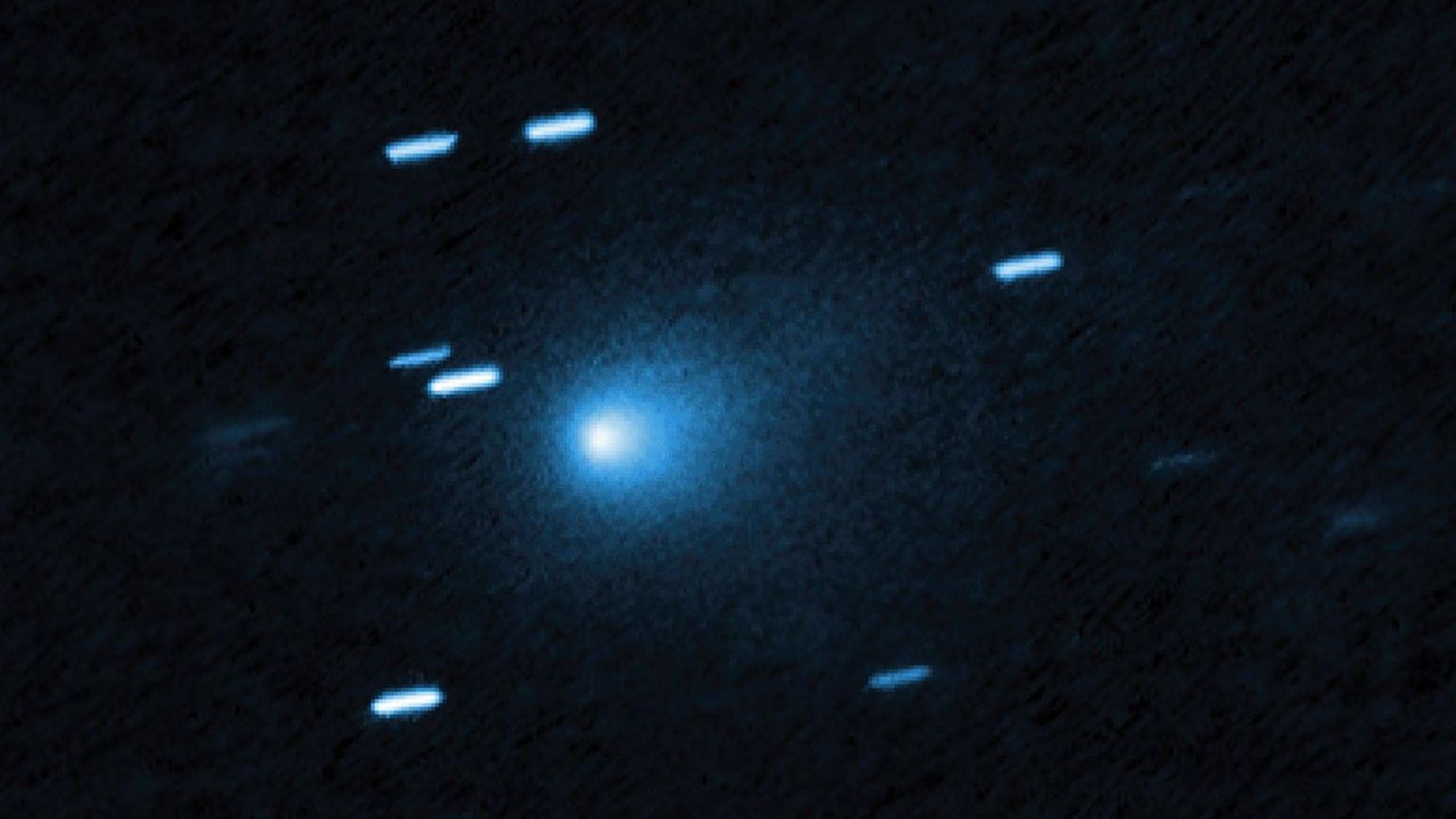
Scientists using the James Webb Space Telescope have determined that the interstellar comet 3I/ATLAS formed from tiny ice grains heavily mixed with dust, a composition that sets it apart from comets born in our solar system, according to Space. The findings come from three observations made with the telescope's Near-Infrared spectrograph between August 2025, before the comet's closest pass by the sun, and April 2026, after that approach.
3I/ATLAS was first spotted entering the solar system in summer 2025. It is only the third object confirmed to arrive from beyond our system, following 1I/'Oumuamua in 2017 and 2I/Borisov in 2019. That rarity gave researchers a rare window into the conditions under which such bodies assemble around other stars, and the Webb telescope was quickly directed at it.
"We designed [JWST] to be ready the moment an active interstellar comet was found and to follow it over time," Martin Cordiner of NASA's Goddard Space Flight Center and the Catholic University of America said in a statement. Cordiner leads the Webb program studying objects like 3I/ATLAS and is a co-author of the new paper.
Why it matters
Comets preserve primordial material from the disks of gas and dust that surround young stars, so their makeup records the chemistry of planet formation. Comets native to our solar system inform scientists about the birth of Earth, Space reports; an interstellar comet carries the same kind of evidence about a different star system, allowing researchers to compare how alike or unlike those environments were.
Researchers cannot say which star 3I/ATLAS originated around, but they are more confident that it formed inside a planet-forming disk, possibly 10 to 12 billion years ago — more than twice the age of our solar system. It was later expelled from its home system and drifted through interstellar space until it reached ours.
A spectral puzzle
Like local comets, 3I/ATLAS consists of ice grains smaller than a micron, a millionth of a meter across. When the sun warms the comet's surface, gas bursts outward and carries those grains into the coma and tail, where Webb can detect them.
Water ice in solar system comets produces a strong absorption feature at three microns and weaker ones at 1.5 and two microns. In 3I/ATLAS, the Webb data showed the three-micron line remained strong while the shorter-wavelength features were weak or absent.
"That combination was a puzzle," said lead author Silvia Protopapa of the Southwest Research Institute. "The strong three-micron band points to water-ice in the coma, but the weak or absent shorter-wavelength bands suggest the ice is not in the form we usually see in solar system comets."
Modeling by Protopapa's team indicated the comet's sub-micron grains are water ice carrying a heavy dust load. Grains from comets native to our system, by contrast, are far cleaner, consisting of nearly pure water ice. "What seems to set [3I/ATLAS' grains] apart is how much dust is mixed into the ice," Protopapa said. "Those grains hold clues to the conditions where the comet was born."
A match at the solar system's edge
The comet's spectrum resembles that of certain medium-sized trans-Neptunian objects — bodies orbiting well beyond Neptune — that are rich in carbon-dioxide ice and carbon-bearing organic compounds. Space notes that a separate 2025 study led by Cordiner found 3I/ATLAS holds one of the highest abundances of carbon dioxide ever recorded in a comet. Those TNOs are thought to have formed in a different region of the sun's protoplanetary disk than most comets, and their composition reflects that origin.
The comparison suggests 3I/ATLAS assembled around its own star from icy material similar to what produced some of our system's TNOs, indicating that planet-building ingredients around other stars fall within a common range of properties. The researchers even raise the possibility that the comet is a fragment of a TNO-like body broken apart in a collision.
"At first glance, 3I/ATLAS looks different from the icy comets we know," Protopapa said. "But when we placed it alongside distant icy worlds in our own solar system, it no longer looked out of place." She added that the icy building blocks of planets, here and around other stars, may share ice in the form of tiny micron-scale grains spanning a range from relatively pure to dust-laden, with 3I/ATLAS sitting toward the dusty end.
Taken together, the results imply that these sub-micron icy grains must form first in planet-forming disks before being incorporated into larger bodies such as comets.
The research is described in a new paper co-authored by Cordiner and led by Protopapa. Watch for further analysis of 3I/ATLAS as researchers continue to compare its chemistry with the solar system's icy populations.





