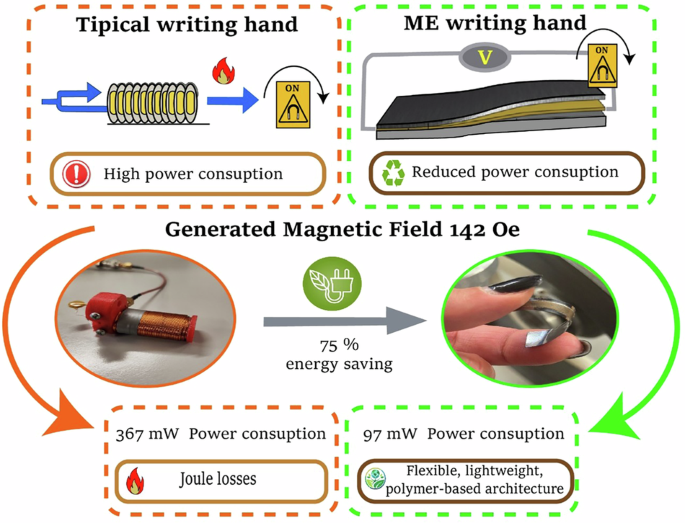
Researchers have demonstrated polymer-based magnetoelectric laminates that produce magnetic fields through applied voltage rather than flowing current, according to a study published in Nature's Communications Materials. The work, led by R. Carvalho with colleagues L. Amorim and A. Garcia, was carried out at the University of Minho in Braga, Portugal, and the Basque Center for Materials, Applications and Nanostructures in Leioa, Spain. The team reports that its best-performing laminate reached a converse magnetoelectric coefficient of 157 mOe·cm·V⁻¹ and generated fields of roughly 142 Oe at about 10 volts under resonance conditions.
The central claim is a power comparison. For the same magnetic field amplitude, the researchers say voltage-driven actuation consumed almost 75% less power than the conventional approach of generating magnetic fields with current. That gap comes from the absence of Joule losses — the resistive heating that occurs whenever current flows through a conductor. A voltage-driven magnetic source avoids that loss channel entirely, which is the mechanism the paper identifies as the basis for the efficiency gain.
Why it matters
Magnetic fields sit at the heart of a wide range of electronic devices, from memory elements to sensors. Generating them conventionally means driving current through a coil or wire, and that current dissipates energy as heat. As devices shrink and multiply, that wasted power becomes a design constraint rather than a footnote.
The study frames the problem directly: energy-efficient ways to create and control magnetic fields without current flow are essential for reducing power consumption in electronic technologies. The laminates reported here are positioned as a response to that need, offering magnetic actuation that is driven by voltage and therefore free of Joule losses.
The numbers give the claim its weight. The fields the optimized laminates produced exceed the switching requirements of representative spintronic architectures by more than two orders of magnitude, according to the paper. In other words, the device generates far more magnetic field than a spintronic switch would need to flip state — a margin the authors describe as a stringent benchmark for low-power magnetic actuation.
How the laminates work
The devices are composite structures that couple two different material behaviors. One component is piezoelectric: it changes shape when voltage is applied. The other is magnetostrictive: its magnetic state responds to mechanical strain. Bonding these layers together creates a pathway in which an applied voltage produces a mechanical strain in the piezoelectric layer, and that strain is transferred to the magnetostrictive layer, which in turn alters its magnetic output. The paper describes this as strain-mediated coupling.
The piezoelectric material used is poly(vinylidene fluoride), or PVDF, a polymer. The magnetostrictive partners are Vitrovac and Terfenol-D. The team varied the thickness of the PVDF layers and tested different magnetostrictive constituents, then examined how those choices affected the laminates' dielectric, piezoelectric, and magnetic responses.
A key variable was the adhesive. The layers were joined with ultra-thin epoxy bonding layers, and the researchers used this bonding thickness to tune what they call interfacial compliance — how much the interface between layers gives under strain — and, through it, how efficiently strain moves from one layer to the other. The paper reports that these structural choices were quantitatively correlated with the converse magnetoelectric coefficient, the figure that describes how much magnetic response the device produces per unit of applied voltage.
The optimized PVDF/Vitrovac laminates were the best performers, reaching the 157 mOe·cm·V⁻¹ coefficient and the ~142 Oe field output at ~10 V under resonance. The authors present the resulting structure–property–function relationships as design guidelines — a set of rules connecting how the laminate is built to what it does — intended to support flexible and scalable versions of the technology.
Funding and open access
The work was supported by the Portuguese Foundation for Science and Technology under strategic funding and a project grant, with a doctoral grant acknowledged for Carvalho. Additional support came from the Advanced Materials program, funded by MCIN with European Union NextGenerationEU money, the Basque Government's IKUR program, a postdoctoral fellowship, and the Basque Government Industry Department's ELKARTEK program. The paper is open access under a Creative Commons Attribution 4.0 International License. The publisher notes that Springer Nature remains neutral on jurisdictional claims in published maps and institutional affiliations.
What to watch is whether the design guidelines translate into manufacturable devices. The paper positions the laminates as a platform for energy-efficient magnetic actuation, but the path from a laboratory benchmark to integrated spintronic hardware will depend on scaling the fabrication and confirming the power savings in working systems rather than in isolated test structures.





