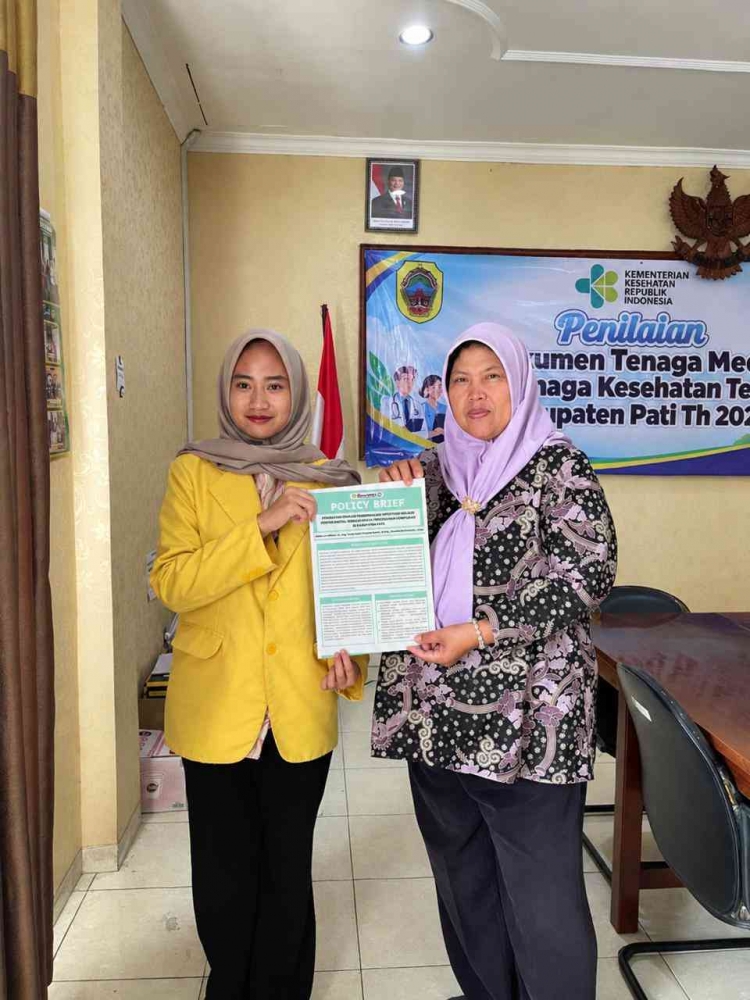
A student in the Public Health Study Program at the Faculty of Medicine, Universitas Negeri Semarang (UNNES), submitted an innovation work in the form of a policy brief on hypertension control to the Pati District Health Office. The handover took place on 25 September 2026 in Pati, Central Java, according to Kompasiana.com.
The work was produced as part of Magang Berdampak SKM Penggerak, an internship program, and is positioned as a contribution toward Sustainable Development Goal 3 on good health and well-being. The student, Adelia Yuvi Alifiani, developed the material as a contribution to promotive and preventive health efforts, Kompasiana.com reports.
The policy brief centers on an innovation called PATUH Hipertensi. The name is an acronym for four steps: monitoring blood pressure, managing medication, adopting a healthy lifestyle, and attending routine check-ups. The innovation takes the form of a digital poster used as an education medium to raise public awareness about hypertension control and the prevention of complications.
Why it matters
Hypertension is a non-communicable disease that carries a risk of complications such as stroke and heart disease. Kompasiana.com reports that the policy brief was prepared against the backdrop of the need to strengthen education on the condition.
The submission also served as advocacy for the results of the student's intervention and as a way to pass on recommendations. The aim is for the PATUH Hipertensi digital poster to be used on an ongoing basis in education activities and in communication, information, and education (KIE) work under the Prevention and Control of Non-Communicable Diseases (P2P PTM) program.
The initiative is aligned with SDG 3, particularly target 3.4, which focuses on reducing premature deaths from non-communicable diseases through prevention and treatment. According to Kompasiana.com, the activity was an effort by students at the UNNES Faculty of Medicine to connect academic innovation with the health promotion needs of a regional health agency, while supporting greater public awareness of hypertension control.
Handover and intended use
The policy brief was presented to Rosalia Rachmawati, A.Md., at the Pati District Health Office. Kompasiana.com identifies her as the recipient of the document.
Through education media that is informative and easy to understand, the public is expected to better grasp the importance of tracking blood pressure, following treatment as advised by health workers, maintaining a healthy lifestyle, and going for regular check-ups. Continued use of the digital poster is also expected to widen the reach of information on hypertension control in Pati District.
The material was developed under Magang Berdampak SKM Penggerak, a program tied to the SKM Penggerak initiative within the public health study program. The internship places students in settings where they can apply academic work to practical health problems, in this case the promotion of hypertension control at the district level.
A familiar pattern for student health outreach
The Pati handover is one of several recent student-led health education projects at UNNES reported by Kompasiana.com. Separate reports describe a policy brief on Instagram-based hypertension education, a booklet called PIJAR REMAJA developed by a student at the UNNES Faculty of Medicine in support of SDG 3, and an education medium on hypertension also framed around the same sustainable development goal. Another report covers health promotion for hypertension control in Magelang Regency.
Taken together, the reports point to a recurring approach: students produce a specific, named education product, tie it to a defined health program, and hand it to a local health authority for continued use. In the Pati case, the product is a digital poster built around four behavioral steps, and the receiving unit is the district health office.
The framing of the work as a policy brief rather than only a poster is notable. A policy brief is typically a short document that sets out a problem and offers recommendations to decision-makers. Here, the recommendation is that the poster be used sustainably in the office's education and KIE activities, according to Kompasiana.com.
What to watch
Whether the Pati District Health Office adopts the PATUH Hipertensi poster in its routine P2P PTM education and KIE activities, and whether the material is used beyond the initial handover, is the next thing to watch.





