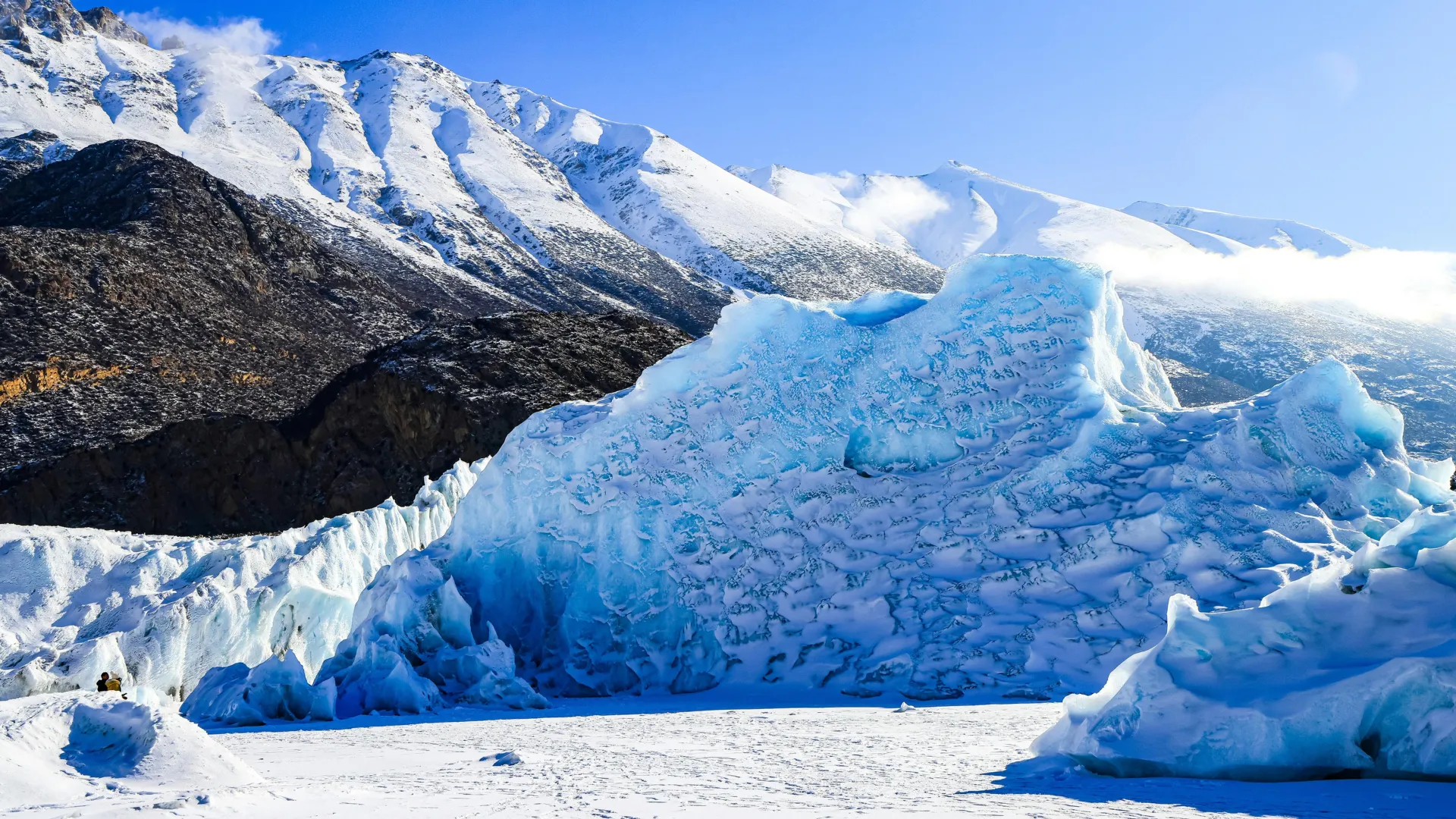
Scientists examining ice cores from an ice cap in northwestern Tibet have found evidence that the frozen record there reaches back more than 128,000 years, according to Science Daily. The finding extends the known glacial history of the region by over 100,000 years and makes these the oldest ice cores recovered from that part of the Tibetan Plateau.
The research, led by Lonnie Thompson of Ohio State University's Byrd Polar Research Center, drew on cores collected from the Guliya Plateau during two separate drilling campaigns, in 1992 and 2015. Science Daily reports that the study was supported by the U.S. National Science Foundation.
Why it matters
Ice cores serve as archives of past atmospheres: as snow piles up and compresses into ice, it locks in chemical traces of the conditions at the time each layer formed. A core that spans more than a hundred millennia gives researchers a rare, long-running account of climate outside the polar regions.
According to Science Daily, the Guliya record is the only mountaintop ice core known to reach that far back. Thompson told the outlet that cores from Huascarán in Peru extend only about 30,000 years, which he said makes Guliya stand out as a unique record.
The work also bears on a longstanding question about the last ice age. Earlier interpretations held that the Guliya ice dated only to the middle of the Holocene, the epoch that began roughly 12,000 years ago after the last glacial period ended. The new dating indicates that at least part of the ice is much older. Thompson said that if Tibet held only Holocene-era ice, it would mean the large ice masses of the last ice age did not survive into the early Holocene — but the evidence shows that they did.
Matching records a quarter-century apart
A central piece of the team's case is reproducibility. Despite being extracted 23 years apart, the 1992 and 2015 cores showed remarkably similar patterns of oxygen isotopes, the markers scientists use to reconstruct past environmental conditions. Science Daily reports that the close agreement indicates the ice has kept a dependable record.
Thompson described the consistency as highly significant, noting that an identical record recovered a quarter of a century later says a great deal about how the ice has behaved over time.
Establishing an age for ice that has stayed frozen for tens of thousands of years required more than matching isotope curves. The international team used radioactive isotopes of beryllium and chlorine, which decay at known rates, to build a timeline. Through them, the researchers identified chemical signatures of the Leschamp Geomagnetic Excursion, a major disruption of Earth's magnetic field that occurred more than 41,000 years ago. The team then cross-checked its results against oxygen isotope records from cave deposits in the surrounding region. Taken together, Science Daily reports, the lines of evidence suggest the Guliya record extends well past 128,000 years.
Thompson said the finding is critical precisely because comparable mountaintop cores outside the polar regions do not reach so far into the past.
The ice cap's setting may explain its endurance. Science Daily notes that its high elevation and the surrounding landscape likely helped create conditions that kept ancient ice in place through major shifts in the environment.
What a longer timeline makes possible
With a firmer chronology in hand, the researchers hope to address broader questions about the planet's glacial history — when ice began forming, how long glacial periods lasted, and when the ice withdrew. Thompson said that reconstructing those natural cycles depends on accurate time scales for records like this one.
The revised timeline also opens the door to reexamining the Guliya cores in more detail. Science Daily reports that the team plans to study additional samples to see how other climate indicators fit into the extended history. Some signals that were previously overlooked, or read differently because the ice's age was uncertain, could take on new meaning.
Thompson said the various measurements point in the same direction, and that the task now is for scientific understanding to catch up with what the ice is recording.
The study's co-authors include Ohio State's Mary Davis and Ellen Mosley-Thompson, along with Juerg Beer of the Swiss Federal Institute of Aquatic Science and Technology; Christof Vockenhuber and Marcus Christl of ETH Zurich; Tandong Yao of the Chinese Academy of Sciences; and Ninglian Wang and Ling Fang of Northwest University in China. Science Daily credits Ohio State University with providing the materials and Tatyana Woodall with the original write-up.
Watch for follow-up analyses of the Guliya cores, which the team says will test how far the newly extended timeline can be pushed.





