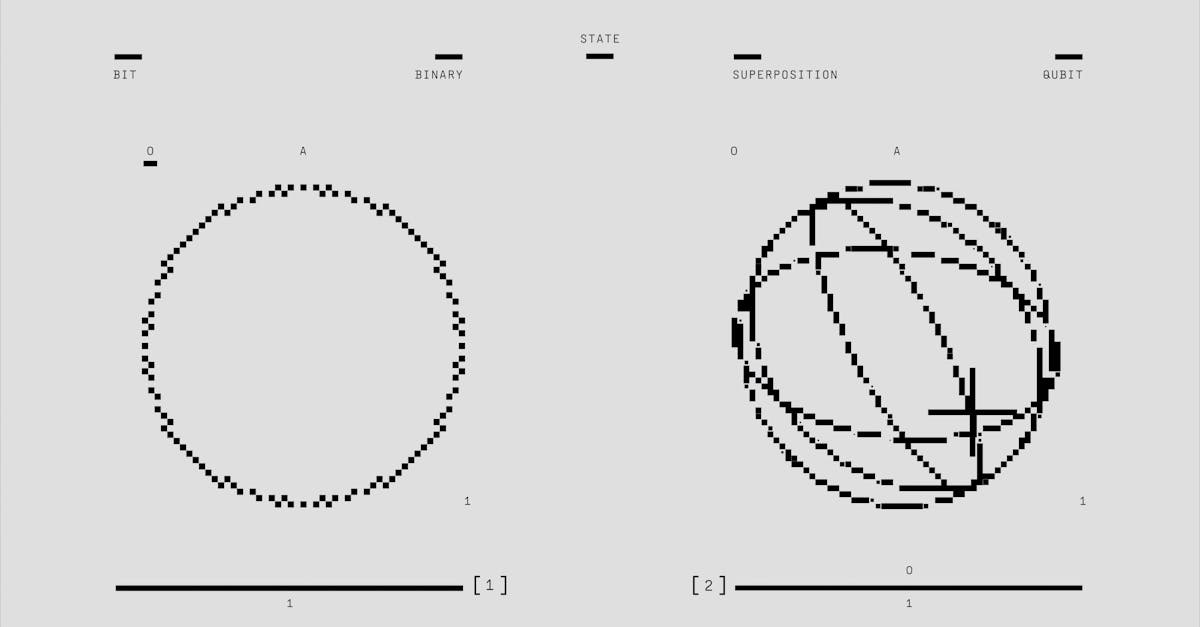
Let me tell you something that stopped me mid-scroll last week: physicists at a major research lab announced they'd used a quantum computer to simulate a phenomenon that, by the standard rules of quantum mechanics, shouldn't have been possible to observe so cleanly. And the result didn't just match theory — it hinted that one of our foundational assumptions might be a little too tidy.
I've been following quantum computing since it was mostly a punchline in tech conferences, and I've learned to be skeptical. Every few months brings a breathless "quantum breakthrough" that turns out to be a slightly better error-correction demo. But this one has a different flavor. Let's dig into why the quantum computing breakthrough everyone's whispering about might actually force us to rewrite parts of the physics textbooks.

The Experiment That Made Physicists Do a Double Take
Here's the setup, stripped of jargon. A team used a programmable quantum processor to model how particles interact under conditions where classical simulation becomes exponentially impossible. Think of it as asking a calculator to solve an equation so long that writing it out would take more atoms than exist in the universe. The quantum machine chewed through it in minutes.
What most people miss is what happened next. The output didn't just confirm the textbook prediction — it produced a small but statistically stubborn deviation. Not noise. Not a calibration error they could wave away. A repeatable pattern that the standard model didn't account for.
That's the kind of anomaly that keeps physicists awake at night, and it's exactly the kind that has historically led to new physics.
I've found that the general public usually hears about quantum computing in terms of speed — "it'll break encryption!" — but the real story is about fidelity. We're finally reaching the point where quantum machines can act as microscopes for reality itself, not just number crunchers.
Why Quantum Simulation Is the Real Quantum Computing Breakthrough
Let's be honest: the flashy headlines are always about cryptography or drug discovery. Those matter. But the deeper shift is that quantum computers are becoming experimental instruments, not just computational tools.
Classical computers struggle with quantum systems the way a map struggles to show every pothole on a highway. You get the general shape, but the texture is lost. Quantum simulators don't approximate — they are the system they're studying. When you build a quantum model of a quantum phenomenon, you're not calculating reality. You're recreating a slice of it.
This matters because:
- Materials science could leap forward if we can simulate electron behavior at room temperature rather than near absolute zero.
- Particle physics gets a sandbox for testing theories that accelerators can't reach — energies too high, distances too small.
- Cosmology might finally get traction on why the universe's expansion rate doesn't match our models.
The Assumption Nobody Wanted to Question
Here's the part that gets philosophical fast. Much of modern physics rests on a set of assumptions about locality and realism — loosely, that things have definite properties whether or not we measure them, and that information can't travel faster than light. Quantum mechanics has always been a little cheeky about this, but the math has held up for a century.
The new simulation suggests that under certain extreme conditions, those assumptions might break down in ways we can actually measure — not just argue about over coffee.
I'm not saying we're about to throw out quantum mechanics. That would be like burning your car because the GPS glitched. But I am saying that a physics textbook written in 2035 might have a chapter that doesn't exist today. And the people writing it will point to experiments like this one.
Here's what most people miss: science doesn't advance by big dramatic revolutions. It advances by small, stubborn anomalies that refuse to go away. This is one of those.
What This Means for the Rest of Us
You might be wondering why any of this matters if you're not a physicist. Fair question. Three reasons:
- Technology follows physics with a lag of about 20 years. The quantum weirdness being mapped today becomes the sensors, batteries, and medical imaging of your kids' generation.
- The quantum computing breakthrough validates a decade of investment. Governments and companies have poured billions into machines that, until recently, mostly proved they could do small things slowly. This is the payoff moment.
- It reframes what "impossible" means. Every time we assume a limit is permanent, someone builds a machine that disagrees.
The Skeptic's Corner (Because I Live Here)
I'd be a bad blogger if I didn't pour a little cold water. Here's my honest read:
- One experiment isn't a paradigm shift. It needs replication. Independent teams, different hardware, same result. That's the gold standard.
- Quantum computers are still error-prone. A deviation could, in theory, be a subtle hardware artifact. The team says they controlled for it. Time will tell.
- The deviation is small. Small enough that reasonable physicists will debate whether it's new physics or just a better understanding of the old physics.

Where This Leaves Us
I've found that the most exciting moments in science aren't the ones where everything clicks into place. They're the ones where a tiny piece refuses to fit, and everyone quietly starts reaching for the toolbox.
So here's my challenge to you: the next time you see a headline about a quantum computing breakthrough, don't scroll past. Read the anomaly, not the hype. Ask what assumption it challenges. Because the textbooks being rewritten aren't just physics textbooks — they're the mental models all of us carry around.
What assumption in your own field is overdue for a rewrite? That's the question this experiment leaves me with. And honestly, it's a good one to sit with.