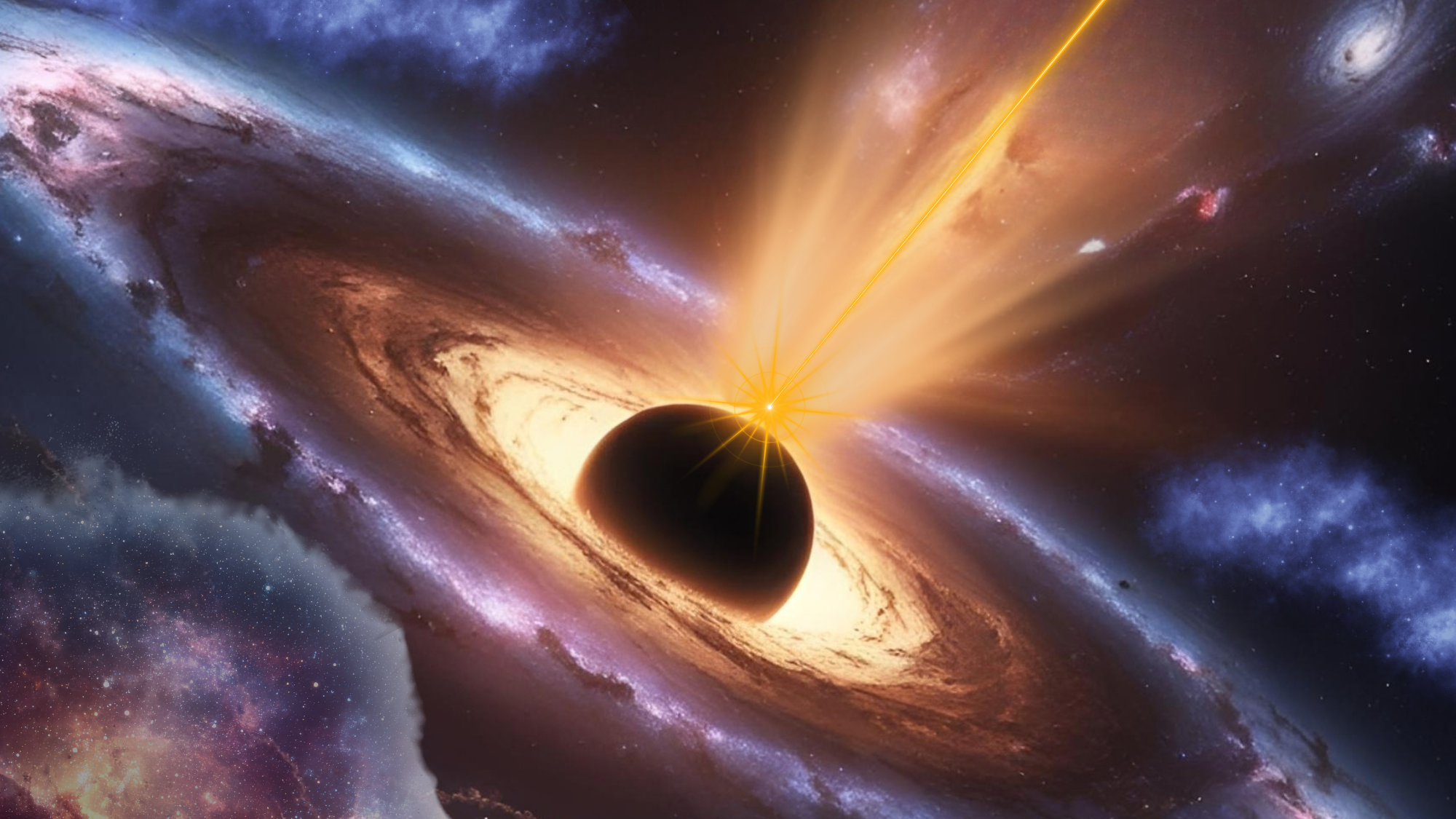
Astronomers have connected an X-ray outburst from a supermassive black hole to radio jets that appeared roughly 300 days later, according to Space. The work relied on NASA's Swift spacecraft, an X-ray observatory, paired with radio data, and it centers on the black hole at the heart of NGC 1275, the brightest galaxy in the Perseus Cluster.
The team also placed limits on how massive that black hole is, estimating it at somewhere between 100 million and 1 billion times the mass of the sun. The research has been accepted for publication in the Astrophysical Journal Letters, and a pre-peer-review version is available on the repository site arXiv.
Why it matters
Supermassive black holes that are actively pulling in matter sit in regions called active galactic nuclei, or AGNs. Their gravity heats the surrounding material until it glows, and some of that material is funneled toward the black hole's poles and flung outward as twin jets that radiate across the electromagnetic spectrum, especially in radio waves.
How the disk of matter feeding the black hole relates to the jets it launches — what researchers call disk-jet coupling — is central to understanding how black holes shape star formation in their host galaxies, and therefore how those galaxies grow. Space reports that NGC 1275 is a particularly useful case because it shows the effect of black hole jets over large spatial scales better than other known systems.
A record flare in 2023
The strongest X-ray flare ever recorded from NGC 1275 occurred in February 2023, according to Space. It lasted under 60 days and was made up of two blasts, each about five days long. During that episode, the X-ray brightness of the AGN at the galaxy's core doubled.
The signal was intense enough that the researchers had to consider and then dismiss a tidal disruption event as the explanation. Those happen when a star passes too close to a supermassive black hole and is pulled apart by tidal forces, allowing the black hole to consume some of the resulting plasma. Team leader Sarah Ketchum of the University of Michigan told Space.com that the team was able to rule out tidal disruption events, which means the flaring most likely came from a jump in how quickly matter was accreting onto the black hole.
Observing this AGN's inner region is difficult, Ketchum told Space.com, because NGC 1275 sits at the center of the massive Perseus cluster, which adds extra light to the measurements. She said the team built a model that let them subtract the cluster's emission from archival Swift data, which revealed changes in the X-ray flux from gas accreting onto the black hole between 2007 and 2025.
Ketchum also told Space.com that Swift's capabilities were central to the study. She noted that other galaxies with AGNs have shown signs of coupling between accretion traced in X-rays and ejection traced in radio, but that NGC 1275 demonstrates the impact of black hole jets on large spatial scales better than any other system.
Mass estimate and a possible 300-day lag
The Swift data let the researchers infer the radius over which the AGN emits radiation. Since a black hole's size tracks its mass, that inference allowed them to constrain the mass of the black hole at the center of NGC 1275 to the range of 100 million to 1 billion solar masses.
The team then set their X-ray findings against existing radio data to examine how X-ray emission relates to the radio jets that disturb gas in the galaxy. Ketchum told Space.com that she and her colleagues found tentative evidence of a delay of about 300 days between the X-ray flaring and the radio emission. That interval would represent the time plasma needs to travel from the base of the jet to a knot or shock formed when the jet strikes surrounding gas or dust.
Ketchum cautioned that the result needs more testing. She told Space.com that the X-ray data sample changes in NGC 1275 only sparsely, which makes it hard to pin down an exact relationship between the X-ray and radio radiation across large stretches of the light curve. More X-ray data would be needed to study the connection further.
She also raised the possibility that if the X-ray flares originate near the black hole, an echo of them should appear from the accretion disk. An emission line from neutral iron has been seen in NGC 1275 data and may be that echo, she told Space.com, though establishing the link would likely require many observations with XMM-Newton and XRISM, the X-Ray Imaging and Spectroscopy Mission.
The observations add a concrete timing measurement to a question that has mostly been studied through comparisons across different galaxies. Here, the same object produced both signals, which is what makes the roughly 300-day gap worth following up.
What to watch: whether additional X-ray monitoring of NGC 1275 confirms the delay, and whether XMM-Newton and XRISM can tie the iron emission line to the flares.





