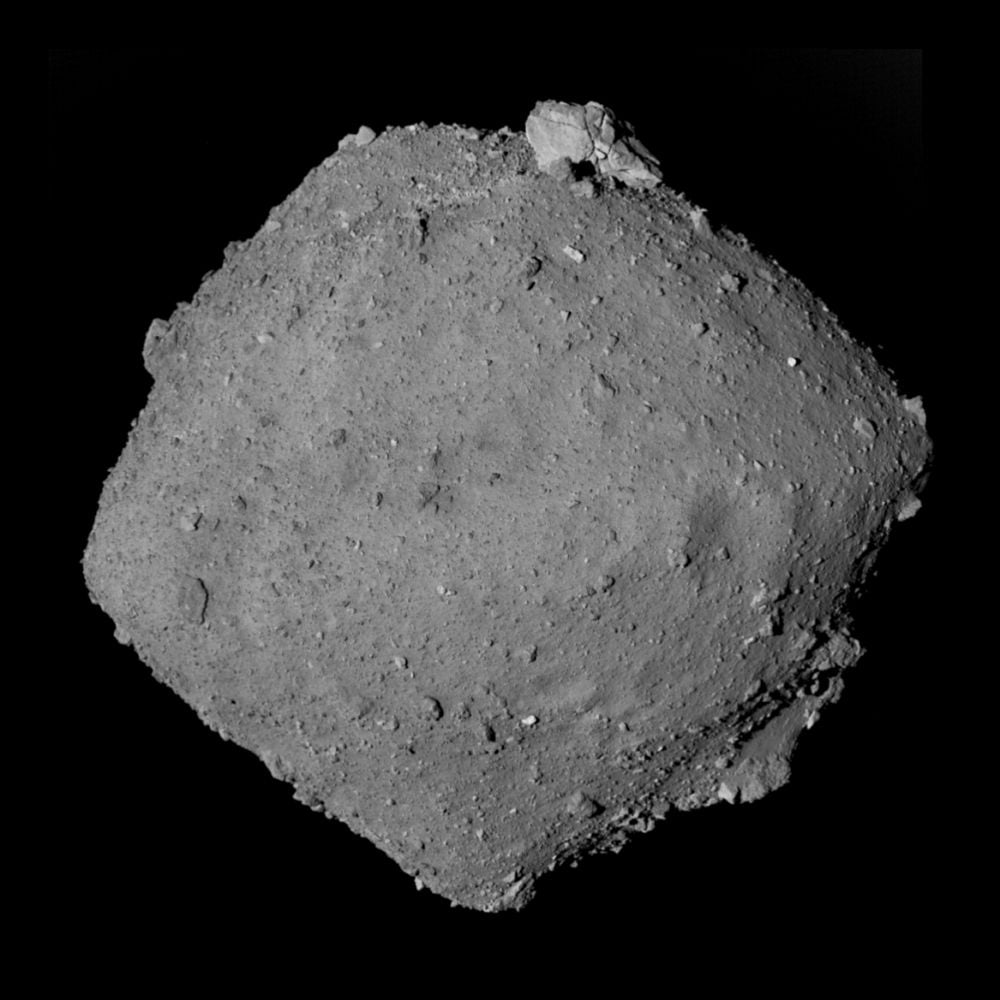
A team of researchers in Japan says a poorly ordered mineral may explain a long-standing puzzle in samples returned from the asteroid Ryugu. Their study, published in Nature Communications Earth and Environment and led by Reon Okumura of Kanazawa University, reports that a magnesium silicate hydrate (M-S-H) with weak crystal structure is widespread in the asteroid's fine-grained material, according to Universe Today. The finding offers a possible way to reconcile two apparently conflicting records of water-driven alteration inside the same rock.
Why it matters
Asteroids are often described as fossils of the early Solar System because much of their material has escaped the geological processing that has reshaped the rocky planets. Earth's crust is continually reworked by moving tectonic plates, by water that changes mineral chemistry, and by heat and pressure at depth; radiation has also left its mark on several worlds. According to Universe Today, asteroid parent bodies were spared most of these forces, which is why space agencies have gone to the effort of bringing pieces of them home.
The Japan Aerospace Exploration Agency's Hayabusa 2 mission collected material from Ryugu and delivered it to Earth in 2020. Nearly six years later, the sample is still producing results as scientists work through its mineralogy and chemistry.
The contradiction at the centre of the new work concerns aqueous alteration — the chemical and mineralogical changes that occur when rock meets water. On Earth, the familiar example is the conversion of common silicate rock into clay, a process bound up with soil formation. Ryugu has no soil, but its material carries clear signs that water once reacted with it.
The problem is that Ryugu's matrix appears to contain two components that seem to have formed under different watery conditions. That would suggest the interior of the asteroid's parent body was unevenly altered, which is difficult to square with the fine scale of the material. Universe Today describes this as a nagging question in cosmochemistry: how could water alter part of the matrix while leaving another part comparatively untouched?
What the instruments found
Ryugu belongs to the carbonaceous chondrite family, and its matrix is generally described as a mixture of serpentine- and saponite-like layered silicates — both minerals known on Earth as products of rock reacting with water. But the researchers note that the asteroid's versions do not fully match the well-ordered terrestrial minerals they are compared to.
To examine the sample closely, the team used two Japanese facilities: the SPring-8 synchrotron radiation source and the Photon Factory High Energy Accelerator. Both generate intense X-rays capable of probing the interior structure of the material.
The expected serpentine and saponite were there. So was something else: poorly crystalline magnesium silicate hydrate.
"What makes M-S-H particularly interesting is that it can accommodate a wide range of magnesium-to-silicon ratios," Keisuke Fukushi of Kanazawa University, the study's corresponding author, told the research team, as reported in the paper. He added that this flexibility may be key to understanding how water-rock interactions proceeded without erasing pre-existing chemical differences within the parent asteroids.
That property is what makes the mineral useful for the puzzle. Most materials hold a stable composition when exposed to the same aqueous conditions. M-S-H, by contrast, can form with differing magnesium-to-silicon ratios under identical conditions, according to prior research and laboratory work cited in the study.
The authors propose that M-S-H was the starting material. If it later transformed into serpentine and saponite phases, its presence could account for the two different outcomes without requiring separate water environments for each region of the parent body. In the new model, poorly crystalline M-S-H makes up the bulk of the matrix, while serpentine and saponite appear as minor, imperfectly formed intrusions. The earlier interpretation pictured tightly packed, orderly grains of the two minerals with almost no space between them.
Beyond a single asteroid
The implications extend past Ryugu. The study suggests that much of the matrix in carbonaceous chondrites more broadly could consist of poorly crystalline M-S-H. If this material precipitated first and was transformed afterward, the varied clay-like compositions seen in these meteorites could have arisen without distinct watery settings in different parts of a parent asteroid.
Universe Today notes that the sample's value lies precisely in its relative antiquity: material that has stayed close to its condition 4.5 billion years ago can inform reconstructions of the Solar System's history. Each new analysis of the returned grains adds to that picture.
Watch for follow-up work testing whether the M-S-H model holds across other carbonaceous chondrite samples and whether laboratory experiments can reproduce the transformation sequence the authors describe.





