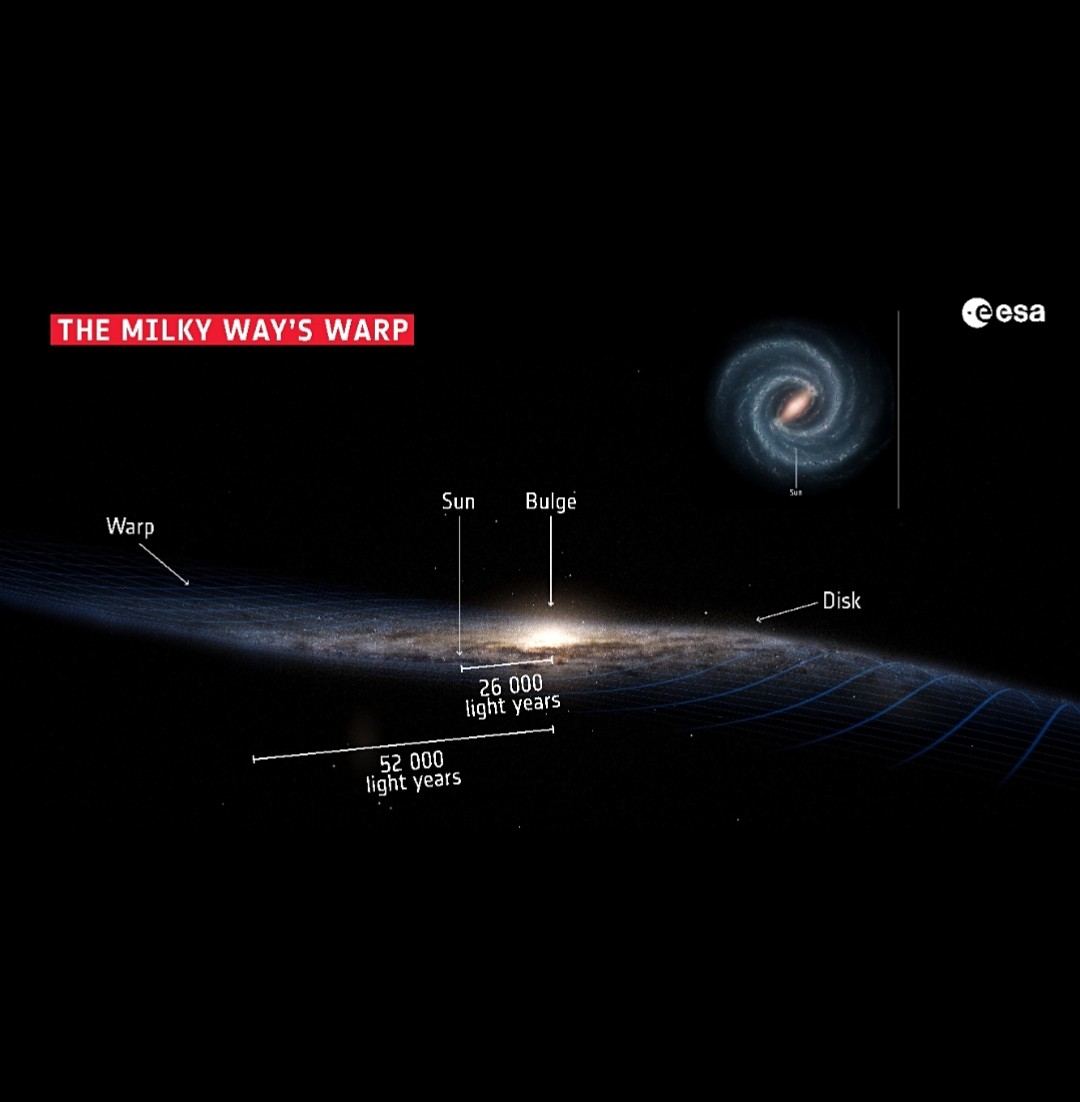
Our home galaxy does not sit in space as a neat, flat disc. According to timur media, a new study has found that the outer reaches of the Milky Way rise and dip in a pattern resembling swells on the surface of water. The research, published on 7 August 2026 in the journal Nature Astronomy, examined more than 30,000 collections of gas spread across the galaxy, timur media reports.
The findings indicate that the galaxy's rim carries a rippled structure that scientists had not previously mapped in full. The work appears under the title "Widespread corrugations superimposed on the Galactic warp in the outer CO disk," and the Chinese Academy of Sciences is cited alongside the journal publication as a source of the research.
Why it matters
The result reshapes a picture most people carry without questioning: that a galaxy is a tidy, level arrangement of stars. According to timur media, the study shows that the Milky Way is not a still and orderly gathering of stars at all. Its shape can shift in response to movement and to the gravitational pull of objects around it.
That matters because the Milky Way is the only galaxy we can observe from the inside, and its structure sets the frame for everything astronomers study within it. If its outer regions bend and ripple, then models that treat the galactic disc as a flat plane may be missing part of the story. The research also points toward the forces acting on our galaxy from outside, which remain only partly understood.
Gas clouds reveal a corrugated rim
The evidence comes from gas rather than stars. The team analyzed upwards of 30,000 gas groupings in the Milky Way's outer regions, according to timur media, and found a wavelike pattern running through them. The study describes this as a corrugation laid over the galaxy's existing warp — meaning the disc was already known to bend, and the new work adds a rippling texture on top of that bend.
The researchers suggest that large objects in the galaxy's surroundings may be responsible for the shape. Small galaxies that pass near or alongside the Milky Way could exert a pull that distorts its edges, timur media reports. The team is careful to note that the exact cause has not been settled and requires further investigation.
It is worth being precise about what the finding does not mean. Some coverage has likened the shape to butterfly wings, but that comparison is only a mental aid. As timur media explains, the image is used to help picture a galaxy that curves and is uneven — not a claim that the Milky Way has grown wings.
A galaxy on the move
The Milky Way is also traveling through the universe. Measured against the faint leftover radiation from the universe's earliest era, our galaxy moves at roughly 600 kilometers per second, according to timur media. That figure describes motion relative to a particular reference point, not an absolute speed through space.
Motion and gravitational attraction together help explain why a galaxy's outline can change over time. The study's authors frame the ripples as part of that ongoing process rather than a fixed feature.
Questions that remain open
Even with improving observational technology, astronomers are still working out how the Milky Way came together and how its form has evolved, timur media reports. The new paper adds a detailed map of the outer gas disc to that effort, but it leaves the underlying mechanism as an open question.
The next step will be to test whether passing companion galaxies can account for the pattern the team observed, and to see whether similar ripples appear in other parts of the galaxy's outer disc.