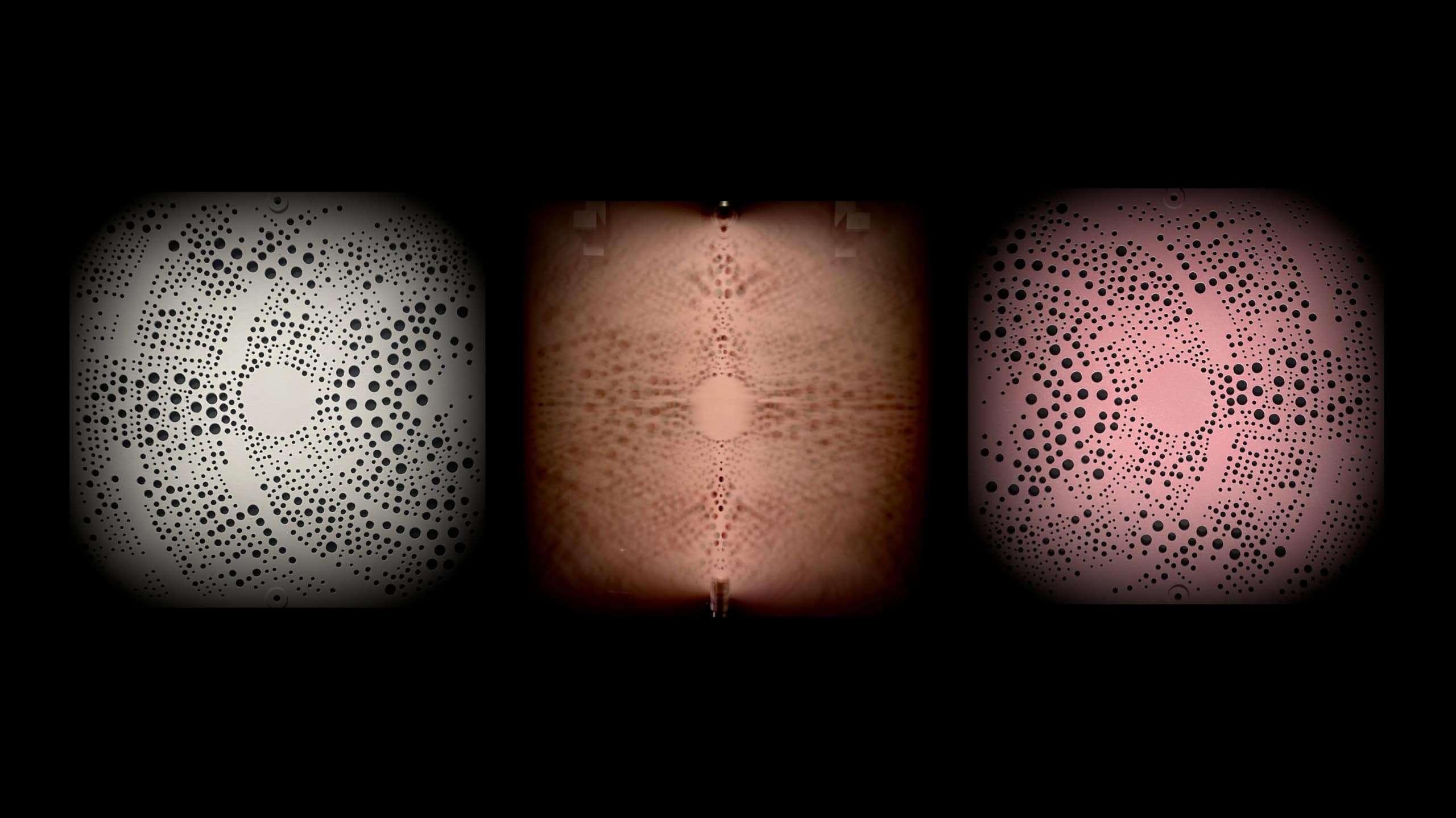
Scottish artist Gregor Harvie has unveiled a new installation marking a century since Erwin Schrödinger published the equation describing how a physical system's wave function evolves over time, Physics World reports. Titled Superposition, the work was produced with the quantum theory group at the University of Glasgow. It will be on view at the Technology and Innovation Centre at the University of Strathclyde on weekdays from 20 to 29 October.
The piece is built around two quantum phenomena: superposition and entanglement. According to Physics World, it consists of 16 aluminium panels, each pierced with hundreds of drilled holes that together form intricate patterns. One face of every panel is white and the other is coloured. When a visitor comes near, the panels rotate at 400 revolutions per minute, and their shapes break apart into what the report describes as shifting three-dimensional illusions.
Why it matters
Quantum mechanics is routinely demonstrated in laboratories and explained in textbooks, but it is rarely something a general audience can walk up to and watch. Harvie's installation is an attempt to close that gap by turning abstract formalism into a physical encounter.
Stephen Barnett, a theoretical physicist at the University of Glasgow, said the work gives people a way to meet the oddness of quantum mechanics directly and to ask questions about what they are seeing. He noted that quantum physics unsettles even our most basic assumptions about whether something can be said to hold a definite state, and that it reveals a reality stranger than anything encountered in ordinary life.
The centenary itself adds weight to the occasion. Schrödinger's equation, published in 1926, remains the central tool for predicting how quantum systems change, and it underpins fields from chemistry to semiconductor design. An artwork tied to that anniversary invites a public that mostly benefits from the equation indirectly to consider what it actually claims about the world.
How spinning panels stand in for a wave function
The analogy works through the panels' behaviour. They are grouped into eight pairs, and where each panel comes to rest is random. Over time, seven of those pairs land on the same side as their partner about half the time. Physics World reports that this serves as a comparison for superposition, with the moment a panel stops standing in for the collapse of the wave function.
The eighth pair breaks the pattern. Looked at one at a time, its two panels still appear to halt at random, but viewed as a unit they present the same face three-quarters of the time. That deviation is the installation's representation of entanglement, the linking of two systems so that their measured outcomes are correlated in ways that separate objects are not.
Harvie's background is unusual for an artist working in this territory. He holds a doctorate in computational fluid dynamics, and in 2024 he marked the bicentenary of Lord Kelvin's birth with a piece called Beyond Absolute Zero. Speaking about the new work, he said he set out to build something a person could stand in front of without being able to say with confidence what they were looking at. The panels, he observed, are mostly holes, so in a sense little is present — yet at sufficient speed they become something striking that the eye struggles to fix. Their appearance shifts with the viewer's position, he added, and one pair behaves in a manner that resists ordinary reasoning.
That last point is the conceptual hinge. Superposition and entanglement are frequently introduced through thought experiments, and the results can feel like philosophical puzzles rather than descriptions of nature. Harvie's version asks visitors to trust their eyes and then find that their eyes will not settle. The randomness is real in the sense that no one can predict where a given panel stops, yet the statistics across the eighth pair carry a signature that individual panels do not show.
What to watch
Superposition runs on weekdays from 20 to 29 October at the University of Strathclyde's Technology and Innovation Centre, giving visitors a limited window to judge for themselves whether spinning aluminium can convey what a century of quantum theory has established.





