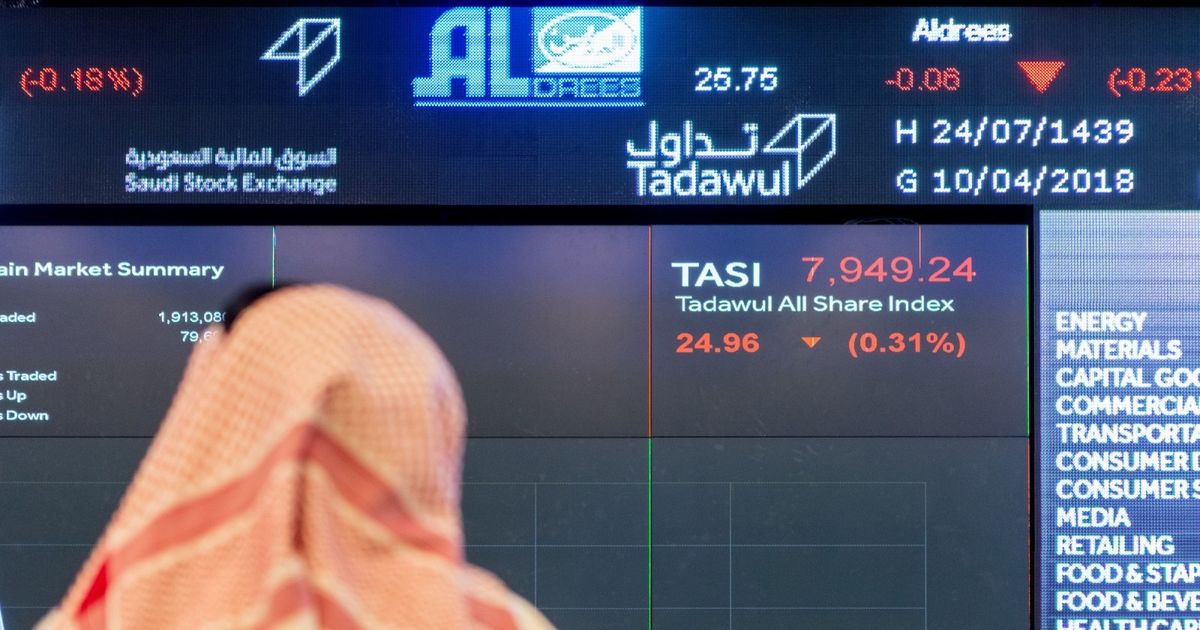
Saudi Arabia's main stock index fell sharply on Sunday, 25 October 2026, dropping roughly 2.4% during trading to about 9,450 points — its lowest level since March 2021, according to الشرق بلومبرغ. The decline came even as some corporate results beat expectations, with investors staying cautious amid geopolitical tensions and worries that higher oil prices could feed inflation and global interest rates.
The drop extended a run of eight consecutive weekly losses, the longest losing streak since December 1994, الشرق بلومبرغ reported. The index ended last week down 4.1%, its biggest weekly fall since May 2024, bringing year-to-date losses to around 7.7% by the start of Sunday's session.
Why it matters
The Saudi market is the region's largest, and its slide comes at a moment when oil prices are elevated rather than weak. Brent crude was near $117 a barrel at the end of last week, yet that did not lift Saudi energy shares at the open, as investors focused on the risk of escalation rather than the revenue implications of higher crude. The divergence suggests markets are pricing security risk over commodity strength.
The weakness also has a global dimension. The rise in crude has revived inflation concerns ahead of this week's Federal Reserve interest-rate decision. Most S&P 500 companies fell in Friday's session, the Dow Jones dropped about 1.2%, and US Treasuries gave back part of the previous session's gains, الشرق بلومبرغ reported.
Security developments set the tone
Investors entered the week against a backdrop of fresh security news. The Saudi-led coalition supporting Yemen's legitimate government announced it had intercepted and destroyed drones and ballistic missiles over Riyadh and other Saudi cities, according to الشرق بلومبرغ. Riyadh's King Khalid airport said it had resumed operations after a two-week halt that followed a missile strike that killed 12 people and injured dozens.
Meanwhile, remarks by US President Donald Trump kept open both the possibility of a deal with Iran and a resumption of military operations, adding to uncertainty over the conflict's direction and the security of supply, الشرق بلومبرغ reported.
Sector-by-sector pressure
The main index's decline was broad. Energy and banking sector gauges fell about 1.3% and 2.4% respectively, while telecommunications and utilities dropped roughly 2% and 3.4%, الشرق بلومبرغ reported.
Among individual stocks, Saudi Aramco lost about 1.8%, Al Rajhi Bank fell 2.5%, Saudi National Bank slipped 1.7%, ACWA Power shed 3.8% and stc declined about 0.78%. The basic materials sector fell 2.6%, deepened by SABIC's reversal into losses.
SABIC's earnings beat fails to hold
SABIC reported quarterly profit of 500 million riyals, against expectations of 238.3 million riyals and a loss of 833 million riyals in the prior quarter, according to الشرق بلومبرغ. Revenue, however, fell 3.1% year on year to 28.17 billion riyals.
The stock initially rose 1.65% in early trading before turning down about 0.8%. Mary Salem, a financial analyst at الشرق بلومبرغ, said the results show quarterly improvement, but judging whether it lasts requires separating core business performance from one-off items and investment results. She added that SABIC's improvement does not necessarily mean the rest of the petrochemical sector performed similarly.
Majed Al-Khalidi, a senior financial analyst at Al-Eqtisadiah newspaper, said on الشرق بلومبرغ's "Al-Sabah" program that beating expectations is a positive development, supported by recovering sales volumes, better logistics and the use of alternative shipping routes. He cautioned, though, that some second-quarter orders may have shifted into the third quarter, which warrants care in assessing how durable the improvement is, with supply-chain challenges persisting and performance likely to vary in coming quarters.
Domestic-facing names hold up
Not every stock fell. Dr. Sulaiman Al Habib gained about 0.9% after the group's third-quarter profit grew 13.2% to 681.6 million riyals, ahead of expectations of 664.3 million riyals, helped by growth in hospital and pharmacy activity and better performance at new hospitals, الشرق بلومبرغ reported. The group approved a dividend of 1.37 riyals per share for the quarter, compared with 1.21 riyals in the same period a year earlier.
Youssef Youssef, director of financial data development at Argaam, said on الشرق بلومبرغ's "Al-Jalsah Al-Ula" program that companies tied to domestic demand have shown more resilience to disruptions than some export-dependent businesses. Al-Khalidi said Al Habib's results reflect the first visible effect of expansions on profitability, though operating, depreciation and financing costs linked to those expansions remain.
What to watch
Attention now turns to the Federal Reserve's rate decision this week and whether oil's climb continues to weigh on sentiment more than it supports Saudi energy valuations.