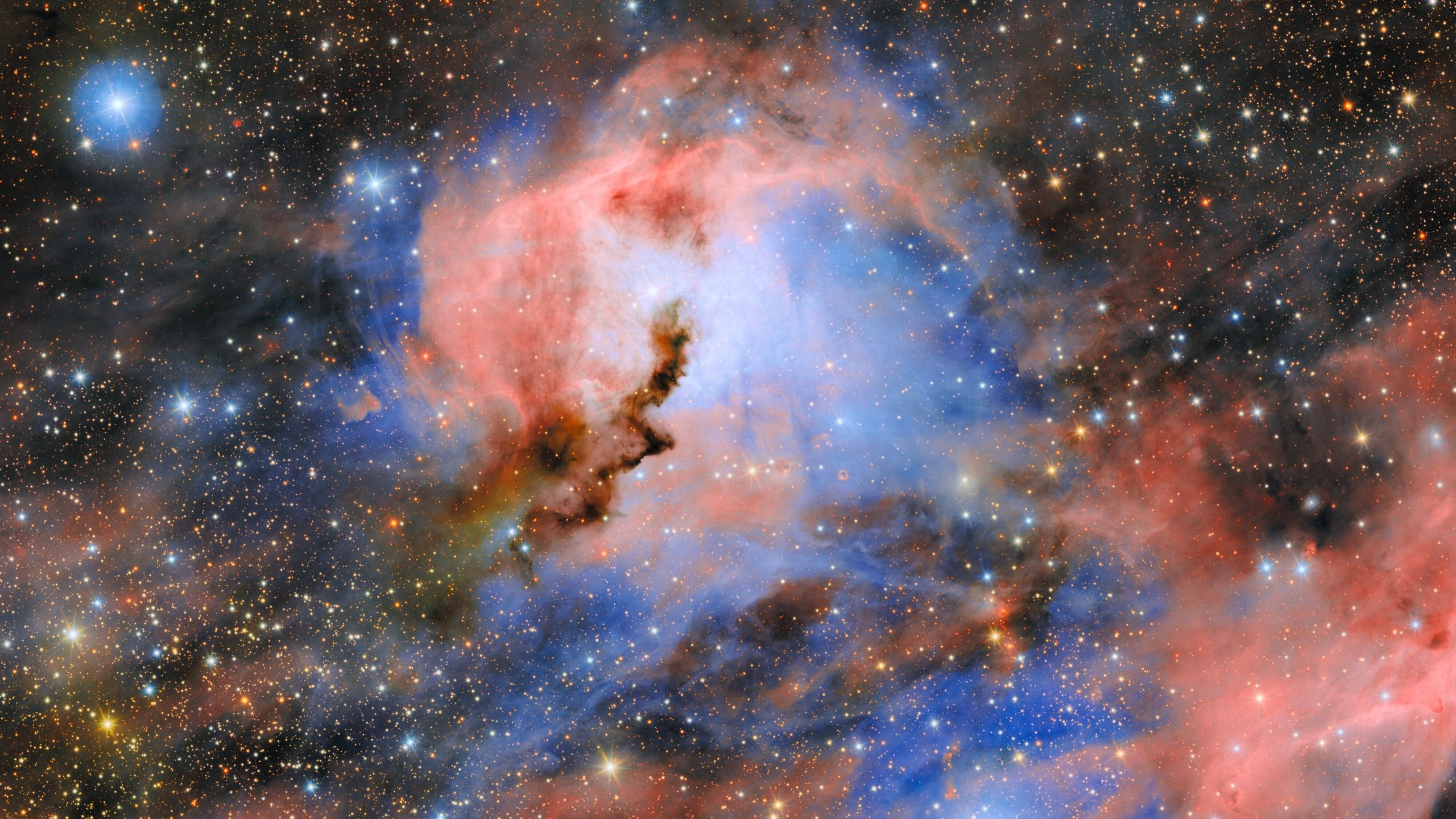
The Vera C. Rubin Observatory released an image on Oct. 22, 2026, showing the head of the Seagull Nebula (IC 2177) as captured by its Commissioning Camera, known as ComCam. According to Live Science, the 144-megapixel instrument was pointed at the nebula as an early test of the observatory's hardware, software and image-processing systems. The nebula sits roughly 3,700 light-years away, between the constellations Monoceros and Canis Major.
The picture centers on a cloud called Sharpless 2-292, the "head" of the bird-shaped complex. Live Science reports that the nebula is made up of three large clouds of gas lit up by radiation. The pink color in the image comes from hydrogen gas that glows as ionizing radiation streams outward from young stars at the center of the cloud. The blue portions are dust clouds that reflect light from young blue stars elsewhere in the region.
Why it matters
The image is not the observatory's final product but a check on whether its systems worked. Live Science reports that ComCam took about 16,000 exposures of the night sky between Oct. 24 and Dec. 11, 2024, according to the National Science Foundation, which manages Rubin together with the U.S. Department of Energy. Those deep-space photographs served as an early trial of the telescope's instruments and processing pipeline.
The test also previewed what the finished facility could do. Rubin has since moved to a far more capable camera, and the crispness of the ComCam frame offers a sense of the survey work still ahead.
A flickering trio at the center
The "eye" of the nebula in the image is not a single object. Live Science reports it is the triple-star system HD 53367, a group of three very young, energetic stars that are actively reshaping the gas around them. Their radiation is what sets the surrounding hydrogen aglow.
The Seagull Nebula's appearance comes from this mix of glowing gas and reflected starlight. The young stars at the center drive the pink emission, while dust elsewhere in the complex scatters blue light from other young stars in the area.
From test shots to a ten-year survey
ComCam's view was wide, but the observatory's current instrument is much larger. Live Science reports that the Legacy Survey of Space and Time Camera, now mounted on Rubin's Simonyi Survey Telescope, has more than 20 times ComCam's field of view. It produces 3,200-megapixel images of the sky every 30 seconds, according to Tony Tyson, Rubin's chief scientist, who previously spoke with Live Science. At that rate, the camera completes a full scan of the southern sky every few nights.
The Legacy Survey of Space and Time has now officially begun. Live Science reports that Rubin will spend the next decade photographing the sky night after night, assembling a time-lapse record of the universe. That record is expected to turn up millions of cosmic objects, from exploding supernovas to previously unknown comets and exoplanets.
The Seagull Nebula image, then, is a small sample of a much bigger undertaking. It shows a star-forming region being carved by the young stars inside it, captured by an instrument that was still being put through its paces.
Watch for results from the Legacy Survey of Space and Time as the ten-year campaign continues.