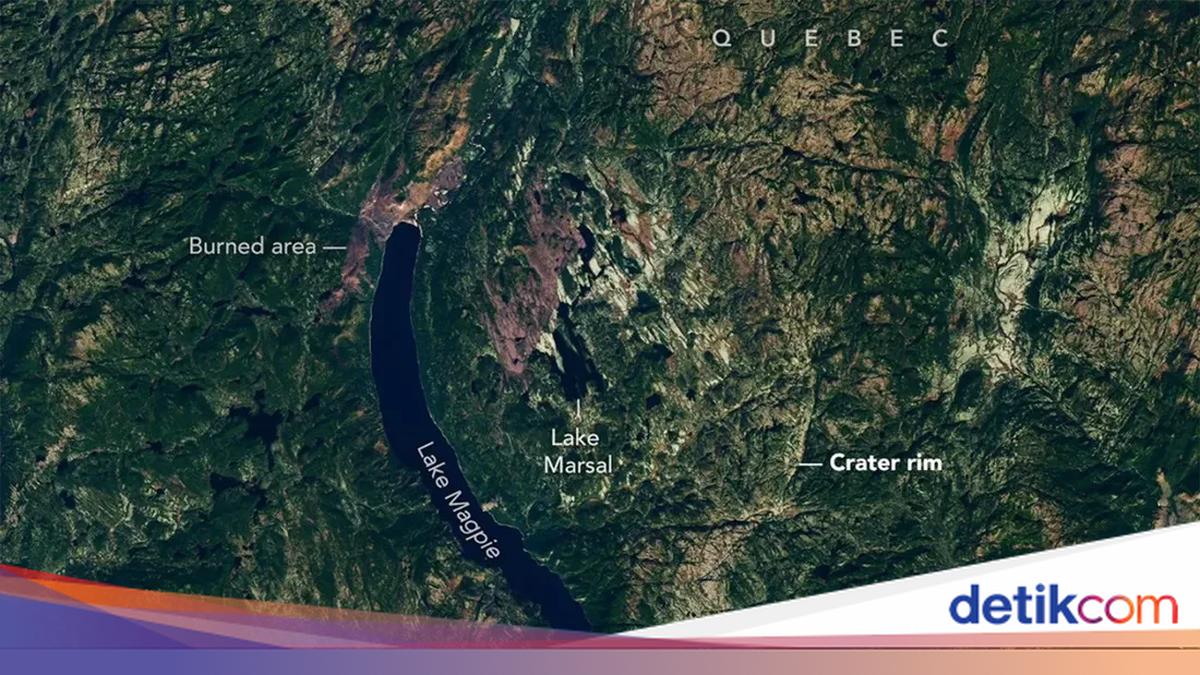
A man planning a camping trip in Quebec instead identified what researchers now describe as a 390-million-year-old meteorite impact crater, according to detikInet. Joël Lapointe was scouting locations in the Côte-Nord region on Google Maps in 2024 when he noticed an unusual circular landform roughly 15 kilometres wide around Marsal Lake. Canadian broadcaster CBC reported the story at the time, and follow-up research has since confirmed the structure's origin.
Lapointe contacted Pierre Rochette, a geophysicist at France's Environmental Geosciences Research and Teaching Center (CEREGE), believing the odd feature might be an ancient impact site. Rochette took the tip seriously enough to investigate. "Looking at the topography, it strongly suggests an impact," Rochette told CBC in 2024, as cited by detikInet.
Why it matters
Only about 200 impact structures have been confirmed on Earth, so a new one is a rare addition to the record. The find also shows that a sharp eye and publicly available satellite imagery can still turn up something that decades of geological mapping missed.
Rochette and his colleagues examined the area more closely and concluded that the small mountain ridges ringing the lake had likely been classified incorrectly. The formation had been interpreted as a volcanoclastic diatreme known as the Marsal breccia, in a region with no post-Grenvillian magmatism. The team argued it fits better with clastic melt-poor rock at the base of a crater floor, similar to the cases at Mistastin and Janisjarvi. They presented that assessment at the 86th Annual Meeting of the Meteoritical Society in 2024.
That was suggestive, but not proof. Confirming an impact requires evidence that cannot be explained any other way, so Gordon Osinski, a planetary geologist at Western University and director of the Impact Earth database, joined an expedition to the site organised by CEREGE. Osinski had been skeptical of the crater interpretation but was interested enough in the site's potential to make the trip.
Breccia cones seal the case
After flying to the lake by seaplane, the team found shatter cones — cone-shaped features in rock produced by the shock waves that follow an impact. Osinski described them as the only indisputable field evidence of an impact event that can be seen with the naked eye, in a statement released by NASA.
Analysis of rock samples led the team to date the event to roughly 390 million years ago. Osinski noted that if a meteor of the same size struck Earth today, it would cause destruction on a regional scale, levelling major cities and affecting the global climate.
The team named the structure Uhackatik after discussions with the local Ekuanitshit Innu community. It is expected to be formally confirmed as an impact crater when the Meteoritical Society committee meets next.
Lapointe, for his part, encouraged people not to dismiss their own intuition or observations, even outside their field of expertise, telling Radio Canada he was thrilled by the outcome.
Scientists believe more impact craters remain undiscovered on Earth — possibly waiting for someone to stumble on one while idly browsing Google Maps.





