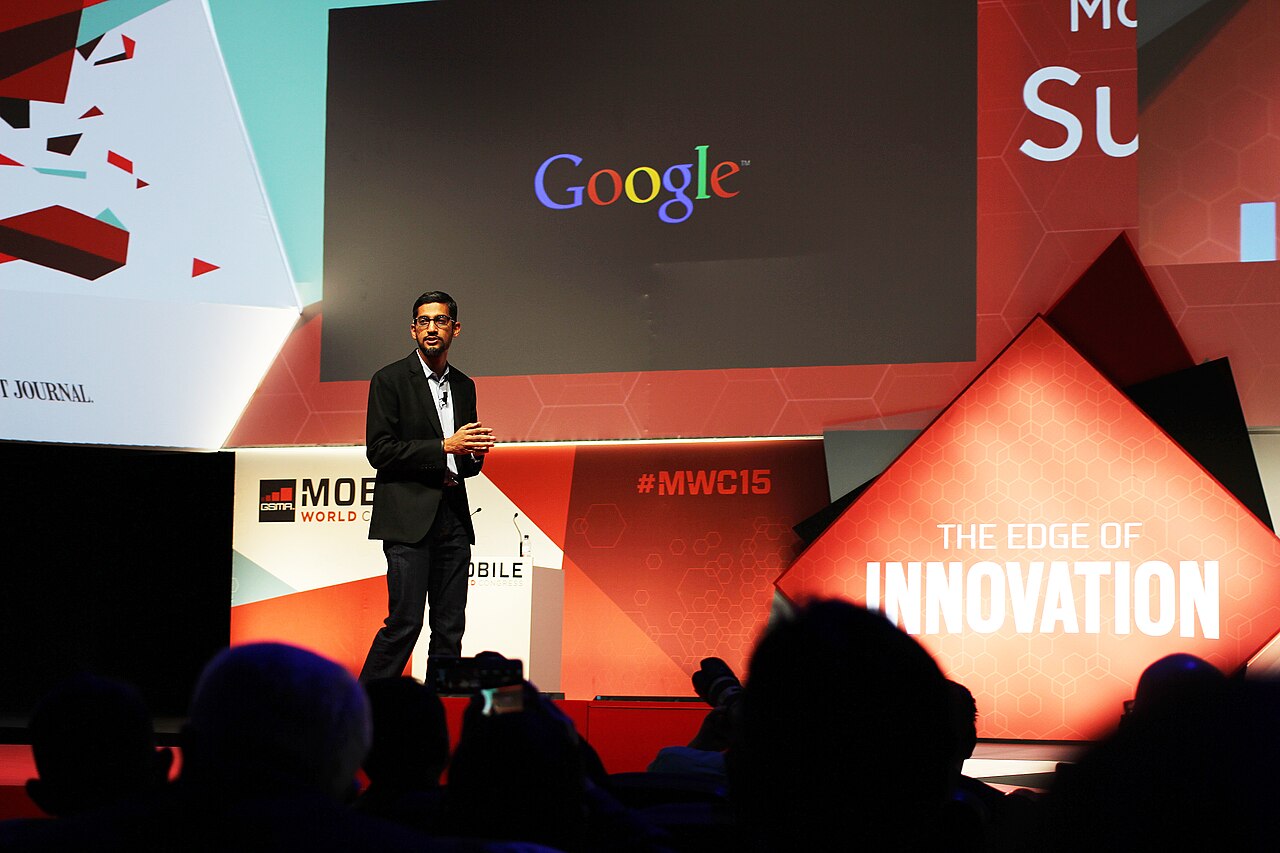
Google chief executive Sundar Pichai has stopped putting a number on how much of the company's code is written by artificial intelligence, telling the Big Technology Podcast that the question no longer carries meaning because AI now touches every part of the work. In the same interview, recorded at Google's Mountain View headquarters and also published by host Alex Kantrowitz as a written Q&A, Pichai played down the prospect of AI systems improving themselves without people in the loop. Martin Cid Magazine reported the exchange.
The remarks came in response to Kantrowitz raising Google's earlier claim that a quarter of its code came from AI and asking where that figure stands now. Pichai called the metric pointless, saying all code Google works with today is deeply shaped by AI.
Why it matters
The percentage Pichai set aside was a rare figure outsiders could hold up against disclosures from other companies. What replaces it — and the evidence behind his more measured view of self-improving AI — rests on Google's own measurements of Google, according to Martin Cid Magazine.
That matters because the industry is watching for signs of recursive self-improvement, or RSI, in which AI systems take part in building their successors. Google's co-founder has spoken about it in ambitious terms, while its CEO is urging patience. The gap between those two framings, and the fact that the supporting data is internal, leaves outside observers with little to check against.
New numbers, same source
Instead of a share of code, Pichai pointed to usage figures for Gemini 4 Argon, Google's latest model, which the company has put in the hands of its own engineers. In the four weeks after launch, Google saw a 30 percent rise in CLs — its internal term for code submissions — and a one-third drop in rollbacks, meaning changes that had to be undone after shipping. Pichai said the company is now tracking newer metrics.
The older measure did not simply fade away. In an April blog post, Google said AI accounted for 75 percent of new code, up from 25 percent in 2024 and 50 percent the previous autumn, according to Semafor and ETV Bharat as cited by Martin Cid Magazine. Semafor noted at the time that some of the claims were nearly impossible to verify independently, and compared them with Snap's 65 percent and Meta's pursuit of similar levels.
On recursive self-improvement, Pichai framed his answer as a clarification of what co-founder Sergey Brin had meant. Brin had described RSI as an important element of Argon, Pichai said, but "we are still far from the end stage of RSI." He described Google's actual position this way: RSI loops exist alongside AI researchers across different areas of model development, and the company has what amounts to agents helping researchers collaborate on building models in a partly automated way.
Brin had gone further days earlier. At a roundtable on Argon that Google shared, he said the company "is starting to get on that RSI treadmill" and that its researchers and the model now work side by side on the next version, Business Insider reported. A Gladstone AI report published this month found that most researchers interviewed at Anthropic, OpenAI and Google DeepMind expect RSI to begin within three to twelve months, according to Martin Cid Magazine.
Google's own scorecard
On paper, the results support Pichai's caution. Google DeepMind's safety report for Argon states there is no significant acceleration from start to finish in AI research and development, whether AI-driven or otherwise, and rates the risk as currently low, TNW reported. According to the report, AI agents write most production code and bug fixes, but humans still review code changes before submission. The share of fully delegated pull requests rose from 7.5 percent in April to 11.9 percent in September; roughly 88 percent still need recurring human guidance or code written by a person.
Those findings rest on Google's own tools. The threshold for when AI automates AI research is judged against an internal benchmark of 74 tasks that nobody outside the company can run. An analysis published on LessWrong points to a line in the report itself: of the original tasks Google reviewed, about a quarter contained bugs that blocked all submissions from being accepted. Because many runs hit their time limits, the report gives no precise estimate for Argon, which passed roughly half of the runs that completed. Google says its conclusion holds even if every incomplete run had succeeded.
Human review is the checkpoint the safety argument depends on. Thirty percent more code submissions means thirty percent more changes for the people doing that checking, and the metrics Pichai chose to highlight count output and rollbacks — not how carefully each change was examined.
Pichai did not dismiss the concern. Research on AI alignment still has clear gaps, he said, and it is reasonable to be worried. His proposed next step is industry-wide standards, including the ability to evaluate models with independent reviewers, modeled on accounting standards and external auditors, along with regulation that will play a role.
By that yardstick, both of this week's claims remain unaudited. Google counts its own changelists, judges its own rollbacks and scores its own research benchmark. The percentage Pichai called meaningless was crude, but anyone could compare it with Snap's. The figures replacing it can only be read from Google's point of view.
Watch whether Google publishes an external evaluation of Argon's research benchmark, or whether the next round of numbers arrives, as this one did, from inside the company.