A physicist at the University of Jinan in China has published work arguing that travelling into one's own past is impossible across a wide range of theoretical universes. Hongsheng Zhang's paper, which is awaiting peer review, was reported by Euronews.com and ScienceAlert. The research also sets out the only two routes by which a time machine could, in principle, send someone backward.
The claim rests on a single feature of relativity: light's direction of travel can never be perpendicular to an object's movement through time. Zhang treats spacetime as a series of surfaces that light can cross. Anything moving at, below or above light speed must pass through those surfaces in the same direction, according to the argument — comparable to a staircase that only permits upward steps. A traveller who can only ascend can never return to the step where the journey began.
Zhang told ScienceAlert that the reasoning involves no exotic matter, no quantum effects and no assumptions about what the universe contains. "The whole content is bookkeeping about directions," he said, according to the outlet.
Why it matters
Physicists describe a journey to the past as a closed timelike curve — a path through spacetime that returns to the exact place and moment where it started. Einstein's equations permit such loops in a small number of situations, including near the centre of a rotating black hole. Zhang's work suggests those loops may not survive once the behaviour of light is taken into account, which would rule out backward travel in a broad class of universes.
Forward time travel, by contrast, is not in dispute. Einstein showed that travelling at high speed or sitting in strong gravity causes a clock to run slower than clocks elsewhere. The European Space Agency notes that astronauts on the International Space Station come home a few thousandths of a second younger than they would have been otherwise.
Two ways a time machine could work
Zhang's paper does more than rule things out. According to the reporting, it identifies exactly two mechanisms that would allow a closed timelike curve to form.
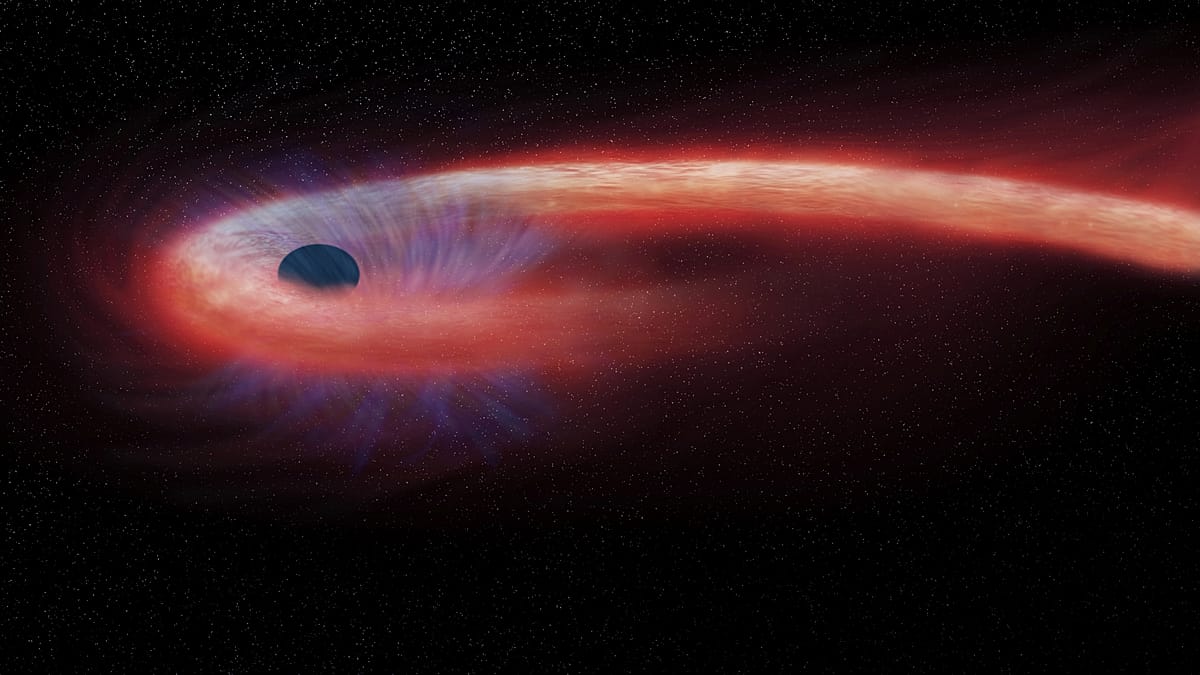
The first is twist. If light rays spiral around one another rather than running parallel, the orderly surfaces that light can cross fail to take shape, and the one-way staircase disappears. This is what Einstein's theory predicts near the core of a spinning black hole, where a rotating mass drags space and time along with it. NASA's Gravity Probe B satellite measured that dragging effect around Earth in 2011. Deep inside the black hole, the pull is strong enough to bend forward motion in time into a closed circle. A traveller on that circle would experience their clock running normally while arriving back at their departure moment. The physicist Brandon Carter demonstrated in 1968 that such loops exist inside rotating black holes.
The second mechanism is the overall shape of the universe. The staircase itself might be sound, but if it wraps around the structure it belongs to, the highest step could lead directly back to the lowest — the kind of impossible stairway drawn by M. C. Escher. A traveller would keep climbing and still finish where they started. Most time machines physicists have designed on paper, wormhole-based ones included, depend on this arrangement.
What the argument does not settle
Zhang was careful about the limits of his result. He told ScienceAlert that the work does not establish whether nature actually permits any of these constructions. "That remains open, and it is the question I would most like to see answered," he said, according to the outlet.
The paper has not yet completed peer review, so its conclusions remain provisional. Euronews.com framed the findings as bad news for anyone hoping to follow in the footsteps of fictional time travellers, and advised packing for tomorrow rather than yesterday.
Watch for the peer-review outcome, and for responses from other relativists on whether the staircase argument holds in every universe it claims to cover.





