A physicist at the University of Jinan in China has published work arguing that travelling into one's own past is impossible across a wide range of theoretical universes, according to Euronews.com. Hongsheng Zhang's paper, which has not yet completed peer review, also sets out the only two mechanisms by which a time machine could, in principle, send someone backwards. The findings were reported by Euronews.com and discussed by Zhang with ScienceAlert.
The result does not settle whether nature actually permits any such machine. Zhang told ScienceAlert that his argument does not establish which of the possibilities the real universe allows, describing that open question as the one he would most like to see answered.
Why it matters
Backward time travel is a staple of fiction and a recurring puzzle in theoretical physics. Einstein's equations of general relativity permit paths through space and time that loop back to their own starting point — physicists call these closed timelike curves — in certain scenarios, such as near the core of a rotating black hole. Whether those solutions describe anything real has remained unresolved.
Zhang's contribution is a constraint on where such loops could arise. According to Euronews.com, he shows that in a broad class of theoretical universes, returning to one's own past cannot happen. The paper also narrows the routes by which it could: only two mechanisms survive his analysis.
Forward time travel, by contrast, is not in dispute. Einstein established that moving at high speed or sitting in a strong gravitational field slows a clock relative to observers elsewhere. The European Space Agency notes that astronauts aboard the International Space Station come home a few thousandths of a second younger than they would otherwise be, Euronews.com reports.
The staircase argument
The core of Zhang's case rests on a feature of relativity: the direction of light can never sit at ninety degrees to an object's direction in time. Euronews.com illustrates the idea by imagining spacetime sliced into layers along which light itself can travel. Anything moving slower or faster than light must cross those surfaces in the same direction — comparable to climbing a staircase that never lets you descend a step.
The reasoning, as Zhang described it to ScienceAlert, involves no exotic matter, no quantum effects and no assumptions about what fills the universe. He characterised the whole content of the argument as bookkeeping of directions.
The two loopholes
Where the staircase picture breaks down, backward travel becomes conceivable. The first route is twisting. If rays of light spiral around one another like the strands of a rope rather than running parallel, the ordered light surfaces fail to form, and the one-way staircase disappears.
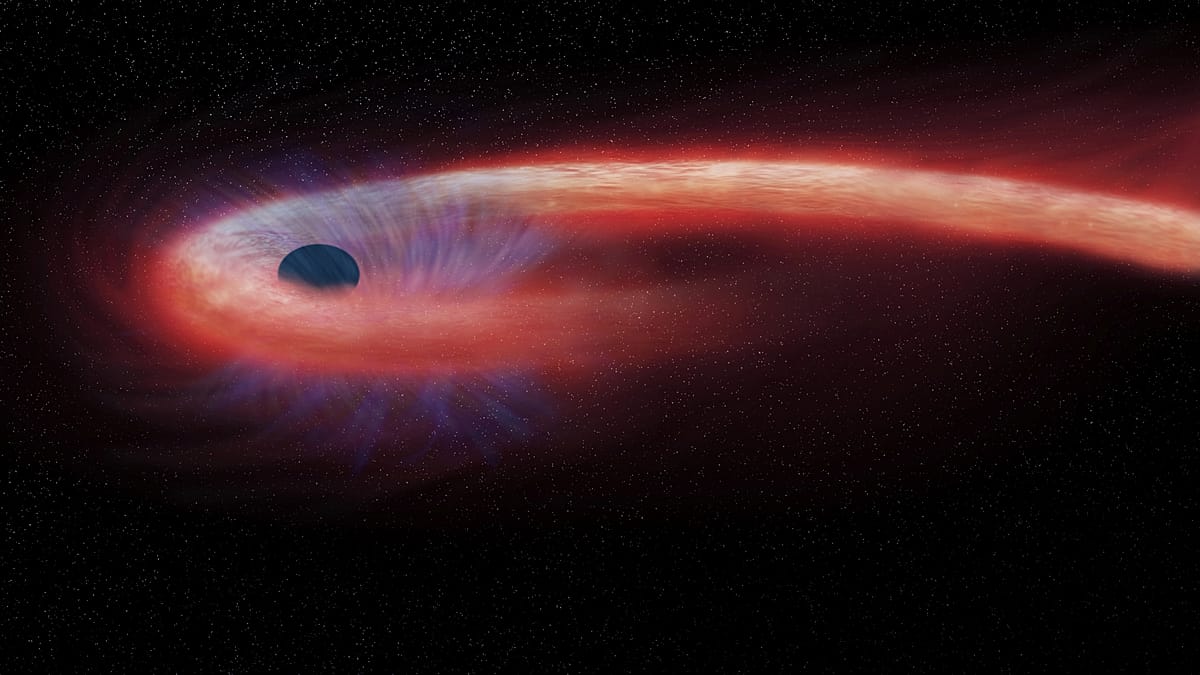
This is what Einstein's theory predicts near the centre of a rotating black hole, where a spinning mass drags space and time along with it. NASA's Gravity Probe B satellite measured that dragging effect around Earth in 2011. Close to a black hole's core, the pull is strong enough that motion "forward" in time bends into a circle. A traveller following that circle would experience their clock running normally while arriving back at the moment of departure. The physicist Brandon Carter demonstrated in 1968 that such loops exist inside rotating black holes, according to Euronews.com.
The second route is the shape of the universe itself. Euronews.com compares it to a staircase that is perfectly built but wraps around the outside of a building, so the top step leads straight back to the bottom — the impossible stairs of an Escher drawing. A climber keeps ascending yet always ends where they began. Most time machines physicists have sketched on paper, including those built from wormholes, rely on this trick.
What remains open
The paper's scope is theoretical. It identifies the conditions under which closed timelike curves could exist and rules them out elsewhere, but it does not say whether either surviving route is realised in nature. That question, by Zhang's own account, is unresolved.
Euronews.com frames the practical upshot simply: anyone packing for a trip might do better to plan for tomorrow than for yesterday.
Watch for peer review of Zhang's paper, and for follow-up work testing whether either of his two loopholes can exist in a universe like ours.





