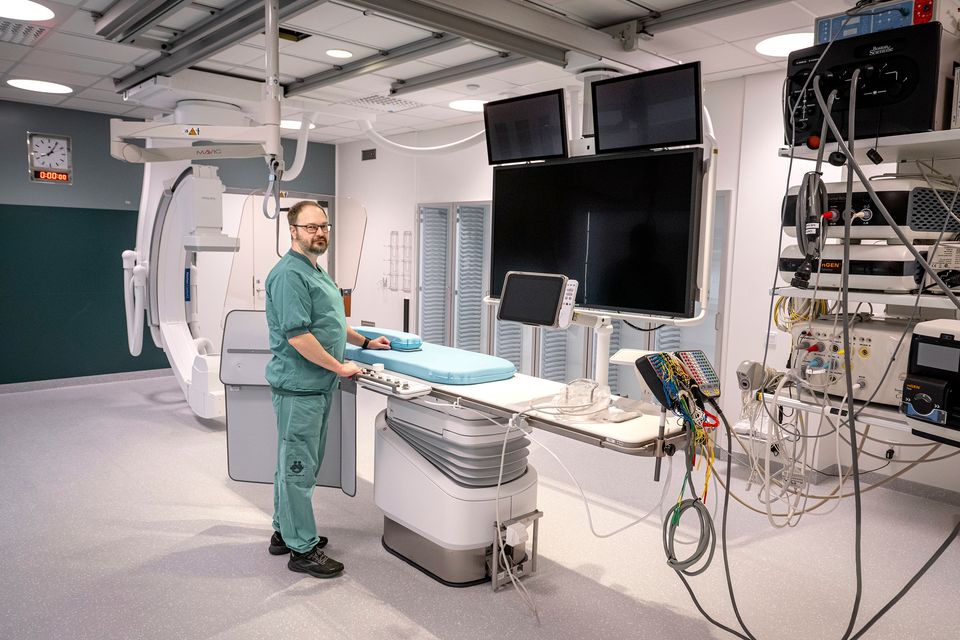
Patients in Örebro County with various forms of heart rhythm disturbance can now be treated in a newly completed ablation laboratory at Universitetssjukhuset Örebro (USÖ), according to Via TT. The unit replaces equipment that the hospital describes as the oldest of its kind in Sweden and is intended both to widen access to treatment and to allow procedures that were not previously possible there.
Why it matters
Ablation is a catheter-based treatment for arrhythmia, the general term for a heart that does not beat in its normal rhythm. Via TT reports that arrhythmias occur in people of all ages and can have several different causes. One form, atrial fibrillation, is now classified as a widespread public health condition in Sweden, and the number of people diagnosed with it is rising.
Aron Sztaniszlav, a senior physician in the cardiology, pulmonary medicine and clinical physiology unit at USÖ, told Via TT that the growing caseload is largely demographic. Atrial fibrillation becomes more common with age, he explained, and the population as a whole is getting older.
Leaving atrial fibrillation untreated can contribute to other serious illness, including stroke, according to the reporting. That makes timely access to effective treatment a significant concern for an ageing population.
A treatment that outperforms medication, but comes with a wait
At USÖ, a range of arrhythmias are treated, and roughly half of the cases are atrial fibrillation, Via TT reports.
Sztaniszlav said ablation is an effective treatment for atrial fibrillation and other rhythm disorders, and that some arrhythmias can be cured outright at the first procedure. In atrial fibrillation specifically, he said ablation is considerably more effective than medication at preventing distressing episodes of a racing heart.
Access, however, has been constrained. Sztaniszlav told Via TT that waiting times for ablation stretch to as long as a year. The hospital currently treats around 400 patients a year with the procedure, and staff hope the new facility will allow that number to rise somewhat. He added that the unit works continuously on refining both outcomes and the flow of patients through its services.
Up-to-date technology and room for sedation
The new laboratory is equipped with current technology, which the hospital says will allow procedures to be carried out more efficiently and will support additional types of ablation that were not feasible before. The space is also better set up for anaesthesia, since some patients need to be sedated during treatment.
Sztaniszlav described the previous laboratory as probably the oldest in Sweden. Moving into a facility with up-to-date equipment means the team can work more effectively and offer a wider range of ablation procedures, he told Via TT.
Fredrik Calais, head of the cardiology, pulmonary medicine and clinical physiology unit, said the advantages of the new lab are numerous, and that the main benefit is the ability to help more patients now that modern facilities are in place. He also said the change should give the operation more momentum.
According to Via TT, the combination of current technology and methods means residents of the county can receive care on a more equal footing with patients at Sweden's other university hospitals.
Another lab on the horizon
The hospital is not stopping with this facility. Calais told Via TT that within a couple of years the unit expects access to an additional laboratory for ablation work. That lab is planned as a combined facility where different kinds of treatment and investigation can be carried out.
For now, the focus is on putting the new laboratory into full use and on reducing the backlog of patients awaiting ablation. How quickly the annual treatment figure rises, and whether waiting times shorten, will be the measures to watch.





