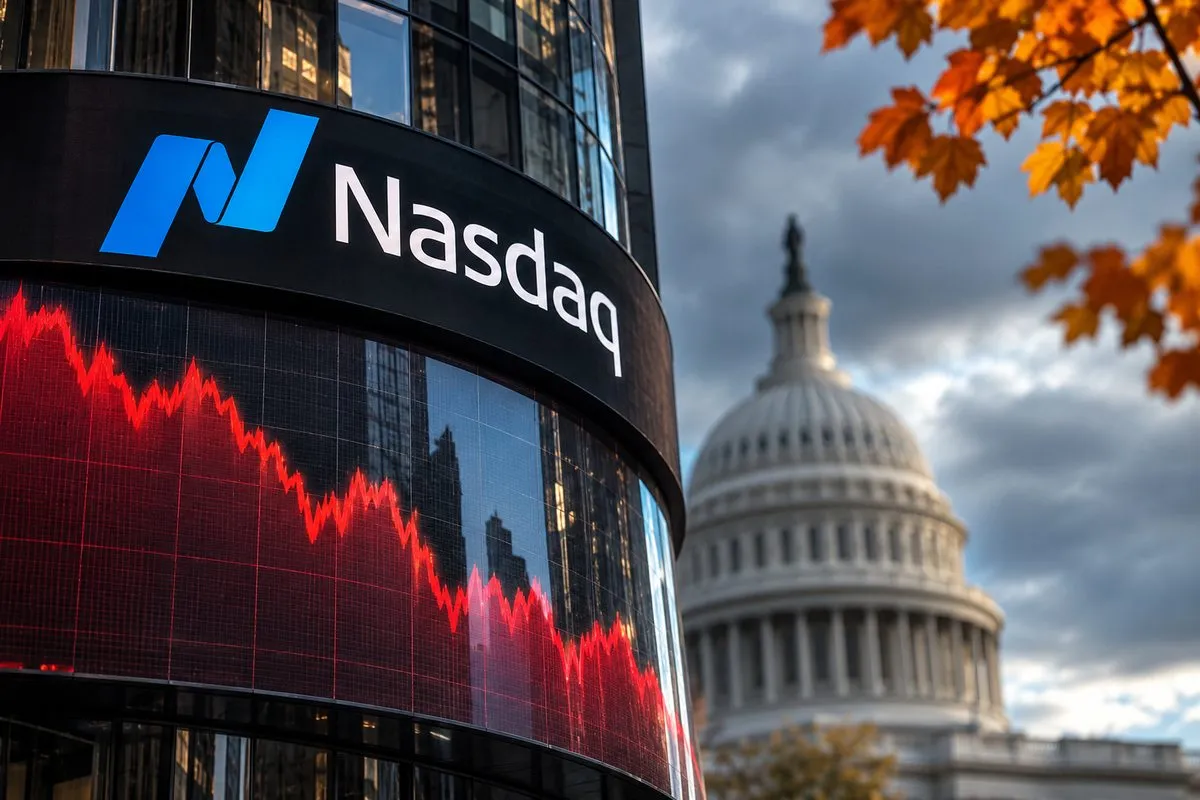
The Nasdaq Composite fell about 5% on Thursday and was headed for a correction, while the S&P 500 dropped more than 3%, as a broad selloff in semiconductor and artificial intelligence stocks erased roughly $2 trillion in market value, according to Finect. The Dow Jones Industrial Average lost more than 1,200 points. The retreat came one day after Wall Street posted its strongest session in months, following Democratic victories in the U.S. midterm elections.
Shortly before 5 p.m. Spanish time, the S&P 500 was down 3.17% at 7,444.66 and the Dow was off 2.10% at 52,233.55, Finect reported, citing Yahoo Finance data. The Nasdaq Composite traded near 24,477, compared with a close of 25,736 on Wednesday.
Why it matters
The swing shows how tightly the market's recent gains have been tied to chipmakers and AI infrastructure, and how quickly that trade can reverse. Finect notes that the roughly $2 trillion in erased value exceeds Spain's annual economic output, which is about $1.9 trillion.
The losses also landed on companies far beyond chip design. Data center operators, cloud providers and server makers all sold off, suggesting investors are reassessing the entire AI supply chain rather than a single earnings miss.
Chipmakers take the heaviest losses
AMD fell 13%, Micron dropped 12% and Nvidia lost more than 6%, according to Finect. The Philadelphia Semiconductor Index was already down 7.1% within the first half hour of trading, with Intel and Marvell also in negative territory.
The decline in AMD drew particular attention because the company had reported a quarter just days earlier that chief executive Lisa Su called its largest and most profitable ever, Finect reported. Record results did not shield the stock.
Qualcomm fell 9% after falling short of Wall Street expectations for mobile chip sales, which Finect attributed to soft demand and lower revenue tied to Apple. The pressure had already built in Asia, where SK Hynix dropped 9.03% in Seoul and Samsung Electronics fell 6.65%.
Election results add regulatory worry
Finect links the reversal to the Democratic takeover of Congress, including in several states that host significant data center capacity, where local opposition to new facilities has been mounting. Investors are concerned that tougher AI regulation could slow construction of new infrastructure.
That fear spread through the sector. Data center operators IREN, Hut 8 and Applied Digital fell between 6% and 11%, according to Finect. The so-called neoclouds CoreWeave and Nebius lost 9.3% and 13.4% respectively, and server maker Dell dropped 10.5%.
Tesla fell 9.9% and SpaceX 8.6% after Elon Musk spent close to $500 million backing Republican candidates, including in Texas, where both companies are headquartered, Finect reported.
The previous day's rally had been driven by relief over the end of electoral uncertainty and a slide in oil prices on expectations of a deal with Iran. The Dow had surged 1,500 points on Wednesday, its best day since April 2025, before Thursday's tech selloff wiped out those gains.
Fund investors felt the move as well. Finect reported that the iShares NASDAQ 100 UCITS ETF, the largest fund in its category on the platform with $27.509 billion in assets, was already down 7.33% over the prior month through Nov. 3, though it remained up 14.64% over 12 months. The VanEck Semiconductor UCITS ETF, with $8.443 billion, had lost 21.53% over the same month after gaining 57.39% over a year.
Finect published the article under its editorial policy and stated that it does not constitute an investment recommendation, noting that investing carries risk and past returns do not guarantee future results.
What to watch next is whether the selling continues into Friday's close, which would confirm the Nasdaq's move into correction territory, and whether Washington signals any concrete regulatory action on AI infrastructure following the election results.