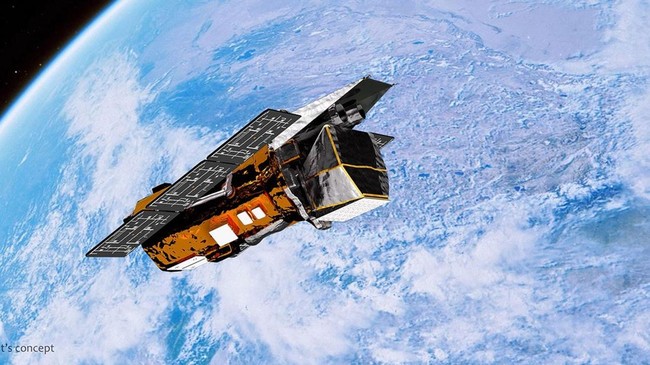
NASA's Neil Gehrels Swift Observatory, a space telescope that has spent more than two decades studying the most violent events in the cosmos, was expected to reenter Earth's atmosphere in the early hours of Wednesday, November 4, 2026, according to CNBC Indonesia. Any pieces of the satellite that survived the heat of reentry could come down in a band stretching from 20.6 degrees south latitude to 20.6 degrees north latitude — a zone that includes parts of Indonesia.
The telescope was launched in 2004 and has since observed gamma-ray bursts, black holes, and other extreme cosmic phenomena. Over time, drag from the upper atmosphere gradually slowed the spacecraft, and a recent increase in solar activity sped up its loss of altitude.
A rescue attempt was mounted with the company Katalyst Space at a reported cost of US$30 million, intended to boost Swift into a higher orbit. The plan fell through after the assisting craft, named LINK, lost control, and the operation was called off.
By October 20, Swift's altitude had dropped below 275 kilometers, and the satellite was declared no longer operational.
Why it matters
Most of a satellite's body breaks apart as it plunges through the atmosphere, and the fragments that remain tend to land in oceans or sparsely populated areas. NASA has stressed that the danger to people is very small — roughly a 1 in 2,100 chance, as cited in the CNBC Indonesia report.
Even so, the reentry path crosses the equator, which puts a string of countries in the potential debris zone. According to NASA's calculations, the surviving material could fall over parts of Southeast Asia, portions of Africa, Central America, and stretches of the Pacific Ocean. Indonesia sits within that corridor.
For a country of Indonesia's size and population density, the practical concern is less about probability than about awareness. The window is narrow and the exact footprint cannot be pinned down far in advance, which is why the agency's guidance centers on monitoring rather than evacuation or other precautions.
A track record of watching the sky
Swift was built to catch fleeting flashes of high-energy radiation, and it did that job for more than twenty years. Its instruments were designed to swing into position within seconds of detecting a gamma-ray burst, allowing astronomers to study the afterglow of explosions that occurred billions of light-years away.
That longevity is part of why its end drew attention. The telescope outlasted its original mission by a wide margin, and its slow decay was a reminder that satellites in low orbit are subject to forces — atmospheric friction and solar weather — that no amount of engineering can fully hold back.
The failed rescue attempt adds another layer. Katalyst Space's LINK craft was meant to demonstrate that aging spacecraft could be serviced or relocated rather than abandoned. The loss of control ended that hope for Swift, and the satellite was formally retired weeks before it fell.
How to follow the reentry
NASA has not published a live tracking map for the event, according to CNBC Indonesia. The timing of reentry can shift with atmospheric conditions, and the precise location of any debris is only confirmable in the moments just before it happens.
That uncertainty is normal for uncontrolled reentries. Objects in low orbit travel at roughly 7 to 8 kilometers per second, and small variations in air density — driven in part by solar activity — can move the impact point by thousands of kilometers over the final orbits.
Observers who want to follow the event can rely on updates from space agencies and orbital tracking services rather than a single official map. The final trajectory will be determined by the atmosphere itself, and the answer will arrive only as the telescope makes its last pass.
What to watch: official statements confirming the reentry time and any reported debris sightings, particularly from equatorial regions along the projected path.





