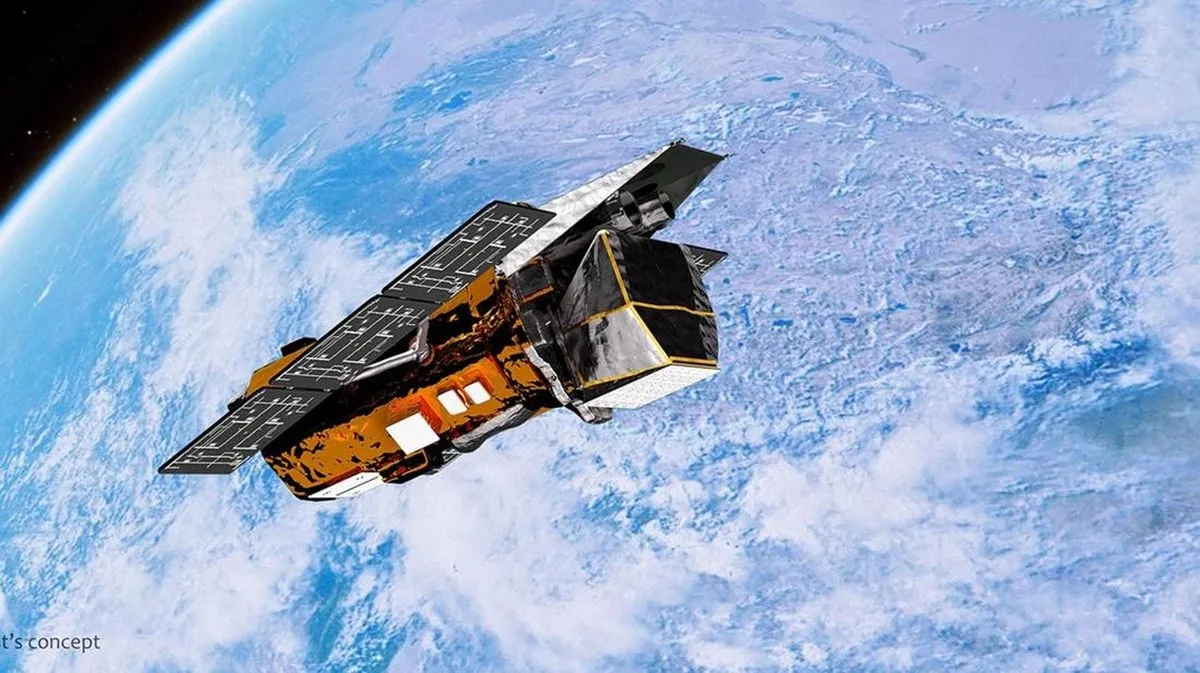
NASA's Neil Gehrels Swift Observatory, a telescope built to watch the most violent explosions in the universe, fell back to Earth and burned up in the atmosphere on Wednesday, Nov. 4, 2026. According to Popularitas.com, the satellite came down over North Sumatra, Indonesia, roughly 322 kilometers north of the equator. The U.S. Space Force confirmed the re-entry occurred at 12:39 GMT, the outlet reported.
NASA said Swift was traveling at about 22 times the speed of sound when it hit the upper atmosphere. The spacecraft weighed approximately 1,452 kilograms at the end of its mission.
Most of the satellite's body is expected to have been consumed by the heat of atmospheric friction, though NASA acknowledged that some fragments may have survived to reach the ground. The agency reported no damage and no injuries from any debris. Popularitas.com noted that it is not known how close the re-entry point was to Medan, North Sumatra's capital and largest city, which is home to about 2.5 million people. The province as a whole has roughly 16 million residents.
Why it matters
Swift was not an ordinary satellite. Launched in 2004 at a cost of about 500 million U.S. dollars, it was designed to chase gamma-ray bursts — the most intense energy releases known to science. Over two decades it also logged hundreds of supernova explosions, black holes tearing stars apart, X-ray flares from stars, asteroids and comets. Work based on its observations fed into roughly 7,000 scientific papers, according to Popularitas.com.
The mission was originally planned to last two years. It kept operating for twenty. That longevity turned a short-term experiment into one of NASA's most productive astrophysics assets, and its loss closes a long chapter in high-energy astronomy.
The re-entry itself carried little risk. Before the satellite came down, the U.S. Space Force estimated the chance of debris striking a populated area as very low, putting the odds of any one person on Earth being hurt at about one in 2,100.
A controlled ending that wasn't
Swift did not have its own propulsion system, and in its final months its orbit grew increasingly unstable. The satellite officially ceased operations on Oct. 20, Popularitas.com reported.
NASA had tried to avoid the uncontrolled fall. In July, the agency partnered with Katalyst, an Arizona startup, on a spacecraft called LINK. The plan was for LINK to rendezvous with Swift, latch onto it, and haul it up to a higher, steadier orbit. The rescue attempt fell apart when LINK began spinning out of control shortly after reaching space. Mission managers called off the effort in mid-August, and Swift was left to continue its descent.
Dean Sladen, an aerospace engineer at the British industrial components supplier Accu Components, said most of the spacecraft would have been destroyed before reaching the surface. In comments sent by email ahead of the re-entry, he said only a few small, charred pieces were likely to make it down, and that nothing would still be recognizable as a telescope.
Sladen also placed the event in a broader context. Satellites of comparable size re-enter Earth's atmosphere regularly, he said, and in nearly 70 years of spaceflight no one has died from falling satellite debris. He cautioned, however, that the long-term risk of accidents from re-entries could grow — which is why, in his view, designing satellites to come back safely is becoming more important.
What to watch
The end of Swift leaves a gap in rapid-response gamma-ray observation, and NASA has not announced a direct replacement. Watch for whether the agency outlines plans to fill that role — and for how the failed LINK demonstration shapes future satellite-retrieval efforts.





