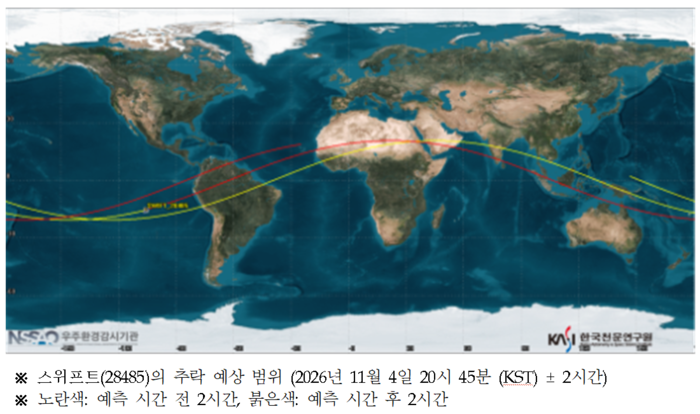
NASA's Swift space telescope is expected to plunge into Earth's atmosphere on the evening of November 4, ending roughly 22 years in orbit, according to 전자신문. South Korea's space agency has concluded that the 1.5-ton satellite cannot come down over the Korean Peninsula.
The Korea Astronomy and Space Science Institute projected, as of 8 a.m. on November 4, that Swift would reenter the atmosphere at about 8:46 p.m. that day. The U.S. Combined Space Operations Center put the moment at around 7:47 p.m., and the European Space Agency estimated about 9 p.m. Despite the spread, 전자신문 reports that the domestic and foreign forecasts all cluster in the same evening window.
Why it matters
Swift is a large satellite reentering without anyone at the controls, a category of event that space agencies track closely because the exact impact point cannot be steered. The telescope was launched in November 2004 to observe gamma-ray bursts, and its mission ended on October 20, after which it was left uncontrolled and its altitude has been gradually dropping. It now circles Earth at roughly 199 to 205 kilometers above the surface, low enough that the atmosphere will soon finish the job.
For South Korea, the practical question was whether any debris could reach the peninsula. The answer, per the space agency, is no — a conclusion that rests on the geometry of the telescope's orbit rather than on luck.
A 20.5-degree orbit that keeps the peninsula clear
Swift's orbital inclination is 20.5 degrees. That figure — the angle between the satellite's orbital plane and the equator — caps how far north and south the spacecraft can travel. In Swift's case, it passes only over latitudes between 20.5 degrees south and 20.5 degrees north.
The Korean Peninsula sits above 33 degrees north, well outside that band. According to the space agency, this places the peninsula beyond the range where the telescope could fall, 전자신문 reports.
Because of that, South Korea has not raised its space hazard alert to the "interest" level. The Korea AeroSpace Administration said it will nonetheless keep watching the situation with the astronomy institute until reentry is complete, given that a large satellite is coming down with no ability to correct its path.
O Tae-sok, head of the space agency, said there is no chance of Swift landing on the peninsula and that his agency would work closely with relevant organizations until the reentry is finished. He added that the agency intends to keep building up its monitoring and response capabilities to protect the public from space hazards such as falling objects and collisions.
What to watch
The reentry window remains an estimate, and the three agencies' times differ by more than an hour, so the final descent may not be confirmed until after the fact. The space agency's commitment to track the event through completion means further updates are likely once the telescope is down.





