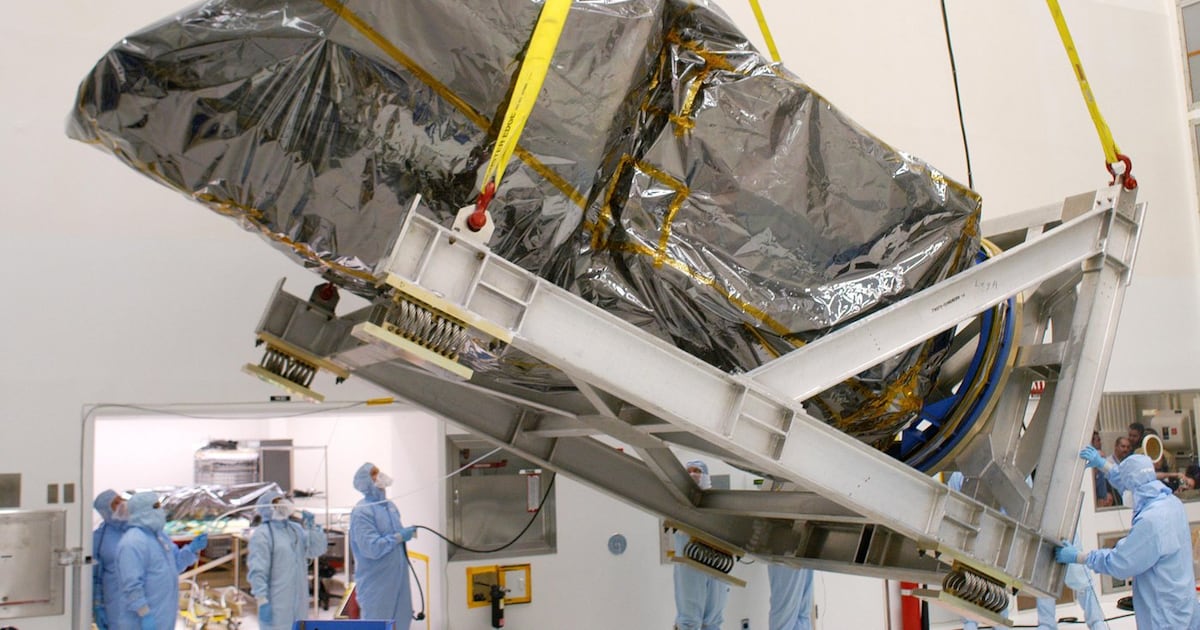
NASA's Swift Observatory reentered Earth's atmosphere on Wednesday, closing out a 22-year run spent hunting the universe's most violent explosions, CP24 reports. The U.S. Space Force confirmed the spacecraft came down near Indonesia after tracking its steadily decaying orbit.
The fall came less than three months after a privately built rescue attempt fell apart. Intense solar activity over the past several years had been dragging Swift lower, and NASA's effort to lift it back up did not succeed.
Why it matters
Swift was launched in 2004 on what was meant to be a two-year campaign to study gamma ray bursts and exploding stars. It ended up operating for roughly 11 times that long, logging thousands of these events, according to CP24.
Its value went beyond its own instruments. Swift functioned as a first responder for the wider astronomy community — flagging bursts quickly so that larger telescopes could follow up and examine them in greater depth. That coordination role made it a fixture of how researchers responded to sudden cosmic events.
The mission's end also puts a sharper focus on a question NASA now faces with a far more famous observatory: how to keep aging hardware aloft as the sun grows more disruptive.
A rescue that ran out of time
NASA brought in a commercial partner to attempt an orbit boost, but the plan came together on a compressed timeline. Katalyst Space built a robotic craft with three arms for the job, and it launched in July. The vehicle encountered problems and crashed back to Earth in September, leaving Swift without a way to raise its altitude.
CP24 reports that it was not immediately clear how much of the 1.5-ton observatory was consumed during reentry. NASA had expected that some of the spacecraft's denser components would survive the plunge.
The reentry itself was not a surprise. The Space Force had been monitoring Swift's sinking path, a consequence of solar storms that have thickened the upper atmosphere and increased drag on satellites in low orbits.
Hubble is next on the list
Swift's loss arrives as NASA weighs what to do about the Hubble Space Telescope, whose orbit is also being eroded by solar storms. Launched in 1990, Hubble is projected to come down by the mid-2030s based on recent analyses, CP24 reports.
The agency has asked private industry for ideas on whether companies could raise Hubble's orbit, modernize its instruments, steer it into a controlled reentry, or take on all three tasks. Any such mission would have to be carried out by 2032.
Nicky Fox, NASA's science mission chief, said the agency has more breathing room to study its choices for Hubble than it did for Swift, where the effort was assembled in a hurry.
NASA Administrator Jared Isaacman said in a statement that Hubble continues to have meaningful science ahead of it and that the agency should examine every sensible route to keeping it productive for as long as it can.
Watch for NASA's review of the industry responses on Hubble, which will determine whether a servicing or orbit-raising mission moves from proposal to hardware before the 2032 deadline.





